


Bangalore blues
The client’s brief was to design a commercial complex on a very prominent and busy Infantry Road, Bangalore in a tight urban site. The fact that due to massive urban development in last two decades, the green cover of city has depleted drastically. In contrast to the Garden City name of city.

Being a very busy commercial hub of Bangalore, with minimum open green spaces, the group took it as a challenge to provide the inmates with open lung spaces and create a buffer between the inmates and the busy, noisy, polluted node in the city, especially after the pandemic.

Carefully crafted commercial hub
The project embraces a strong sustainable narrative, with each aspect well thought for a careful balancing of sustainable and energy efficient parameters.
“What struck us most was the presence of a huge tree on site. These two characteristics helped us formulate the generative diagram for the conception of the project. We decided to conceive the plan, such that the building weaves around the existing tree, not just physically but also phenomenally in a way that it becomes part of the experience. We paved the way to the main core area through the existing tree, to create a stellar volume and landscape court as transition spaces.” avers the design group.

Design strategies
These spaces also are conversation starters and a gathering and interactive spaces. The architects did not stop here; rather created another courtyard at the second-floor level to carry on the natural elements to the upper levels.

This helped the designers to not only to add layers to protect the inmates from the harsh sunlight and the noise from the surroundings, but also create a feel of being closer to nature for the inmates.
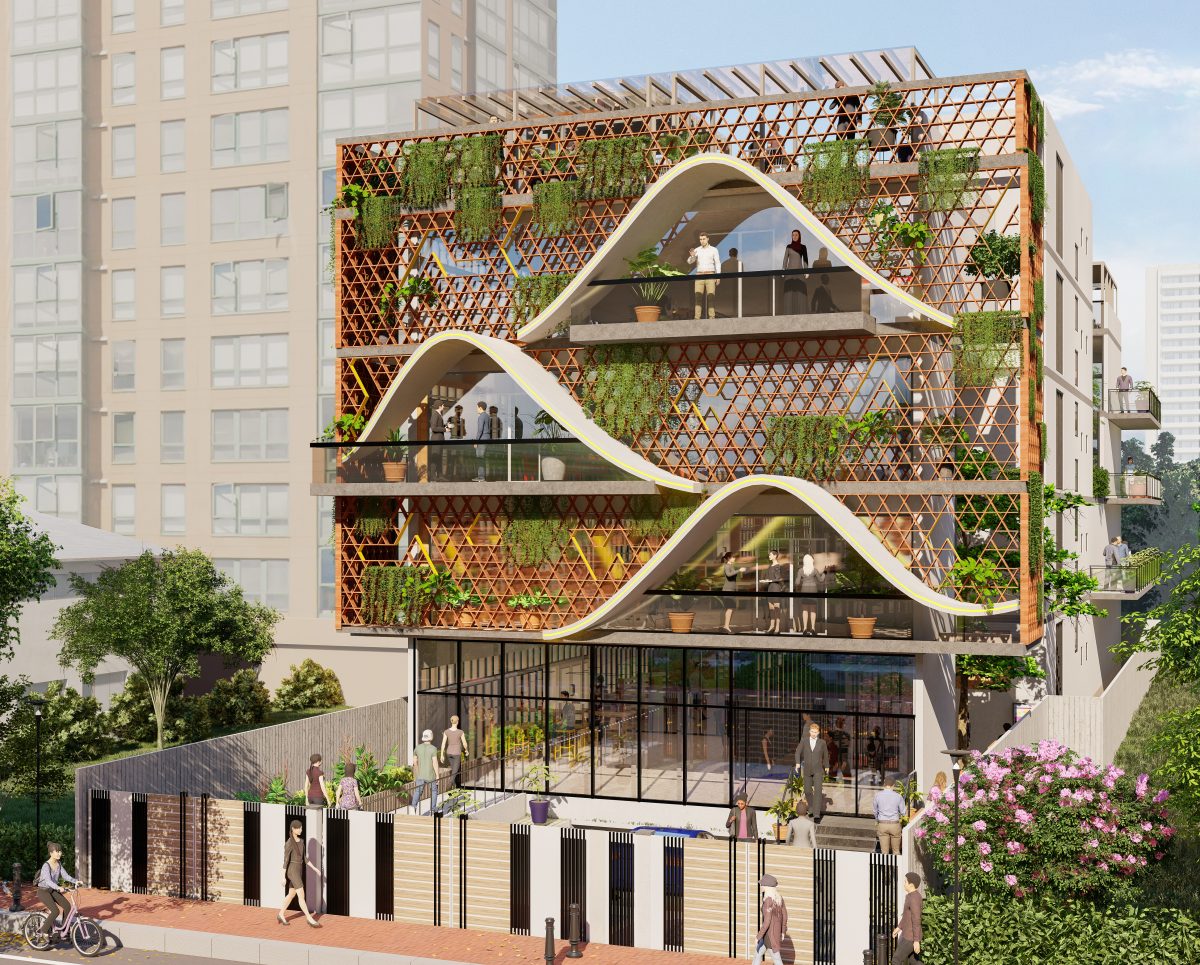
The second important stand taken was to wrap most of the building with a thick layer of green along with a modern interpretation of traditional jali screen.

The core of the building placed along west side to cut down on the harsh sunlight veiling in interiors. Most of the spaces on the periphery open up to the strip of green open spaces, which function, dually for the required services and also creating a blanket between the sunlight and inmates.

A double atrium cuts through the building to connect the various floors both visually and spatially.
Unfolding the ‘jali’ concept
The idea of the jali with green was twofold. The jali screen would enable us to cut down the harsh sound from the street traffic and the general humdrum of the city. It would also cut the harsh light that would infiltrate the interiors. The traditional Jali was re-imagined in a contemporary pattern to form a light ephemeral veil for the interiors. We infused life into this jali by juxtaposing it with a layer of curated plants.

The plants protected by the jali help create a soft ambience in the interior. The jali also creates interesting patterns through- out the day, forming various ambiences for the inmates. Dynamic play of shadow and light, broken with landscape, propagates for the wellbeing of human mind. The protruding concrete arches not only shade the open balconies, but also make a bold statement and breaks the monotony of jali.

Sustainable approach
Sustainability was also one of the major aspects during planning of this project. Starting from strategically orienting the building in a way where the south and west sides are shaded, to planning for solar grid, recycling of sewage waste with eco STP which uses no power during its life cycle nor require any major maintenance. Rain water harvesting system is adopted to recharge ground water.