


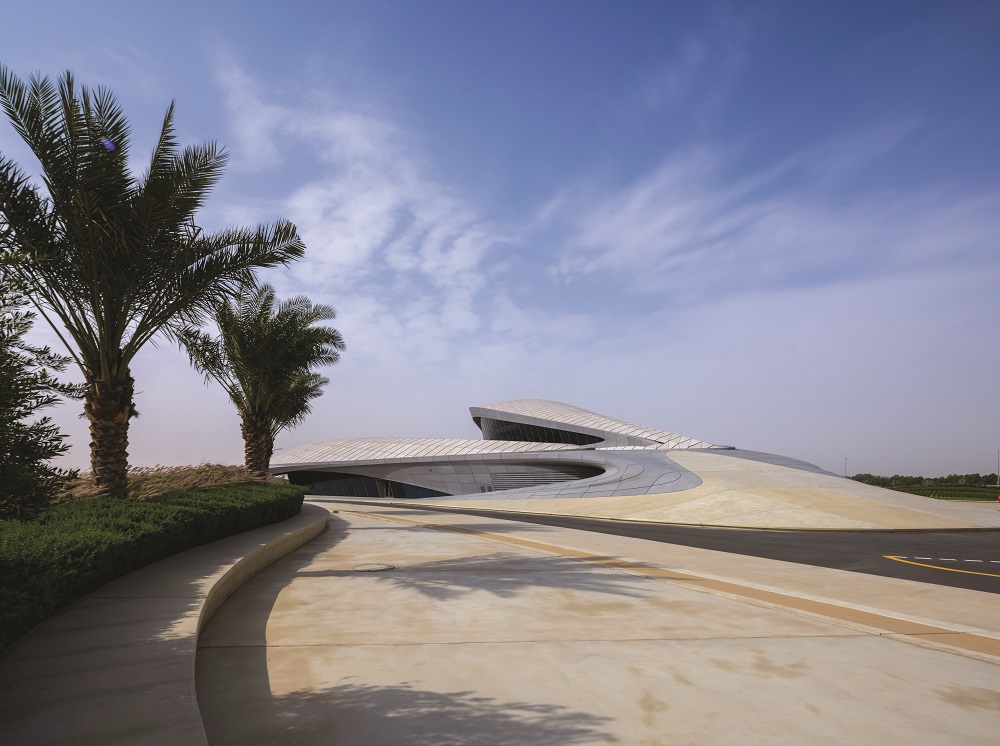
Designed by Zaha Hadid Architects, the BEEAH Group Headquarters in Sharjah is a shining example of how to build sustainably and incorporate the latest smart technology.
One of the final works of renowned architect Zaha Hadid before her death in 2016, the headquarters of BEEAH is an architectural marvel, set against the dunes of Sharjah.
The design was crafted as a series of interconnecting dune-like buildings which become one with the location and optimise local climatic conditions.
The structure has various passive and active design elements that come together to create a skeleton for green architecture. Powered by renewable energy, the building is said to have ‘ultra-low’ carbon footprint, minimal water and energy usage and was built using recycled construction materials, processed at BEEAH facilities, which help the headquarters to operate at net-zero, LEED Platinum standards.

Green standards
Design elements such as the curved structure of the building allow the flow of natural sunlight while limiting harsh exposure and reducing energy required for lighting purposes. High thermal mass allows heat to be absorbed during the day and dissipated at night, minimising the energy required for cooling.
The landscaping was done using regional plants that were irrigated using water-efficient systems and recycled greywater. Solar panels power the HQ, supported by Tesla battery packs for energy storage. Windows were positioned to reduce solar gain and Low-E glass was used to minimise entry of infrared and UV light inside the building itself.

Smarter office
The building is integrated with AI technology and has over 100 AI use cases, including self-learning and self-healing capabilities. Digital twin technology tracks and forecasts MEP system functions, while optimising the building for energy efficiency. There is also predictive AI, which is equipped for remote, hybrid, mixed and virtual reality work such as those in the Metaverse.
This AI-integrated office of the future features cloud technologies from Microsoft and digital twin and automation technologies from Johnson Controls. Combining Johnson Controls Digital Vault technologies with Microsoft Azure, the headquarters’ building management system is designed to optimise energy efficiency and make the best use space.
EVOTEQ, a venture of BEEAH Digital, served as a technical project manager to facilitate the integration of technologies and development of systems.
The AI features in the BEEAH Group Headquarters include digital workspaces, smart back-office integration, smart lobby-visitor management, smart security and a range of touchpoints across functions such as HR, customer care, procurement, administration and building management.
Smart building technologies are integrated with AI to study and predict occupancy, automatically adjusting light and temperature based on preferences. Virtual concierge with facial recognition on entry, helps trigger protocols for employees or visitors, including hospitality services. The building is also integrated with smaller but efficient systems, such as smart meeting rooms that automatically transcribe meeting minutes and email them to all participants. A companion platform helps employees automate tasks such as sending administrative requests or ordering a beverage. The building also carries powerful cloud capacities for end-to-end integration of systems, devices, and services.

- What’s in the structure?
Nada Taryam, managing director of Civil and Architectural Projects, BEEAH Group, outlines the processes and challenges in completing the project:
- Did you always know the number of people it would house or was the space designed with flexibility in mind?
In the brief that was sent out to the architects we specified the amount of employees. We had to calculate how much the company is going to grow in the next few years and, based on that, we allocated a number.
It is worth mentioning that BEEAH has offices all around the UAE, as well as our recycling facilities and in Egypt and in Saudi, so the staff that are located within this building are for the core functions.

- Were there any specific processes you put in place to overcome any construction challenges?
I’m an architect by background, and I understand how these things come together, and I understand the importance of keeping some things and being able to let some things go.
I was able to navigate through that as I had that flexibility and it was an ongoing process with the architects to say ‘this is a challenging thing, how soon can we sit together with the engineers, with a contractor, to come up with solutions?’.
We had to push through a lot of these challenges to reach to a desirable outcome. It is not easy and usually you would find people who would give up and let something go but, from my point of view, if I’ve learned anything from this project is that as long as you believe in something, you just need to ask the right questions to get to the solution, and to be consistent with what you believe.
A lot of a lot of the things that makes this project special, would have been overlooked if we did not have a collaborative approach. If you just put on the client hat, it wouldn’t have turned out the same way. I had to put on my design hat, my construction hat and sometimes my client hat for all of it to come together.

- What are the key elements that future-proof the building?
I think the way that the building is designed, to be very spacious, allowing for flexibility and movement and circulation… That in itself helps the space to adapt for the future. Even in terms of connectivity and systems, there is a lot that the visitor does not necessarily see, because it’s all covered.
We have made provisions for the future in case we do require additional power requirements and for any integration of future technology and all of those things.
So we embedded within the structure of the building, within the skeleton of the building, to accommodate those changes that could take place in the future.

- What are the main features of the building that you’re proud of?
For me, one of the most exciting phases was when the structure came up. It’s all covered right now with panels but when you could see the skeleton of the building and see all the nuanced details.
People now come in and see the finished project but they don’t know how much is behind all of that so tha was the most interesting thing for me. I invited people to come see it during construction, especially students, just to learn from this whole process. Obviously, the finished building matters but, for me, the bones of this building are what holds the most interest.
- Who did you collaborate with?
Burohappold did the engineering of the project. London based firm Atelier 10 were the environmental engineers and the MEP engineers as well. Al Futtaim Construction was the contractor and Arabian Profile was the subcontractor. The latter did all of the interior panels as well as the exterior and it also contributes to the sustainability factor because all of the panels were locally produced and made in Sharjah, which was important for us.
The steel structure was by Unger steel, who were fabulous. They finished everything on time. There is Lindner for the glazing. The F&E was designed and or specified by Citterio. We also collaborated with Zaha Hadid Design, which is the production arm of ZHA, to design some of the furniture pieces in the building and we accented those pieces with different furniture from different brands. Finally we also collaborated with Masdar on the solar PV farm.

- What part of the design process did the art installations play?
While finalising the building design, I thought that we needed to have a private art collection for BEEAH. We have acquired and or commissioned pieces for the building and it will be a continuous process. Currently, we have some pieces inside and outdoors. One of them is a kinetic sculpture, powered by wind, which is very suitable, because being in the desert, we get a lot of sand storms and from the inside we’re all shielded but as you look outside and you see this sculpture moving fast, you realise that the wind is very high. Another piece that I personally love is the one by Keita Miyazaki. We commissioned the specific installation by the Japanese artist and he created this piece which is assembled out of used car parts. He welded them together and then added the Japanese technique of origami to finish the piece. It perfectly fits into the theme of BEEAH, which is recycling while also adding a playful artistic aesthetics.