

How to keep the workforce engaged
Workplace design, like any other vertical, works on the basic principle of the 3 C’s:
- Client,
- Climate, and
- Context
However, in a dynamic and continually evolving landscape of the workplace, last-mile connectivity (how quickly one can reach from home to the office/desk) and hybrid/flexible seats that allow a complete change of environment every day are essential elements of a successful workplace. There has been a paradigm shift in the way companies work today. With new technologies being introduced to aid different ways of working, be it online or offline, the workspace needs to be redefined and redesigned to keep engaging the workforce and bring them back to the workplace.

Designing for Neurodiversity
Dynamic, by definition, is changing and ever-altering. Today’s workplace needs to adapt to the modifying needs of the workforce and reinvent design strategies to encourage the workforce to engage with their immediate surroundings.
Designing for neurodiversity is the key factor in making a workspace conducive to better output and productivity.
Flexibility is vital to keeping up with the changing needs of office design. The ability to enable employees to operate from any desk and collaborate with teammates with the click of a button on an ergonomic table to movable screens that allow impromptu meetings constantly keep the users engaged with their work environment.
The workspace is an extended identity of the users who need to feel comfortable yet agile to be most productive. In continuation to the workplace design, one of the most important aspects contributing to the success of a commercial building are the abutting spaces. CyberHub in Gurgaon or BKC in Mumbai are prime examples of how the spill-out spaces close to an SEZ add value to it.

The error in building workspaces without cognisance
Today, the commercial and workplace sector still faces issues with last-mile connectivity. How quickly one can reach from home to the office and desk is a challenge that we still continue to face. Traffic, parking, and disrupted public transport facilities make the commute to work a tedious activity. The ease of commute needs to be redesigned and reevaluated. The online work mode supports this issue, which is why people avoid commuting altogether. A module with workforce division and flexibility of time can help reduce the load on transport at peak hours.
The other challenge is our approach towards how we build our workspaces without cognisance of materials, incorporating technology and flexibility of time and space. Today, we can operate out of any place and work as long as we have internet. Hence, collaboration needs to be reflected in the design to upgrade, update and enhance the workplace to be a haven of work.

Tech talk
IoT plays a key role in all aspects of design for quick connectivity and information transfer. The comfort of every user and data of every visitor required for the analysis of a perfect work environment are all mapped via data that is simulated in real-time. Large corporations to small vendors are all trying to communicate and provide information online and create a database to cater to a larger audience.
The workplace is no different; with apps available by various office blocks or building facilities that provide information on parking space availability to booking meeting rooms all in advance at the click of a button to allow a smooth transition from den to desk.
We must keep up with the fast pace of artificial intelligence development. The lights, materials, work desks, meeting spaces, and sensor-based technologies in a workplace are all evolving with continuous research and the need to provide a more conducive environment, so the users to perform better. Hence, today there is a lot of focus on the happiness and well-being of the user to get better productivity. No longer will a pigeonhole do. The workspaces are now more vibrant and inviting, stimulating the minds to work together.

Balancing sustainability
One of the most important criteria of workspace design post-pandemic is the health and hygiene audit of the workspaces. No longer the fire and safety audit alone will suffice. Workforces need to be provided with a barrier-free, touchless approach from parking to desks and have a well-ventilated workplace where the air quality is of utmost importance. Anti-bacterial surfaces and peel-off desk cover options are some of the other measures required.
Post pandemic companies have already reduced their workforce to half. This has helped to reduce the pressure on public transport, roads, and other facilities at peak hours. This model is sustainable not only for the environment but also for the office space that now operates in a balanced way rather than at an overflowing or loaded capacity.
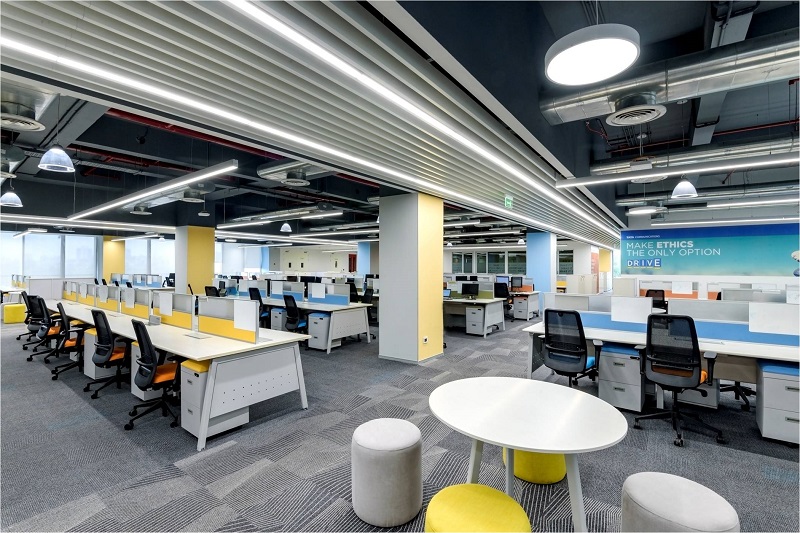
Besides the capacity policies, a considerate effort is being put into understanding the optimum use of space, daylight, water, air quality, power, and other facilities in a workplace. To redesign our facilities, each of the above is being considered to reduce overhead expenses and add more value and meaning to the place of work.
Biophilia is the most common practice to bring the great outdoors inside so that one feels closer to nature. However, the redesign of active and passive strategies with the help of AI is the upcoming process that is being pursued for a sustainable future.

Impact of behavioural science on workplace design
Today’s workplace is no longer only a place to come and work. It has become an extension of our personality. The companies want people to take pride in their workspace. They want to provide them with optimum comfort and choices to produce better results at work.
As per Einstein’s theory of happiness and the ‘HAPPINESS HALO’ that explains behavioural science for better experience design, the mind is most productive when it is positively stimulated and happy. Not only does the physical environment affect the mindset, but it also instills feelings of loyalty and pride in the workforce. This is why the idea of hierarchy and individual space design no longer has a place in the workplace.
Together organisations are moving upwards and onwards. Open work, collaborative and hybrid work modules are here to stay. Team areas and alternative meeting rooms are replacing the private offices or work desks. The WE is more important than the ME.