

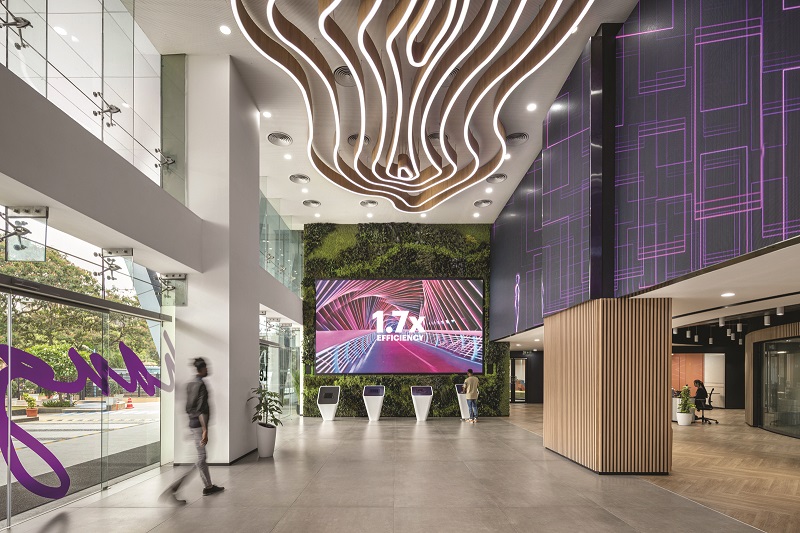
A trained architect and a workplace design expert, Brian Pilley is in charge of the day-to-day operations for M Moser India.
He reveals that at M Moser, the design process starts with a clean sheet of paper and no preconceived solutions. They first try to understand the client’s company culture and business objectives before putting pen to paper.
“Planning, look and feel, branding, and more, come later in the process. Confirming objectives and goals and understanding needs and concerns is vital. Without them, you cannot suggest an appropriate solution to a client,” advises Pilley.

Building a community space, not just a workplace
Commenting on the rapidly changing workplace design trends, Pilley mentions that “Clearly, the past few years have changed everything. Working from home, hybrid working, hoteling – call it what you will. These events have changed (and will continue to change) the way we work in the office.
Flexibility has become a key driving factor because not many of us know what the future will bring. All we know is that change will continue as a new normal. In that respect, I see that floorplates now have less formal desking and more open, collaborative spaces and meeting pods. Offices are now becoming important places to meet, collaborate and build a sense of community.”
He adds that the workplace itself won’t disappear, but will need to evolve. “I think the layouts with rows of L-shaped desking facing one direction will change. There will be fewer private offices and more meeting spaces. The workplace will offer more choices in terms of seating arrangement so people can choose what works best for them. Employees need options, not only because they perform different tasks but also because they are different. In fact, office spaces also need to support neurodiversity. Likewise, there will be less hierarchy, and corner offices may well become outdated. Employees are looking for transparency; they are looking for approachable leaders and not bosses. Corner offices where the top management gets all the natural light and the best views won’t be acceptable for much longer.”

The war for talent is real, and offices are a key differentiator
Pilley mentions that the two most commonly seen challenges in the sector are understanding what your client’s competitors are doing in terms of working hours/locations/back to work policies.
“We help clients with market and competitor analysis but most importantly, we help them identify what would work best for them. We support them in developing their new office guidelines through leadership interviews, workshops, and employee surveys.”
He adds that addressing the problem of retention is another challenge in the sector. “Offices are a key differentiator and tool for attracting and retaining staff today. The war for talent is real and businesses are using offices as a tool for attracting and retaining staff. Employees are looking for vibrant office spaces conducive to collaboration, innovation, and socialising. They want choices – to work from a desk, stand at a workstation, or simply lounge on a sofa. They are looking for facilities such as full fledge cafeterias, gyms, game rooms, music rooms, mother rooms, etc. They appreciate companies that take care of their wellbeing by introducing greenery and maximising natural daylight, for instance.”

The growth of technology over the past 2-3 years has been fairly mind-blowing. Pilley observes that “We are beyond 3D visualisations and walkthroughs. I would say that there are five key areas where things have changed.
1) LIDAR scanning of sites and building services installations.
2) Clash detection of building services: resolving the problems before they happen on site. Digital inspections such as Matterport and Openspace. Using virtual space capture technology helps us streamline project management processes. So our teams can collaborate seamlessly within a digital project model. It improves efficiency and, therefore, the speed of project delivery.
3) Desk booking/ room booking/ occupancy sensors:
Integrating smart building technology can remove friction points and support energy efficiency and sustainability when looking at hybrid or agile office space.
4) Monitoring of Indoor Air Quality and CO2 levels:
As people around the world return to the workplace, their health and safety are a top priority. The role of proper ventilation in preventing the spread of infectious diseases has become increasingly clear during the last two years. As a result, indoor environmental quality deserves a renewed focus.
Understandably, working people wonder if the offices they’re being called back to are safe. Many organisations recognise the importance of creating a safe, healthy indoor environment to their credit.
5) Lastly, greater use of Zoom/ Teams/ Blue Jeans etc., to connect teams- particularly in conjunction with WFH.
Going to the office has never been a more conscious decision. Tech tools to connect the workplace with the home and everywhere in between have become necessary for hybrid and work-from-home strategies.
Adhering to green practices
Sustainability needs to start at the top. It needs to be a goal from Day 1. As Moira Moser, the founder of M Moser Associates would say, “If you don’t have sustainability in the design, then it’s not good design.”
As one of the leaders in terms of LEED and WELLness, it is refreshing to see both philosophies as considerations in almost every project. M Moser frequently has clients who are less concerned about the certification itself, but are keen to adopt best practices because it’s the right thing to do.