


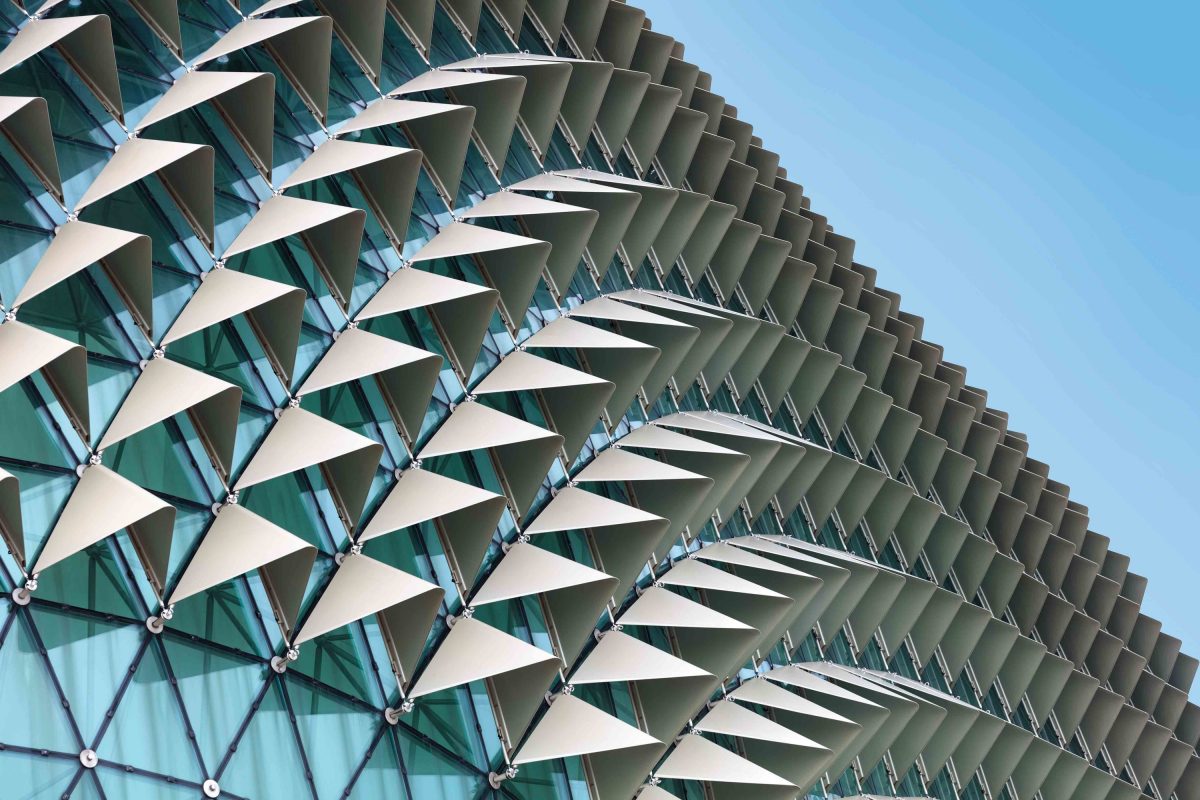
Visualising aluminium’s application in the future:
Lack of space, due to exponential rise in population, in urban areas has not only given way to taller buildings but also stresses on (faster) construction. The use of aluminium in high-rise buildings will come into vogue. Aluminium has two main advantages when compared with other metals.
Firstly, it has low density – about one-third that of iron and copper. Secondly, although it reacts rapidly with oxygen in the air, it forms a thin, tough and impervious oxide layer that resists further oxidation. This does away with the need for surface-protection coatings such as those required for other metals, particularly in the case of iron. All the indications are that the growth in the use of aluminium will likely accelerate. It is expected that aluminium with specifically improved properties will be popular in many applications soon, meeting the increased economic and ecological demands of construction.
Aluminium oxynitride, seen in a Hollywood film and referred to in the media as transparent aluminium, is now actually being developed. The revolutionary ceramic alloy is created by fusing nitrogen, oxygen and aluminium in precise measures. Transparent aluminium is three times stronger than steel, four times harder than fused silica glass, 85% harder than sapphire and, as the name suggests, optically transparent. The material is resistant to corrosion, radiation and oxidation, and could be used to produce windows and domes for under-sea and deep-space vehicles, lenses for high-impact cameras and other types of safety glass. You could even clad skyscrapers with it. The commercial version of transparent aluminium is ALON. It has been made for monolithic windows up to 45 x 90 cm and can be used in architecture for glass balconies and truly fire-resistant glass window panes – that is, when the costs for manufacturing the miracle ‘metal’ drop; it is still quite high.
The three factors of place, weight and time turn out to be important in the use of aluminium in the construction sector. Today, aluminium is recognised as one of the most energy-efficient construction materials. It is cost-effective because it requires less maintenance and no cost for galvanising, coating and painting. It can be installed conveniently and quickly, and the construction becomes environment-friendly, sturdy, durable and, of course, cosmetically more stylish and modern. Future products like aluminium furniture, aluminium kitchen, aluminium skirting will also increase the consumption of the material in the coming years.
Part of the building/construction that aluminium is best suited for and why:
A building is not less than a machine today. Aluminium, the building material for the modern age, established itself as an important factor in the building and construction industry during the course of the 20th century. Possible applications range from façades, windows and doors to conservatories, interior decoration, aluminium form-work and many more.
Whether it is office towers, shopping arcades, museums, airport terminals, railway stations, stadiums or residential buildings, façades made from aluminium profiles and panels offer architects unlimited opportunities for creativity.
The ‘personality’ of many a modern building only manifests itself fully when aluminium is used. Just as skin protects the body, aluminium façades protect buildings from the elements. They serve to keep out heat, cold, rain and noise, providing a high level of comfort for the people in the buildings. The outer skin of a modern building, therefore, has to satisfy numerous demands. The choice of façade type and supporting structure will depend on the specific requirements. With aluminium profile systems, one can use classical mullion-transom façades, unitised façades, structural glazing, double-skin façades or special structures such as pyramids, polygons, barrel vaulting or round canopies. Aluminium is suitable even for large-surface use and for extreme loading, such as in high-rise buildings and television towers. In the world’s tallest skyscrapers, the façade elements enclosed in aluminium frames are capable of withstanding winds of up to 200km an hour as well as seismic shocks measuring five on the Richter scale. Even for less spectacular buildings (for examplel, hospitals and movie halls which demand a high degree of absorption of structure-borne and airborne noise), aluminium has proven its worth for support purposes.
Aluminium is widely used in building and construction, especially for the exterior of structures – like for cladding, façades, doors and windows. For highrises, aluminium has always been the first choice with architects and developers because it is a lighter material.