


Whether it is the trend for sleek designs or the constant drive to create the most experimental forms, structural steel is making a wide range of creative – and pragmatic – expressions possible. Most projects also no longer hide the metal structure but display it proudly, either finished in a choice of colour or by retaining its industrial simplicity. As a prefabricated element, structural steel brings in a certain level of convenience and sophistication to the construction process too – improving the time frame in which the project can be delivered.
“For constructions that require large spans, flexible curves and/or heavy industrial or commercial uses, steel is highly efficient,” point out Gayathri Shetty and Namith Varma, principals, Gayathri & Namith Architects (GNA). The ability to cater to some of the most challenging projects, either in form or design brief, has made steel a go-to construction material for highly conceptual outputs. The application of this sturdy material has gone beyond engineering marvels like bridges, and has made way for futuristic, architectural feats that would have been otherwise improbable.
While the material is often applauded for its flexibility and versatility, the fact that it can deliver a clean, systematic construction process has also augmented its popularity. “A shift from the concrete-based conventional method of constructing buildings to steel structures, will halve the completion time to two years,” highlights Akshay Sekhri, marketing-head, Pomegranate Design.
In an industry where time is money, the advantage of steel structures cannot be stressed enough. Precision-based construction methods create less room for error or surprises – especially when executed with the right skill and knowledge.
In a developing nation like ours, the many advantages of structural steel are still to be explored and practically deployed in various construction sectors. “In India, we have been hesitant to use steel for structural systems, primarily due to cost constraints. Lack of familiarity and use has led to lack of proficiency in the design of steel structural systems, limited steel fabrication capabilities and limited market support,” says Nirmal Mangal, director and country head – India, M Moser Associates.
Few projects, both within the country and outside, are breaking this cycle of ignorance and apprehension. It’s not just larger-than-life designs that are successfully resulting in steel structures. We chronicle four distinct projects, set in unique contextual environments, that use structural steel to deliver appropriate, workable designs.
Meditation in Steel
To be completed later this year, GNA’s upcoming project relies extensively on structural steel for its organic form. The Brahmrishi Ashram Meditation Centre in Tirupati is inspired by the shanka (or the conch shell). Along with the principles of Vastu Shastra, the building’s form is derived from the characteristics and geometry of the shanka. The conceptual design is an interpretation of the theme – ‘unshackle your thoughts and set them free’.
The Brahmrishi Ashram Meditation Centre in Tirupati is inspired by the shanka (or the conch shell).
“Conch shells have a significant place in Indian mythology. It’s believed that, if held near the ear, the sound of the ocean humming gently resonates from within. We wanted this experience to resonate within the built space of the meditation hall, and achieved it by first identifying the geometry from its natural form and then transforming it into an integrated shell structure with progressive cut portions that would aim at heightening one’s senses during a meditation seminar – just like the experience in a place of worship,” share the architects.
Creating such an uninhibited structure was possible with a steel framework that spans a wide radius, with absolutely no vertical columns within the main internal space. The meditation centre occupies a good 1.3 acres in the 17.2-acre site, making it a fairly large structure. The shelled roof has slits at different levels for natural light to stream in and add to the serene atmosphere. “We oriented the structure in the cardinal directions, auspicious to that of a typical Hindu temple plan. The entrance vestibule to the east and the Gurusthana or Stage to the west allow the circulation pathways to move from the east to the west just like in Hindu temple architecture,” the architects add.
STEEL HEADQUARTERS
Commissioned to M Moser Associates, a new campus in Indore for a global software company is envisioned as a sustainable integrated pedestrian-oriented environment, connecting a mix of commercial, hotel, retail and recreational space. The project is divided into four phases: headquarters building, central landscape and shared amenities (phase one); commercial office and data centre (phase two); commercial office (phase three); and hotel and retail program (phase four).
As a 45m cube tilted on its axis, the HQ immediately draws all attention in this software park. The cube is conceptualised with photovoltaic transparent glass façade facing south and two façades of fritted glass facing east and west with clear glazing facing north, to the lake. The interior floor plates, adding up to 15,100sq-m, revolve around an internal atrium connected by a central core and monumental stairs.
In M Moser’s upcoming Indore project, steel frame system with composite metal decking will be used to create a 45m tilted cube as a HQ building.
Due to its challenging geometrical form, multiple structural systems were explored for the headquarters building during the concept design phase. “The studies indicated that, because of varying floor plate sizes and configurations, it would be difficult and expensive to build the project in reinforced concrete system. The studies also indicated that a steel moment frame system with composite metal deck would be the most cost-effective and constructible structural system,” architects at M Moser explain. The lateral bracing for the structure would be accomplished using reinforced concrete shear walls at the core. Additional benefit of using steel structural system would be the speed of construction and much higher level of construction tolerance and quality.
STEEL HOME
In one of their most recent projects, located in the northern part of Bengaluru, Designhaaus used structural steel to meet the client’s brief. “Our client being a man of vast experience wanted his house to reflect his philosophy that ‘simplicity is the ultimate sophistication’. Part of his initial brief was to have an organised approach devoid of all clutter that is associated with a conventional construction methodology,” share Gourav Das and Rajeev Kumar Sharma, directors, Designhaaus.
After a lot of deliberation, it was decided to build the house predominantly with structural steel. “Being a part of the petroleum and gas industry, the client had prior experience in building steel structures and was fully aware of the advantages associated with it. This nascent idea was to be extended and adapted to develop a construction methodology fulfilling the requirement of a full-fledged residence. From there on, the approach was to think beyond the obvious and explore new possibilities,” the duo add.
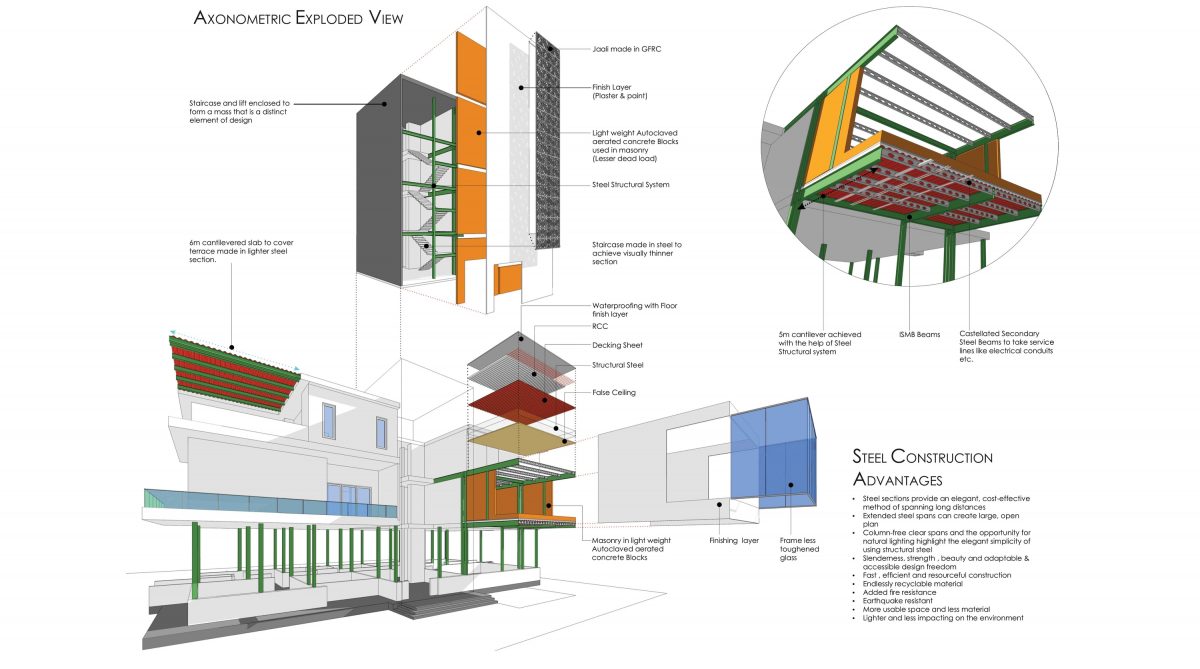
The five-bedroom house was built on a structural system of RCC footings with ISMC (Indian Standard Medium Channel) columns, ISMB (Indian Standard Medium Beam) with steel decking sheet, finished with 50mm-thick RCC having minimal reinforcement bars. The beams are castellated allowing service lines to pass through them. The bottom surface was finished with gypsum false ceiling in the interior, while waterproof fibre cement boards were used for external application.
The central circular hall of the Malawi Church is built in local burnt red bricks and supported by a lightweight steel roof with IBR sheeting.
In continuation with the philosophy of optimised and non-cluttered design, the structure was completed using lightweight AACB (Autoclaved Aerated Concrete Blocks) and extruded PU foams. “The requirement of sand in plastering was substituted with the use of quarry dust and fly ash mix which brings in a whole lot of advantages in terms of increased workability, reduction of cement consumption and decreased permeability,” the architects disclose.
A floor-to-floor height of 4m is maintained at the two lower levels, which significantly lifted the upper floor to capture the best views around. To maximise these views, blocks were added, deducted and modified – resulting in interesting juxtaposition of masses. “This led to the formation of expansive covered/uncovered terraces and sit-outs, which help in keeping the upper levels connected to the ground despite levitating higher up in the air,” Das and Sharma explain. The entire block faces the southwest corner, adhering to the local cultural context. It also helps in opening up a large expanse of landscaped lawns in the north and east side which act as buffer spaces from immediate neighbouring surroundings.
“This project remains a humble attempt to develop a prototype of House in Steel, which we believe can be adapted to varying contexts with a few changes and will be much more relevant in the days to come,” state the directors.
Adaptability of structural steel in such wide contexts and geography is quite noteworthy. It is evident that the many benefits of the material don’t need to be restricted to a handful of projects. As the market matures, it will be interesting to see what new steel marvels await us in the future.