



In the eyes of the world, architecture and design may appear as just another profession but for those actively pursuing it, it is nothing short of an endless passion project. With all the thought and deliberation that goes into realising a sketch into a built-form, many firms today prefer to take up the project in its entirety – from concept to execution. Design and build – also known as Integrated Project Delivery – is definitely not a novel concept in the industry, however, the work done by the architect-led, Design & Build (D&B) firms is as innovative as it is impressive.
One of the pain points in the design sector has always been the management of different stakeholders in delivering a single project without compromising on its design integrity and original vision. For clients, the design brief needs to be met through seamless execution with minimum to zero hassles, delivered in a cost-effective manner. The D&B model has the best interests of both parties, offering a win-win scenario for all involved. And when it is an architecture and design firm leading the D&B service – as opposed to solely a turnkey contractor, the expertise on board is unmatched.
Whether it’s a multinational company relocating to the Silicon Valley of India, or a large corporate looking for a standardised replication of its offices, a boutique office with creative spaces, and even sustainable residential bungalows and buildings, architecture and design firms in India are utilising this delivery strategy to create award-winning projects in a fraction of time. Here’s a glimpse of a few notable firms in the country and the exceptional work they are doing using the D&B advantage to fit their design ethos.

JTCPL Designs, Mumbai
Specialisation: Corporate Interiors
Lofty goals rarely translate to pragmatic success but when JTCPL Designs set out with the “dedication to service the workspace industry through good design” in 2002, it was anything but wishful thinking. The Mumbai-based design firm has visualised and built work environments for big names such as Standard Chartered Bank, Cushman & Wakefield, HDFC Ergo, Axis Bank, Emirates, Bisleri, Visa, and Bank of China… and with each project, they have established themselves as experts in corporate interior D&B. JTCPL Designs excels not only in the breaking down of the complex brief into liveable, productive designs but also delivers these projects through an efficient timeline and actionable schedule. However, at the heart of it, JTCPL Designs believes they are in “the business of people – after all the business of business is people” – citing a quote by Herb Kelleher.
Case study: Fractal office
Fractal is considered a major disruptor in the HR space and the challenge for JTCPL was to demonstrate how the company’s distinct values could be translated to the workplace. The team came up with a design concept that revolves around the experiences of four major user groups – clients, Fractalites, recruits/trainees and families of Fractalites – after observing each group in action. Of the various colour concepts being proposed, Fractal preferred a Scandinavian palette; and from a program perspective, the design had to incorporate features like sit and stand desks, wellness rooms, an all-faith prayer room, lactorium for nursing mothers and a children’s play area.
With LEED Gold certification from USGBC (under LEED CI v4 Program), the Mumbai-based workspace incorporates many pro-active Green measures: efficient lighting fixtures, integration of daylight and occupancy sensors, efficient HVAC systems, low flow fixtures in washrooms that save upto 40.21% water, among others. Specialising in D&B helped JTCPL Designs to prevent more than 85% of the construction waste from reaching the landfill. “Construction waste management plan was finalised at early design process which allowed sufficient time for planning, coordination, identifying appropriate agencies and finalising contractual agreements for waste diversions,” Ninad Tipnis explains.
“D&B is a refined way of collaborating for a successful project where we assume the role of curating relationships based on our unique abilities and incorporate these into the project. The client has the luxury to interact with one entity and when it’s an architect-led D&B firm like ours, it ensures design fidelity at all stages of the project.”
Ninad Tipnis, principal, JTCPL Designs
For the firm, the founding principal Ninad Tipnis is the “anchor and captain of this ship” steering them to success. His personal design philosophy is characterized by simplicity, distinct lines and forms that incorporate a sense of flexibility as well as scalability. However, it is the architect’s positive attitude and enthusiasm for always delivering the best that pervades the team while his ability to thrive under pressure is an inspiration in itself. Together, the architect and his team thrive on three principles or “Design DNA” as they call it: mainly being creative at every step, practising integrity through ethical working and transparency, and being humble task makers. In the end, their purpose is to leave people in a better environment than they found them in, and create a niche for the practice by simplifying work life through collaboration.
Total Environment, Bengaluru
Specialisation: Sustainable Residential Buildings
An alumni of IIT Kharagpur with a degree in architecture, Kamal Sagar was navigating through the profession predictably, with a brief stint in the US, followed by a series of independent projects in Pune. It was in 1996 when he moved to Bengaluru that he found his true calling in the profession. The quintessential hunt for an apartment reminded him of the bad state of large-scale housing projects in the country — and to his dismay, developers weren’t open to his sensible design solutions. One man’s apathy became another’s mission, and Sagar decided to take on the task of developing and constructing liveable apartment buildings himself. This model of forwarding integration led to the genesis of Total Environment, a construction and real estate development company run from an architect’s perspective with a vision to design and build without compromise.
Total Environment’s hands-on approach extends from the layout to the furniture to the garden – and more! “Every home is part of a product family that has its own characteristic plan, specifications, details, furniture layout and customisation options,” explains the architect. A dedicated in-house team – Centre of Excellence for Sustainable Design – focuses on research and development for sustainable design concepts and features. The firm takes their D&B commitment a step further with Machine-Craft – manufacturing facilities and construction/delivery capabilities for furniture, fenestrations, metal and glass works, masonry, flooring, specialised interior works and landscaping. “We have an elaborate Quality Management System (QMS) too which focuses on inspection, testing, prevention and providing a direction to ensure control over all associated activities, and to mitigate potential quality risks,” adds Sagar, clearly a perfectionist who sees great value in offering people an opportunity to live in a house that is thoughtfully built.
Case study: Windmills of Your Mind, wellness centre
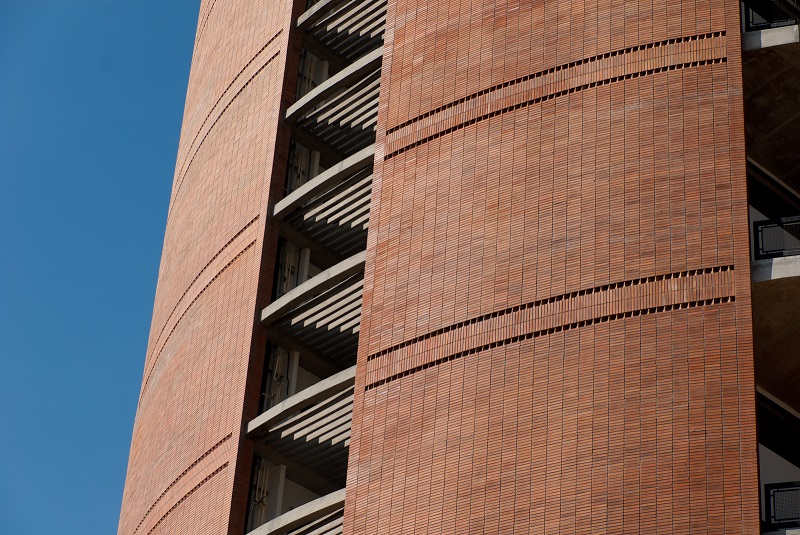
Windmills of Your Mind is Total Environment’s flagship D&B project built on a 24-acre property on the edge of a small lake in Whitefield, Bengaluru. Comprising seven 20-storey towers, the property encompasses a total of 1.75 million sq-ft of residential space with an interesting mix of 405 large formats, fully-furnished and custom-built homes. Nature resonates throughout the property from the green rooftops of the villas and community centre to the terrace gardens of individual simplex, duplex, and triplex apartments, adding to the 3,400 trees interspersed within the property. The horizontal landscaped green surface area in the project is larger than the land on which it is built.
Constructed with exposed wire-cut bricks, the façade needs minimal maintenance, it reduces the transmission of heat and reduces the load on the structure. The commitment to sustainability is reflected in architectural design and infrastructure: wells and stormwater drain recharge the groundwater every 30m, custom ceramic discs in each faucet reduce water consumption, and the green rooftops and terraces make the air quality better. A standout feature in the project is the 70’ x 14’ double-height garden in the duplex apartment, sporting a water body, and glass deck on the upper level and a wooden deck on the lower level. The water body running along the outer edge of the garden is also a safety feature, preventing one from getting too close to the edge. If it isn’t obvious yet, Total Environment meticulously plans and executes the minutest details in order to deliver the best in residential developments, thinking always from an architect’s perspective.
“We have made a significant difference in how a home is perceived, and challenged convention by providing customisation options even in the mass housing context. All this could not have been possible without D&B.”
Kamal Sagar, principal, Total Environment
…
Firm: Infinitti Design Studio, Mumbai
Specialisation: Corporate and Institution Interiors
Led by Santha Gour and Saawant Kaul, Infinitti Design Studio combines the efficiency of D&B with its innate talent for out-of-the-box designs. The studio views each design as an opportunity to create something unique for the client while combining familiarity with new materials and technologies. “New materials and their challenges excite us. However, even while we try to keep designs fresh through innovation, our designs are rooted in the practicality of construction, timelines and budgets,” highlights Gour. Wanting to make a mark as “the vanguard of future-forward design in India”, the studio strives to create spaces that maximise the positive impact of design on the environment, use appropriate technologies and materials and source labour locally.
With over 45 years of experience between them, both Gour and Kaul bring to the table their expertise in creating a well-thought-out design which translates the client’s brief into a built form, expressing shared ideologies and vision holistically. Their combined experience helps them in ensuring better design output and lesser compromises in design. Gour has been an advocate of architect-led design-build since the beginning of her career, having witnessed the tremendous advantages one can reap by saving cost and time while maintaining the integrity of the design. At Infinitti, she and her team hone their D&B skills by focusing on corporate and institutional interiors, while also pursuing design projects across other typologies and scales.

Case study: Wellness Forever Chemists, corporate headquarters
Designing the 15,120sq-ft corporate headquarters for Wellness Forever Chemists and Pharmacies meant more than scoring a big client for Infiniti. Instead, they got an opportunity to work with a client whose primary focus was his employees. For a successful D&B project, client relationship is key and when the client is passionate about the project as much as the designer, the project delivery becomes more efficient. The design brief was to curate large open spaces for interaction between employees where they could engage with vendors in an informal environment as opposed to sterile, closed meeting rooms. “He wanted to pay a lot of attention to natural materials, greenery in the office, wellness in the office, the quality of light in the office, washroom designs, especially for women, etc. A large part of his workforce is women dominated and he seriously felt the office design was his way of looking after his employees,” shares Santha Gour.
In response, Infiniti designed and delivered a capacious space, carving out a large chunk of the reception and waiting area as an open lounge for meetings, interaction or for coffee breaks. “By its very essence, the word ‘wellness’ carries a holistic meaning. We created design elements imitating trees in the reception lobby, natural sandstone and green walls, bought in the much-needed respite to an otherwise large floor plate,” notes the architect about the customised schematic of the space. Even though the layout is fairly open, the design ensures a fair amount of privacy with the help of metal screens that also appear as a decor element. An open ceiling with suspended linear lights complements the open office aesthetic, which is informal and more in line with design trends that would appeal to the largely young employee strength of the office.
“With our design & build deliveries, we can offer our clients a one-stop solution with guarantees on both completion of work on time and quality control. This hassle-free system means we do not have to deal with ten contractors at a time, which is generally the case in normal project deliveries.”
Santha Gour, owner, Infinitti Design Studio
…
Firm: Wallmakers, Kerala
Specialisation: Sustainable architecture and interiors
The genesis of Wallmakers is one where defeat was met with resilience. Inspired by greats like Laurie Baker and his exposure at Auroville, architect Vinu Daniel set out to create a niche practice that focuses on mud architecture that would be sustainable to its core. He drafts a unique design and recruits manpower to build his first project, but the client changes his mind at the last minute, instead asking him to build the compound wall only. That first hands-on experience in 2007, humbly making bricks, not only gave his practice the name Wallmakers but also charted a new journey of discovery of materials and the joy of offering in-house expertise in executing a project. Ever since, the practice has devoted itself to the cause of using mud and waste as chief building components, to make structures that are both utilitarian and alluring. “While the work and construction of a building result in the production of a lot of scraps, we believe in not being deterred by this demon, but instead have learnt to build with it,” says the principal architect.
Soon in 2008, he won an award for a low-cost, eco-friendly house from the ‘Save Periyar’ Pollution Control Committee for the house constructed for a cancer patient. The “wallmaker” began to find widespread acceptance for his work: being featured in Rahul Mehrotra’s ‘Architecture in India’, winning the Kochi-Muziris Biennale Pavilion and building the largest Conoid ever built using ferrocrete; IIA National award; Commendation Prize of HUDCO DESIGN AWARDS; and the enviable International Sustainability Award 2018. Each milestone has prompted him to resolve to devote his energies toward the cause of sustainable and cost-effective architecture. From designing and constructing a church, residential architecture and interior design to hospitality projects, Daniel is always up for a challenge and has developed a robust design and delivery approach with an openness to experiment with new techniques and materials with his team of professionals and skilled craftspersons.
Case study:
Based in Delhi, the clients wanted an eco-friendly and peaceful abode in the busy city of Trivandrum. The design also had to overcome the primary obstacle of water-logging issues prone at the low-lying site and ensure the building wouldn’t hinder the flow of water, instead it needed to be percolated into the ground and harvested. “We had to come up with an alternative and sustainable solution which could also enhance the spatial quality – a pond in the lowest point of the site so that water is retained in the site as well as, adding to the veristic vibe of the residence,” explains Vinu Daniel. When it comes to materials, the 3,100sq-ft residence exhibits the brilliance of natural materials as well as scrap items.
The bamboo façade – reinforced with steel – supports the staircase, creating a semi-open place for the owners to relax and sit. A rotating jali work made from CSEB bricks (Compressed Stabilized Earth Blocks) imparts privacy to the bedrooms. Not only does it allow light to stream in, but the polar arrangement allows ample ventilation. The base plate of washing machines find an ingenious new purpose as grills – “use of such grills instead of fresh ones propagates the idea of up-cycling as well as serves as a medium of income for labourers,” mentions Daniel. Uprooted trees and waste wood from sawmills are morphed into furniture for the residence. Wallmakers’ D&B speciality enables them to create such structures that most contractors would struggle to grasp, and design interiors with materials that mostly go unnoticed or are not used to their full potential.
“It is believed that the “large wooden horse” left at the gate of Troy as a gesture of peace (but for infiltration) by the Greeks was actually a misnomer. In fact, somebody mispronounced or misheard the word “battering ram” for a “horse”. Similarly, in architecture, one often wonders why you design a “horse” and it ends up being built as a “donkey”. The worth of any architect who only submits plans and sections at site is that of a glorified draftsman than a genuine creator. Therefore, design and build…period.”
Vinu Daniel, principal, Wallmakers
Firm: DSP Designs, Mumbai
Specialisation: Corporate Interiors
Commanding domain expertise in mixed-use architecture (design) and corporate interiors (D&B), DSP Design focuses on delivering spaces that “outlast tomorrow with human experience at the heart of the business outlook”. Founded by Yatin Patel, Mehul Shah and Bimal Desai, the practice is structured around five multi-disciplinary studios across India and Singapore studio; besides being a member of ONE Global Design that allows operations in North America and the UK. Experts in integrated project delivery modules, the studio has delivered over 100+ D&B projects for Fortune 500 organizations like Microsoft, Atos, Analog Devices, Soceite Generale, Halliburton, Mattel Toys, Sunlife Financials, Mathworks and more. DSP’s D&B vertical is adept at managing large-scale projects with élan – with projects up to 300,000 sq-ft with about 10 million USD in value.
What sets them apart is their analytical data-driven and intelligent computational workspace research that governs the context of the work philosophy at DSP. “The biggest testimony to a good business is the faith and confidence from its clients affirmed beyond just a single opportunity to serve them. DSP Design has built its legacy within the entire gamut of design on the foundation of trust,” highlights Shah, the founder and principal spearheading the D&B portfolio. Pushing the firm to be proficient with the latest technology, Shah has ensured that DSP is at par with any global design firm in terms of design, execution and technology. When you consider the volume – in terms of projects – and the award-winning results the studio achieves, their D&B expertise is undoubtedly one of the best in the country.

Case study: Sunlife Financial office, Mumbai
In Gurugram, the 156,000sq-ft Sunlife Financial is not a typical workplace design one associate with a finance company. In fact, DSP challenges workspace trends within the Banking and Financial Sector with a ‘resimercial’ schematic – a style that blends the warm and comfortable vibe of residential furniture into the workplace. Conceptualised as an agile, forward-looking, sustainable work environment, the design puts a strong emphasis on the people and its measurable impact on wellness, productivity and operational performance of the facility with no compromise on aesthetics.
The vertical campus planning builds on the ideology of “Fuel Better Ideas” and “Get Active”. To that effect, an internal feature staircase delivering a connected campus environment links key spaces, while infusing ‘mobility’ and enhancing ‘user experience’ within the facility in the process. Huddle galleries across the workspace allow users to work from anywhere and promote agility. Workstation planning has been achieved to lend a new dimension of an assortment of “I” and “We” space typologies such as linear workstations, height adjustable desks, and collaboration desks – referred to as Platforms enabling staffers to configure work settings as needed. The office is also technologically enabled to respond to the comfort-based needs of the staffers and also serve as a great tool for the facility management teams.
“75% of our clientele have allowed us the opportunity to serve them more than once. With our D&B services gaining unprecedented momentum, we truly understand that design is not just about visual appeal, but also about applicability, utility and response to the environment.”
Mehul Shah, founder, DSP Design Associates
…
Firm: VPCPL, Mumbai and Bangalore
Specialisation: Corporate Interiors
Over the last two decades, Vijay Punjabi Consultants Pvt Ltd (VPCPL) has forayed into D&B projects cautiously and gradually as the market evolved. Headquartered in Mumbai with branch office in Bangalore, the four-decade-old firm forays into projects of varied scale and types on pan India basis with projects currently underway in Mumbai, Bangalore, Hubli, Devengere, Mangalore, Bathinda, Hyderabad, Kolkata, Gurgaon, Pune, Vadodara, Coimbatore, Ludhiana, and Sasan (MP), to name a few locations. Their D&B specialty, however, focuses on interior design of corporate offices, with clientele including TCS E-serve, NTT Data, Concentrix Daksh, Mead Johnson Nutrition, Deshaw, SBFC & Qualcomm, to name a few.
Being an architecture firm gives VPCPL an edge over turnkey contractors because they understand both standardised design methodologies and customised, creative D&B projects. Large corporates have clearly defined design guidelines, from cabin and workstation sizes, and defined lighting LUX levels, to clearly spelt out MEP details. “We need to raise the bar in terms of design and execution here. Consistent performance is key to client comfort in such projects,” shares executive director Poornima Ananth, who heads the South Operations and has developed an expertise in software development centres, banks and corporate interiors. In comparison, small or mid-scale firms opt for this delivery model for ease of transaction and single-point responsibility. “Where a client has no specific standards but only a requirement, we as architects help build the standards with our vast database,” Ananth shares. The firm also enjoys creative freedom in the process and merges it with the efficiency and cost-effectiveness of the delivery management. For VPCPL, navigating the two spectrums of D&B projects with confidence and good success rate is their core strength.
Case study: Qualcomm’s office in Noida
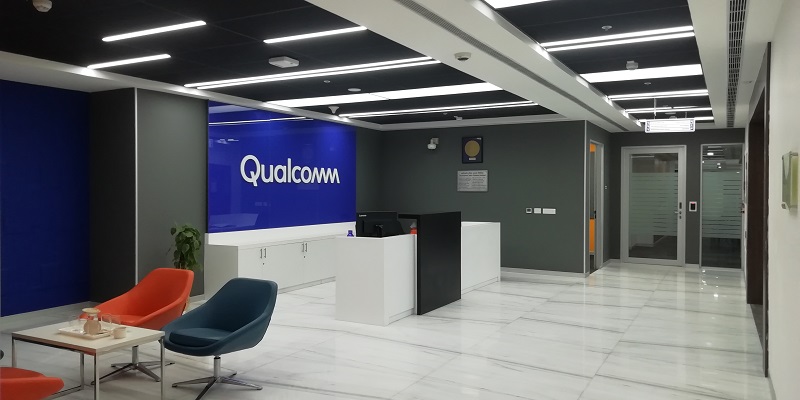
For Qualcomm’s office in Noida, VPCPL worked around defined infrastructure standards to build the 105,000sq-ft space for 475 people. Two contiguous towers over an expansion joint were built to ensure that facilities and amenities like café, building support, relaxation rooms, and stores are placed centrally in both towers. The brand colours of the corporate are predefined and find themselves articulated through wall paints, acoustic panels and graphics. Placed adjacent to the glazing, the workstations receive maximum daylight and the entire office is provided with occupancy sensors for energy saving. The cafeteria is a multipurpose space designed for town hall meetings as well. Apart from the open office and meeting rooms, VPCPL designed specialized labs like an audio and proto lab that involve complex MEP demands like a supply of compressed air and <35 db levels.
In contrast to the cookie-cutter model of large corporates, the SBFC Office approached VPCPL with a brief for a vibrant and cheerful office that would defy the serious finance company image. Colours and informal meeting areas define the office. TT tables in the break areas double up as discussion tables when needed, and garage furniture adds a fun element to the space. Columns are rendered with writing glass for encouraging informal meetings and interaction within teams. To manage noise levels, the otherwise open layout is interspersed with break areas along with acoustical screens, ceilings and panelling. The only formal area in the entire office is the conference room. “The challenge in design-intensive D&B is to ensure procurement of items from diverse sources in time. SBFC Office was completed within 60 days of site work,” highlights Ananth.
“D&B Model hones our skills as architects who understand build ability with respect to time and cost. This challenge of D&B Projects invigorates us and the learning are helping us to sharpen our skills even in consultancy projects.”
Poornima Ananth, executive director, VPCPL
Firm: NCUBE, Delhi+
Specialisation: Corporate Interiors
Workspace dynamics are changing, especially with the rise of co-working spaces – and firms like NCUBE Design [formerly known as Nelson (India)], a premier design firm providing Interior Design and Build services to major corporations around the globe, are responding to this transition with confidence. With over 100 professionals spread across seven centres – Delhi (Head Office), Bengaluru, Mumbai, Pune, Hyderabad, Kolkata and Chennai, NCUBE Design boasts of in-house international talent, holding the global space with over 15 years of collective experience. An affiliate of Nelson USA, the firm specialises in “workplace strategies and plans that optimize facilities, support technology needs, reflect corporate cultures and impact the way people work or live.”
At NCUBE, real estate and workplace decisions are aligned with business objectives by delivering solutions with clear, quantifiable results – and all the necessary expertise to achieve these goals is found under one roof. The office fit-outs and alternative workplace solutions are actively managed by an in-house professional team of architects, interior designers, 3D artists, procurement specialists, quantity surveyors, construction managers, landscape designers, MEP, ICT and AV engineers and branding specialists.
Case study: PVR Cinemas Corporate Office in Gurugram
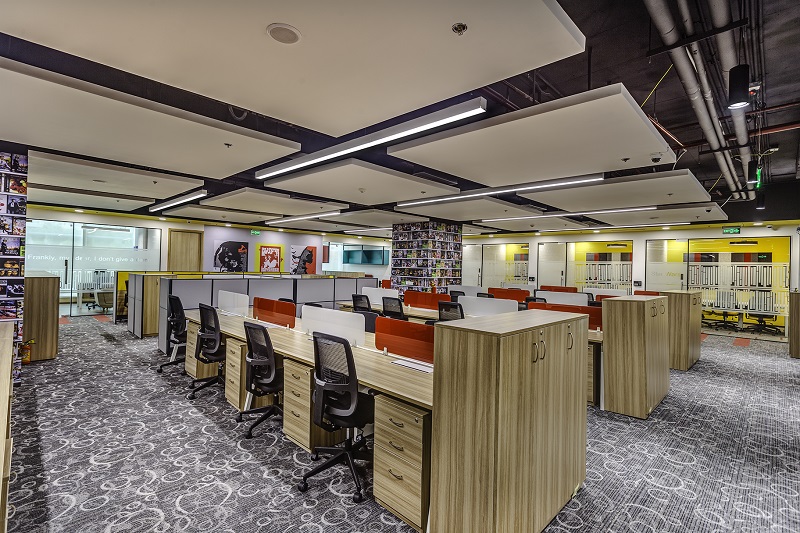
When commissioned to design the PVR Cinemas Corporate Office in Gurugram, NCUBE developed a design that stays true to the spaces, colour, artwork and stories associated with PVR Cinemas. Since the business focused on films, the office is infused with movie-themed design features all around. However, given the modest budget, the D&B project had to take up an innovative approach to present the distinctive design. Additionally, the task was to develop one portion of the given floor plate, essentially a carpet area of 5,823sq-ft.
In response, the design balances open and closed spaces, achieved by defining work hall zones based on their functional typology. Since the main objective was to create a space which should reflect the identity of PVR, the office has a vibrant set-up. Complementing the cinema’s references and its bright colours is the white palette, seen either on ceiling panels, partitions or as a wall finish. Maintaining a fairly pragmatic layout – a square floor plate with existing toilet blocks on one corner – the design supports a uniform distribution of spaces. Cabins and meeting room areas are planned on the periphery in order to provide unhindered circulation in the office. In many ways, the PVR Corporate Office is an ideal example of what a D&B project is like – a perfect mix of modular features that offer flexibility in design and aid faster execution, and thematic representations in terms of wall treatment and colour psychology that personalise the space with the brand’s unique identity.
“A unique process driven approach has helped the brand rapidly grow in the design space in the country, as it continues to offer an integrated platform to deliver solutions to service diverse client requirements.”
Amit Ramani, vice chairman & strategic advisor, NCUBE
Firm: M Moser, Bengaluru+
Specialisation: Commercial Projects
A veteran in the workplace design and delivery segment, M Moser Associates has built a reputation for being experts in the field not just in India but the world over. More so, they have developed long-lasting client relationships with some of the best-known multinational companies – an edge every D&B firm wishes to have. Since 1981, the firm has been providing a holistic approach to transformative physical, social and digital workplace environments, integrating expertise in workplace strategy, architecture, engineering, interior design, and digital infrastructure, together with sustainability and wellness. This positions M Moser at the forefront in offering clients integrated and unique project solutions of any size and level of complexity. When it comes to its Indian operations, the firm has mobilised its efforts to build for contemporary workspaces for clients such as Yes Bank, Booking.com, Titan, Accenture, Renault-Nissan-Mitsubishi, TiVo, PayPal, among others.
Brian Piley, a chartered architect with credentials from Dundee University in Scotland, leads the Indian offices with his 30 years of design, project management and business management experience. His specialization in commercial office refurbishments and industrial complexes in Asia enables him to confidently understand and fulfil the workplace needs of multinational companies operating in the complex Indian market. Under his leadership, M Moser offers international and local clients the ‘Glocal’ advantage – wherein international expertise and contextual understandings are merged to develop an effective workplace design strategy. “Although design and build can be a highly effective way to deliver projects, M Moser assesses the unique needs of its clients to provide the solution that suits them best,” points out Piley.

Case study: PayPal office, Bengaluru by M Moser Associates
Mobilised by the success of a number of pilot projects in the US, PayPal sought M Moser Associates to replicate concepts of flexible, collaborative and open working in India. The new 330,000sq-ft Bengaluru workplace consolidates the company’s technology and customer support teams. Just like the organisation, the space needed to be dynamic and young with a thriving collaborative spirit fueling day-to-day operations. Configuration of sit-stand desks and a wide variety of meeting room designs – in the form of a library, project lounges, writing booths, an assortment of lounge seating and more – bring the brand’s ethos alive. Featuring a small incubation area at the core for hosting start-up ventures, the rest of the space is dedicated to talent attraction and retention with two floors housing the online payments technology team and another four flours allocated to customer support. Part of the D&B exercise was to futureproof the office, and modular planning enables 10-15% growth of collaborative spaces.
Amphitheatre-style seating enables innovators to connect, while a designated Tech Space facilitates new technology experiences including VR (Virtual Reality). Every entrance to space features a games area that extends into a breakout space, fostering a relaxed ambience and intercommunication between teams. Common areas are focused on employee engagement featuring striking local-inspired street art, developing a strong contextual connection between the multinational company and its surroundings. “PayPal’s core values are presented in symbolic forms throughout, developed by artists with Indian heritage. Holistically delivering the project from design through to construction for a remotely located client, M Moser has created a culturally infused, collaborative hub for talent attraction, incubation and innovation,” concludes the design team.
“The holistic D&B approach enables us to provide integrated solutions that empower people to be their most productive, supporting the cultural transformation required to meet an organisation’s unique and evolving business needs.”
Brian Piley, head of office, India, M Moser Associates
Firm: RSP Associates,
Specialisation: Commercial Projects
“A right answer is an outcome of an apt question” is the mantra by which RSP India functions. Established in 1996 and headquartered in Bengaluru, the company adopts a multi-disciplinary and participatory approach to design, growing its roots from a cohesive international corporate culture that fosters collaboration. Their expertise in the domain of design and build is best proved by the fact that the firm has completed 170 million sq ft completed projects, won 40 awards and accolades, and has a track record of 70% repeat clientele. Several of India’s largest corporates and Fortune 500 companies like Microsoft, Google, Qualcomm, Cisco Systems, Franklin Templeton, Hewlett Packard Enterprises, Exxon Mobil, Infineon, 3M, IBM, Citrix, Motorola, GE, Infosys, Monsanto, Robert Bosch, Wells Fargo, etc. trust RSP to design and deliver the best workplace strategy for their employees.
RSP has a team of over 340 professionals running operations in five cities collectively believe that ‘quality is not just an outcome, it’s a culture. There are ten factors dictating workspace design – choice in design, noise control, thermal comfort and temperature, employee management, sensory change and variability, access to nature and daylight, spatial quality (“crowd or clutter”), air quality, ergonomics and colour therapy. Offices are not just plain work desks anymore, it is about connecting spaces, creating informal spaces, café-style working modules, connecting people through smaller spaces, and providing various seating options. Being a design and build firm means they have to account for these design changes and adapt their build capabilities accordingly, devising new ways to deliver the program with the same efficiency.

Case study: Infineon, Bengaluru, corporate office
Infineon, Bengaluru, is a corporate office with all verticals distributed over ten floors. The ninth-floor functions as the corporate floor and the tenth floor is a Business Centre designed to the specific requirements of each user group. In their design and build process, RSP replaced the conventional L-shape workstation with sleek, linear options, preserving views toward Hotel Oberoi and fostering a collaborative zone at the centre of the office. The zoning and circulation aim to break away from cliches associated with office spaces and introduce a level of flexibility into the function and movement.
Geometric shapes and accent flooring further enhance wayfinding, besides adding vibrance to the workspace. Collaborative zones on every floor interact vertically through the staircase to create a more holistic environment. This staircase is designed centrally to not only serve as a mode of vertical transportation but force the users to use the stairs over the lift. A Concept Centre on the ground floor along with the reception provides a holistic overview of the company and its achievements, resulting in an ambience that impresses visitors and employees alike. RSP’s D&B initiative here creates a proactive workplace strategy that takes into account the aesthetics of the place but more so focuses on creating seamless, day-to-day operations that keep wellness and productivity centre stage.