



- What was the brief from the client? And how did you achieve the same intertwining of your style?
Shirin: The client’s brief was to provide a top-notch workspace experience that would help retain their young talent pool. To achieve this, we decided to create an office space that felt like a “home away from home,” with aesthetics that catered to their business needs. This allowed us to intertwine our style with the client’s vision and provide a workspace that was both functional and comfortable.

- With evolving office designs, what latest trends have you absorbed into this project?
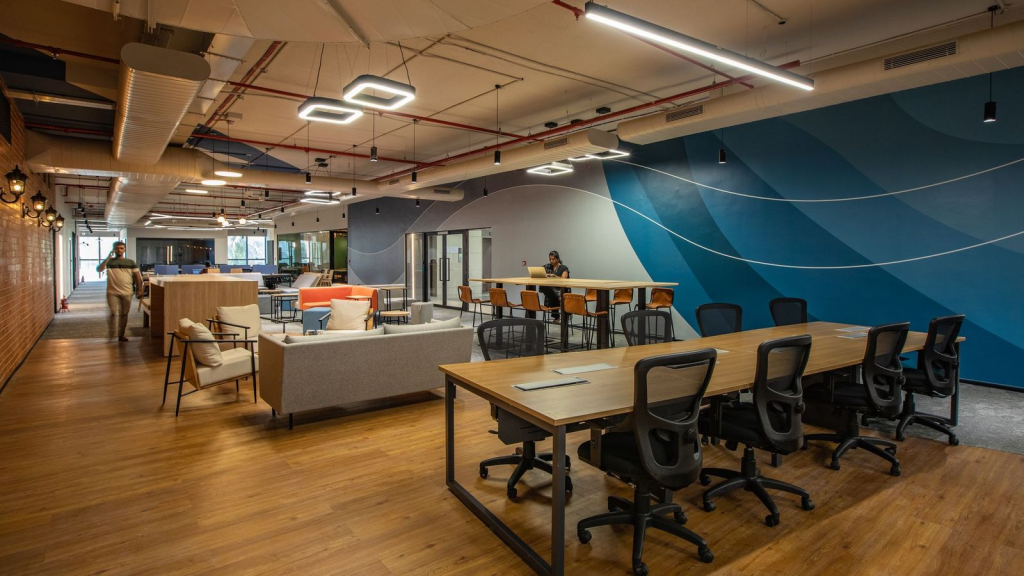
Shirin: In this project, we’ve absorbed the latest trend of providing employees with greater autonomy when it comes to choosing their workspace. This means we’ve incorporated a variety of different workstations, including open focus pods near windows, standing desks against walls, and even swings within the work area. We’ve also included social spaces that can double as alternate workspaces, offering informal discussion spaces, brainstorming areas, and even room for larger team meetings. By integrating these features, we hope to create a workspace that is both functional and inspiring for employees.

- What are the environment-friendly initiatives taken for this project?
Kathir: In terms of environmental sustainability, we incorporated several features in our design for this project. To maximize natural light and reduce electricity usage during the day, we strategically planned the open spaces to face the windows. We also installed motion-activated sensors for lighting and faucets in the restrooms, which contributed to our efforts to conserve energy. Another eco-friendly measure we implemented was a paperless workflow, achieved by eliminating the need for a separate repro area in the spatial design. By implementing these initiatives, we were able to create a workspace that is both energy-efficient and environmentally responsible.
- Can you give us insights on the selection of furniture and finishes of the project?
Shirin: Our main goal was to enhance collaboration among team members, so we opted for modular furniture with an open and transparent design. The only private spaces are earmarked manager cubicles, which feature privacy screens for added confidentiality. All manager cabins are equipped with height-adjustable mechanisms to ensure the wellness of the team. When selecting loose furniture, we placed great emphasis on safety and ergonomics. As for the finishes, we chose materials that accentuated the space while also focusing on acoustic and lighting enhancements. Overall, our furniture and finishes were carefully selected to create a workspace that is both functional and aesthetically pleasing.

- What were the difficulties, or first setbacks encountered?
Shirin: During the initial stages of the project, we encountered some difficulties. One of the main challenges we faced was finding the right balance in spatial planning and meeting the project requirements while utilizing the glazing side to maximize sunlight in the workspace. Additionally, the unique base build required us to accommodate larger rooms, which required careful planning. Despite these challenges, we were able to create a workspace that encourages curiosity and collaboration by designing curvy neighborhood clusters that add visual interest to the environment. Overall, we were able to overcome our initial setbacks and deliver a space that met the needs of the client while also being functional and visually appealing.

- If you had to name the design style used, what would it be?
Kathir: The design style we used for this project was a modern contemporary approach that would appeal to the younger workforce of the firm. We incorporated subtle accents of the brand’s colors and neutral shades throughout the office. While it’s difficult to pinpoint a specific design style, I would describe the overall theme as an ‘aurora borealis of office.’ This term encompasses the subtle nuances in the lighting method, which created a captivating visual display and allowed us to highlight specific elements of the space. Overall, our design style was tailored to the needs and preferences of the client while also being visually stunning and unique.
- What were the inspirations and key concepts for the development of the project?
Kathir: The primary inspiration for our project was the idea of creating a “Home away from Home” theme. This concept was motivated by the fact that people had become accustomed to online meetings during the pandemic and desired a dynamic and engaging workspace once it was safe to return. Striking a balance between the familiarity of working from home and the needs of a traditional office environment was a key conceptual aspect that we considered during the development of the project. Overall, our goal was to create a space that was comfortable, inviting, and conducive to collaboration and productivity.

- What is your favorite element of design in the project?
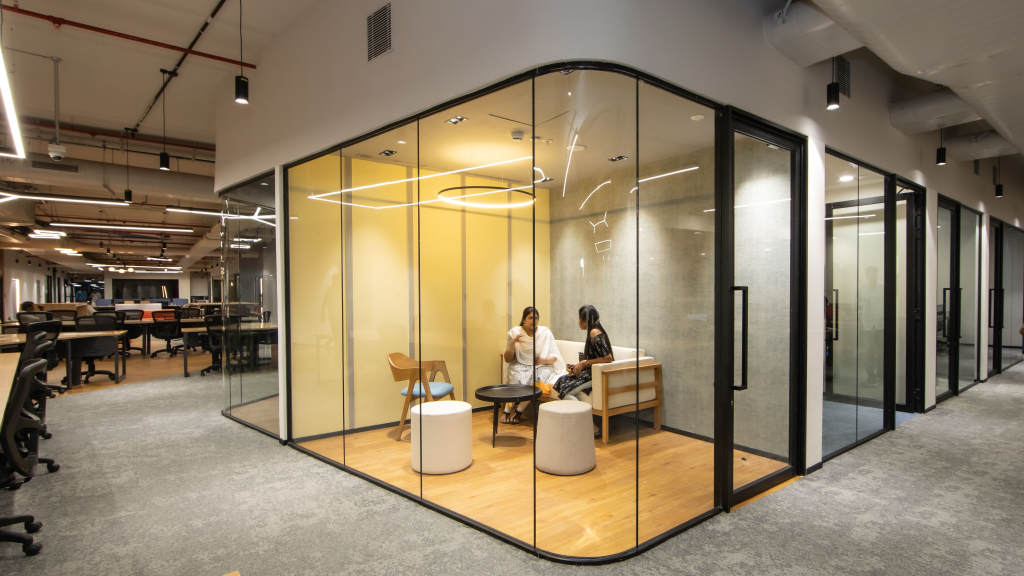
Kathir: Regarding my personal favorite element of design in the project, I must say that I am particularly fond of the curved neighborhood meeting cluster located near the social space. This feature creates a sense of intrigue and discovery, with each turn revealing a unique design element, such as the meeting room accent shade that translates to the linear lights on the ceiling, the lounge meeting room with ambient decorative lighting that focuses on the participants, and the accented curtains around the glass facade in the conference room with light shadowing the curtain. These details have been carefully crafted to break the monotony and add interest to the space, and I am proud to have been a part of their design.
- If you had to describe the project in 2-3 words what would it be?
Kathir: I would describe the project as “Inspiring, Inviting, and Exciting.” The design perfectly aligns with the aspirations of the employees and fulfills the business requirements.
- Explain the use of colors and/or other details to add value to the design.
Kathir: We used a subtle interpretation of the brand colors throughout the interiors to maintain consistency and create a cohesive look. The cafe area is a standout with its regal green color scheme and warm lighting that complements the orange leatherette finish on the benches. The outdoor extension of the cafe also adds character to the space with its unique presence of outdoor furniture and canopy. To highlight the elements during the night time, we added strategic highlighters that create a striking visual impact. Overall, the use of colors and other design details helped to add value to the project by creating a visually appealing and functional space.
- One learning that you’d take up from this project?
Shirin: As a designer, I am constantly seeking ways to improve my skills and abilities, and this project has reinforced the notion that learning is a continuous process. Design is a constantly evolving field, and new technologies and trends emerge all the time. While it’s important to stay up to date on these changes, it’s also crucial to have a strong foundation of skills and knowledge that we can rely on. In this project, I learned the importance of striking a balance between these two approaches. By constantly seeking out new knowledge and skills, I was able to create a design that was both innovative and effective. At the same time, I was able to rely on my expertise in the field to ensure that the design was well-executed and met the needs of the client. Ultimately, this experience reinforced for me the idea that design is a lifelong learning process. No matter how much we think we know, there is always something new to discover or a new skill to master. By approaching our work with a commitment to ongoing learning, we can create designs that are both innovative and timeless.