



As we go back to the office, many of us are likely to find changes in how we engage with each other and with our workspaces. Chances are, our perspective is a bit different, and our thinking broadened. There’s a deeper sense of connectedness, rooted in a shared experience over months past.
Can we reimagine the office given what we’ve learned and how we’ve changed? People want a place to find focus but also spaces for spontaneous chats. Can we create meeting rooms that act as destinations for working together? How do we reshape a social space to also serve as a “performance” collaborative space?
The formats that follow offer a guide for reactivating and revitalizing the workplace- ready for today and the future.
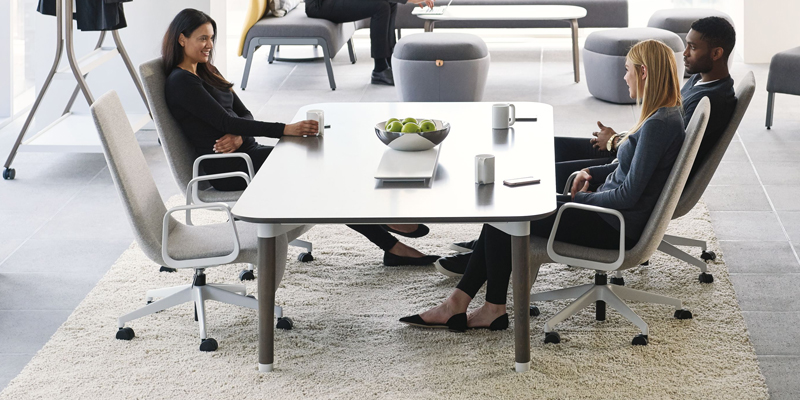
SOLO PERFORMANCE TO COLLABORATION
Performance workspaces will propel a return to the office, but the landscape of the workplace may look a little different. High-density, permanent-address workstations may be reconfigured as workers seek more diverse choices of where to go to achieve solo focus work.
To reactivate collaboration, a percentage of square footage can be allocated to informal meeting spaces placed next to workstation clusters. Spare workstation components may be inventoried for future use.
Collaborative areas set within the open plan facilitate spur-of-the-moment exchanges. It is essential to design such settings to draw people in, supporting inclusive group work while taking into account the design and flow of the office landscape as a whole.


MEET IN COMFORT
Meeting rooms will continue to be spaces for sharing ideas. The conventional meeting room is typically fitted with a table and chairs, digital presentation tools and storage furniture. As a static landscape, this model provides little in the way of user adaptability and choice.
Reinvigorate meeting rooms into more agile and adaptable settings. Smaller rooms with moveable, lightly scaled furniture offer one or two users a quiet place to work, plus the ability to reorganize the space as needed.
Meeting room design must be both functional and versatile in order to support a more dynamic mode of work as people return to the office to participate in scheduled team meetings, ad hoc problem-solving and socializing.

ENERGIZE SOCIAL SPACES
Welcoming and inclusive social spaces facilitate performance collaboration. Detached social settings should be connected in a way that allows users to leverage the space in different ways throughout the day.
Unified social settings bring people together. A mix of materials and textures suggests a residential comfort and warmth that draws people in, while a mix of seating permits varied work styles and postures.
An inviting social space in place of a formal reception welcomes employees and guests to a dynamic destination rather than a “waiting area.” The communal bar encourages engagement and a variety of seating with a residential tone alludes to domestic comfort and relaxation for casual interaction.