



W. Clement Stone once said: “You are a product of your environment.” It is this adage that is today driving decisions for many around the world when it comes to designing and organising the spatial build of a workplace. In an economy, which is saturated with competition, retaining talent and innovative minds is no easy feat. Understanding how one can set up an infrastructure that’s not just an office shell but one that acts as a strategic tool for productivity, collaboration, and growth has become imperative. Much of it also has to do with the company’s culture; Godrej Properties has successfully been able to grasp the nuances of creating ingenious spaces.
As true for any workplace, architects have a paramount influence over the outcome of its built space; Anubhav Gupta, CEO at Vikhroli and the Chief CSR & Sustainability Officer for Godrej Properties Ltd, explains how the company has effectively interpreted its ethos and principles in its building.

- Could you give us an insight into the basic brief that underlines the foundation of the company’s design approach for its buildings?
Commercial office space globally has evolved following new drivers that influence the way we work today. Our focus has been to create a sustainable icons, which offer world-class spaces, amenities, infrastructure, connectivity and flexibility. Our goal is to increase user satisfaction and work productivity, foster innovation in the work place, and, deliver truly sustainable buildings. Ingrained in our design approach and the method by which our projects are delivered is a collaborative design process. Working closely with our architects, engineers and leasing teams has been central to our process which has allowed us to deliver successfully in this dynamic market. Each project we are involved with presents a unique set of challenges and it is through this collaborative process, coupled with the ability to be nimble and flexible, that a design vision can be delivered in light of these challenges. As an organization we are looking to define markets, rather than follow the market. It is this progressive mindset, along with a robust company infrastructure that has allowed us to persevere. Our sustainable design led approach to real estate development prioritizes key aspects of good design, beyond form making, from the start to the final execution of our projects.

- When designing commercial campuses what are the common challenges?
With the development of each commercial asset (Godrej One, Godrej BKC and more recently Godrej Two), our learning curve has been progressive. Per our assessment, market conditions for commercial real estate tend to be very dynamic with inherent challenges. At the business plan stage these include the cyclical nature of the asset class, high capital requirements, the trade-off between built to suit and build to lease options, increasing tenant parking requirements and building efficiencies. For product development – evolving workplace norms, amenity requirements and wellness features tailored to the requirements of an increasing hybrid office are the area of focus. During development planning these translate to the necessity for a suitable mix determined by a defined leasing strategy which in turn should be informed by robust customer insights. Time, cost and quality challenges can be addressed by setting up an integrated design, engineering and construction team. It is also imperative to define a suitable facilities management strategy as well as sustainability goals in advance of the design and development of engineering systems. In our experience we have found it helpful to integrate commercial precincts within a mixed used master plan to leverage shared physical and social infrastructure. Business requirements are best addressed by maximum design flexibility with respect to leasing with buildings designed for both vertical and horizontal tenant splits and floor plates configured around compact and efficient cores. The vertical transportation strategy should allow for leasable office floor areas to be split into multiple options, each being independent of the rest in terms of access, maintenance and services.
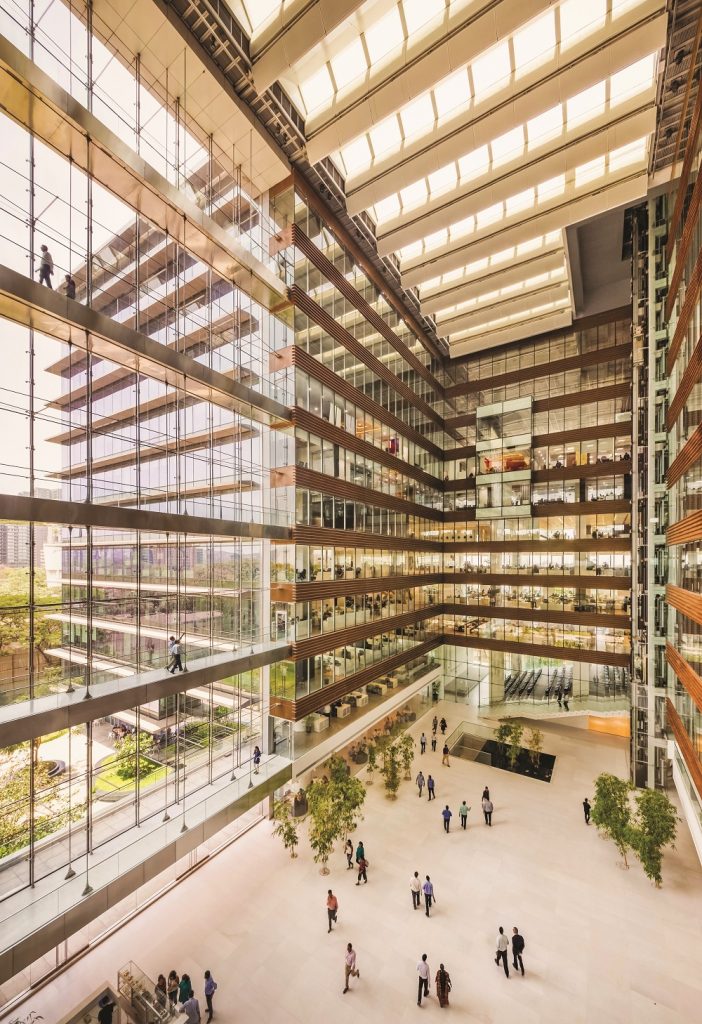
The external envelop performs well on numerous parameters – day lighting, solar shading, minimizing heat gain and occupant comfort. Both these buildings are Platinum rated for the highest performance in sustainability.
- Could you give us some insights on the key aspects that are incorporated within the buildings you design?
Designed by renowned American architects Pelli Clarke Pelli, our headquarters building, Godrej One, is our first delivered asset of The Trees master plan and is a standing testament to the product design and quality envisioned for the larger development. The name is also symbolic, as the building brings together our group companies under one roof. Conceived with Japanese architects, Nikken Sekkei, our second commercial building Godrej Two has been designed as a Grade A office space with maximum flexibility made possible by both vertical and horizontal tenant splits with each floor plate configured around an efficient core. One of our key focus areas in our commercial buildings has been natural light brought about by both lease depths and well-engineered facades. The external envelop performs well on numerous parameters – day lighting, solar shading, minimizing heat gain and occupant comfort. Both these buildings are Platinum rated for the highest performance in sustainability.
Workplace design that encourages collaboration and fosters wellbeing is a key driver of organizational innovation and productivity. Generous floor to floor heights of 4m and an efficient 1500mm planning module ensure grand airy spaces which aid in efficiency, flexibility, multiuse and overall comfort and wellbeing for users. Thoughtfully designed relief zones interspersed throughout the building provide breathing room for quick breaks or even an ideal venue for semi-formal meetings. Our headquarters building, Godrej One has a grand central atrium which not only brings light into the heart of the building but ensures visual connectivity to the outside green from multiple vantage points. Godrej One and Godrej Two entrance lobby concourses are generous not only connecting two sides of the building and adjoining landscape but also providing for a grand experience to the retail, F&B, creche and convenience program housed on the ground floor of each building. Integration of landscape and public art from leading international and Indian artists are generously placed within our buildings. Rooftops are landscaped to host for events and parties with magnificent views of the mangroves.
With state of the art below grade mechanised car parking, much of the grade level outdoors have been given back to the pedestrian in form of tree lined landscape plazas, waterbodies, lush lawns and play spaces punctuated by more public art. This language of green outdoor spaces is carried through the buildings in their lobbies, alcoves, balconies and rooftops; and the public program on the ground floor of each building ensures an active street life thereby making the masterplan engaging and vibrant.
At Godrej, our workplace also represent our values. People, talent, our teams and our community are at the heart of our enterprise. We believe that in progressive workplaces where business, functions and teams are no longer seen as silos; democratic and vibrant spaces both indoors and outdoors allow for a certain level of engagement, wellbeing and choice. This in turn drives an aspiration to be rooted to both values and place which go hand in hand to encourage innovation, collaboration, productivity and growth in the workplace.

- While working on projects that involve several stakeholders, what are some of the challenges that are still prevalent in the industry?
The delivery of Class A commercial buildings is a highly involved and intensive undertaking. Keeping to the highest benchmarks of time, cost and quality is key to make success of the venture. Multiple teams and a complex value chain needs to be managed efficiently at all times. Setting up the right teams with clear roles, responsibilities and resources at the outset is key. With funding structures in place; market research is usually recommended to understand the market, ascertain the mix/positioning and viability of the business plan to set up the venture. Robust project planning and scheduling are base hygiene to refer back to the rate of progress on any project. Design and engineering form the backbone of the pre-construction process for which the right partners need to be onboarded to work hand in hand in regular workshops, charrettes and other intensely collaborative formats. BIM and other forms of technology may be leveraged to help manage these multiple tandem inputs better in real time. Bringing the next stage partner early on in the process is always helpful to ensure timely inputs and to avoid abortive work. Clear and timely decision making on multiple trade-offs during this process is important. Managing building approvals alongside makes it necessary to do things first time right and be fully baked in terms of details to ensure timely and uninterrupted progress. Post the preconstruction stage, the tender, quantification, contractual and procurement process is a detailed exercise. Expertise from internal teams or assistance from QS/Project Management agencies may be required to ensure for both accuracy and efficiency. The right contracting strategy and contractor selection often play an important early role in the successful delivery of any project. Despite robust drawing sets, Design and Engineering need to work with the contractor to ensure the ability to build successfully what was conceived on paper. Select mock ups and tests may be required depending on the complexity of the building components. Typically the construction will follow a substructure (below grade development), super structure (core and civil work), MEP and façade, finishing, commissioning, handover and leasing schedule.
Due to its complex value chain and dependency on multivariate elements that need to work seamlessly for success, the challenges seen in commercial asset delivery are many. While most of these elements will be in control of the executing teams, in India due to the nature of the industry, we also come up against situations that tend to be outside our control which need to be factored in. Overall the challenges seen may be broadly understood for impact on time, cost or quality. While each decision may have a stronger impact on one of these variables, it is likely that it may impact the other two by influence as well. For example – poor planning, lack of understanding the market, risky funding, abortive design development, poor coordination and construction management may have an adverse impact on time which will also impact cost. Inaccurate budgeting, untimely decision making, poor contracting and procurement strategy may directly impact and increase the cost of the building. Shoddy workmanship, poor supervision, erroneous detailing and cutting corners impacts the quality among other parameters. In our experience, a lot can go wrong and practice does make perfect. We apply the 80/20 rule to the factors which may be under our control and those not. We endeavour to perfect the 80 by setting up efficient systems proven by practice while we gather our learnings to anticipate what could go wrong on the 20 to ensure we can make up for any eventuality and yet achieve success.

- What are the specific strategies that Godrej Properties has adopted to reconcile with the constantly upgrading technologies?
Our approach for commercial development is based on the first principles of robust planning, experiential design and optimised engineering to maximize natural light and exterior views for an open and flexible work environment to foster comfort, efficiency and ease of each occupant. Each space is designed to accommodate and anticipate the diverse needs of businesses/teams and are supported by cutting edge technology to ensure a state of the art global workplace. Smart spaces, embedded communication technology, convenient charging points, use of sensors, destination controlled elevators, intelligent lighting, QR code enabled convenience, health/wellness monitoring systems, hybrid workspaces and smart hot desks are a few examples already in use to enable the needs of business especially in a post pandemic work scenario. We believe that our focus on these first principles allow us to be resilient and affords us a greater flexibility to adopt easily upgradable technology as it develops to serve the dynamic needs of our workplace community.
- How has the company used IoT to its benefit, especially from a facilities and building infrastructure point of view?
We leverage technology to monitor, provide data and enhance our building performance particularly on sustainability parameters. Our commercial buildings are equipped with integrated building management systems (BMS) that monitor the energy consumption of all engineering systems including electrical, chilled water and plumbing allowing for us to pass on optimization benefits to our tenants. Trend analysis of power consumed is recorded in the system with the ability to identify outliers with corresponding event details for analysis and optimization. Automated tenant billing with BTU meters installed for energy monitoring are connected to the BMS. Separate chiller plant managers (CPM) are provided to control the chiller operation and are programmed to optimize chiller operations basis occupancy and usage of the system.

- Given sustainability is at the forefront of the company’s agenda, what are some of the various measures taken by the company? What are some of the key innovations?
Godrej One, Godrej Two and Godrej BKC are all Platinum certified which is the highest compliance for Green Buildings globally. Our commercial portfolio has been equally appreciated in terms of commercial success, quality of space, lifestyle offer as well as employee and tenant satisfaction.
The design for all three buildings enables a healthy working environment that functions meticulously and facilitates lower utility expenses due to energy savings, water efficiency, carbon dioxide emission reduction, improved indoor environmental quality, stewardship of resources and sensitivity to its impact. A sustainable work environment that is also energy and resource efficient contributes to a healthy workplace. Engineered to high standards, the curtain wall facades with fully unitized aluminium panels ensures that the interiors are well-lit and at optimum temperatures, so the impact of heat gain is minimized and energy savings optimized.
Notable features that focus on employee well-being include:
§ Daylighting: Use high quality glazing envelope to minimize heat gain, increase light transmittance and enhance comfort
§ Air quality: Monitor indoor air quality thereby enhancing the awareness amongst occupants on the impacts of air pollutants
§ Indoor emissions: Institute measures to reduce indoor emissions and microbes, thereby reducing the associated adverse health impacts on the occupants
§ Quality of Recycled Water: Ensure acceptable quality of recycled water to minimise the risk of water borne diseases
§ Occupant Satisfaction: Ensure that the occupants are satisfied with the comfort conditions, thereby enhancing their well-being and productivity
§ Acoustic Comfort: Minimise noise levels and provide acoustically comfortable environment for the occupants, to enhance productivity and reduce the associated negative health impacts
§ Olfactory Comfort: Minimise odour in service areas to reduce discomfort and associated negative health impacts for occupants
§ Ergonomics: Provide ergonomically designed spaces to enhance occupant comfort.
§ Building resiliency: In case of emergencies, carbon monoxide sensors in the basements automatically switch on the ventilation fans, while the integrated fire alarm and public announcement (PA) system aid prompt evacuation of the building’s occupants.