

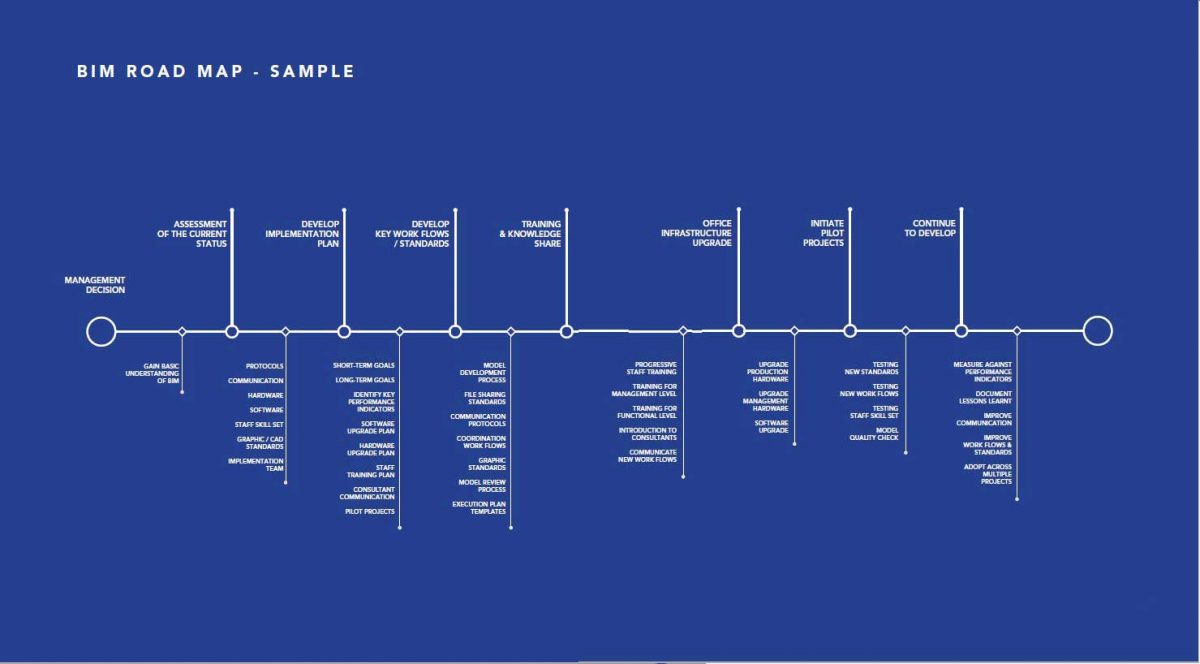
Road map is critical for any implementation and more so for BIM which requires the team to understand the level of implementation and have specific set of goals to work towards. Road maps are of various kinds depending on the team trying to embark on the journey.
It is important to ensure that the BIM Road map is integrated with other relevant initiatives and goals that are in-place for the organization. This requires the team to work with both internal and external parties that are involved in the daily working and decision making process. This helps to ensure that the entire project team is growing together to succeed in a collaborative BIM project.
Key elements of a successful BIM Road map includes:
- Company BIM Vision Statement
- Assessment of the existing technology and work-flow
- Long-term Goals & Short-term Goals
- BIM Team & Organization Chart
- Target BIM Uses
- BIM Standards & Templates development
- Technology Upgrade
- Training & Knowledge sharing plan
- Key performance Indicators
- Project Implementation Plans
- Pilot Projects
A road map should be considered as a live-document not only used to help monitor the implementation process but also to update the implementation strategy as when required.
1. ASSESSMENT
Assessing the existing status of the organization in terms of the technology used and the work-flows currently practiced is critical while planning for the organizational level BIM Adoption strategy. This assessment stage will help understand the team members to identify and prioritize the issues to resolve using BIM methodology.
Whether its a first time implementation or an update to an existing BIM environment, an assessment of the current status and existing capabilities will help the team to identify the areas to improve on the next steps accordingly. Developing an assessment requires the team to collect information regarding several aspects of implementation.
Organizational-level Assessment
While considering an organizational level implementation, the following are the key aspects to document in the assessment report;
- Typical project scope of services and involvement of BIM.
- Existing work-flows in the current practice for both internal and external related activities.
- Existing software and hardware and the upgrading requirements
- Challenges and issues faced in the current practice.
- Documentation of any previous BIM projects.
- Research on BIM capable software and hardware and feasibility of implementation.
- Internal team BIM capabilities and past experience / training requirements.
- External parties (consultants) BIM capabilities and readiness for BIM.
- Relevant project deadlines and goals.
- Research on local public sector BIM Mandates and guidance if any.
Project Level Assessment
Project level BIM implementation requires the team to work more collaboratively with all project stake holders. The assessment for this requires consideration towards all project specific issues such as;
- Project scope of services and involvement of BIM.
- Current status of the project & schedule.
- Project Team BIM capabilities & training requirements.
- Existing challenges and room for improvement.
- Existing project information drawing quality, details & presentation standards.
BIM Implementation requires a commitment of both time and money and it is important to incorporate these aspects into the assessment process.
2. SHORT-TERM GOALS
BIM Implementation is a progressive and time taking process and there is always room to improve and gain new benefits.Having a list of short-term goals based on the immediate benefits of implementing BIM will help maintain the momentum. Being able to achieve set-goals in a short duration of time will help the management and the functional teams to gain confidence and encouragement to move forward.
While it is obvious that the real return on investment in BIM is not evident until few years after the successful implementation, BIM offers several immediate benefits at project level. BIM Road Map can be developed by targeting to gain this immediate benefit of BIM while concurrently developing the capabilities required for future gains.
Having an achievable list of short-term goals is essential to experience the success of implementation early in the process and to maintain the team confidence levels. Short-term goals will help to test the BIM strategy in place early in the process and to improve at frequent intervals.
Key short-term goals:
- Achieving the following key goals can ensure that the early benefits of BIM are utilized;
- Obtain additional BIM Capable software and hardware.
- Develop BIM Standards and Templates for selected BIM Uses.
- Conversion of selected 2D Library to BIM.
- Train selected team of members to become BIM competent.
- Prepare a BIM task force to be the single point of contact for all things BIM within the organization.
- Identify and resolve existing issues in the current practice based on the assessment report.
- Streamline BIM related communication for all internal activities.
- Meet specific BIM Mandates set forth by the local construction authorities if any.
- Successful completion of selected pilot project using the new work-flows.
- Achieve a selected level of BIM Maturity ( Level 2 or Level 3 ) based on the current status.
Breaking down the activities required to achieve the short-term goals with help keep the team to continue to improve while the organization is preparing for the larger picture at the back end.
3. LONG-TERM GOALS
While achieving the short-term goals keeps the team moving forward in the implementation, it is critical for the management to have a list of long-term goals. Long-Term goals will help develop a business case for the implementation and a perspective towards investment and returns involved in this process.
As the functional group continues to make progress towards the short-term goals set forth, long-term goals will help to maintain the BIM Vision for the organization.
Long-term goals help gain better clarity towards the larger picture for the organization in terms of the business growth, development strategy etc.
Key long-term goals
- BIM is perceived as an organizational level project management system.
- Achieve improvement in productivity.
- Complete transformation of all organizational level activities from 2D to BIM System.
- Staff at both functional and management levels are fully trained and are capable to carry out the day to day BIM activities with ease.
- Obtain the return on investment for BIM Implementation and plan for next steps.
- Build a BIM Ecosystem with capable external consultants in-line with the project activities.
- Improved efficiency in daily project activities both internally and externally.
- Increased understanding of the project design and all stake holders.
- Reduced loss of information and design conflicts for all projects.
- Improved quality of all projects as whole beyond the scope of work.
- Achieved the BIM adoption level (Level 2,3 or 4) as aimed
- Market BIM capabilities to gain new business opportunities.
Implementation of BIM should be perceived as a journey with room to improve at all stages. While the long-term goals will provide a right direction to stick to the company’s vision for BIM, it is important to continue to test and improve on the existing work-flows and standards frequently. This help the organization to stay up to date with the emerging technologies and gain the competitive edge in the industry.
NOTE:
The Part 2 of the artcile further explores the Importance of a BIM Road map for identifying key performance indicators, planning technology upgrade, training plan and implementing schedule.
Below are the other topics included in the series:
- A brief introduction to BIM
- How BIM can deliver optimum results
- In-House BIM developement V/S Hiring external consultants – Which is better?
- Top 5 areas where BIM can help realise a project’s full potential
- Understanding the “I” in BIM
To contact Voxel1 Solutions visit: www.voxel1.com