

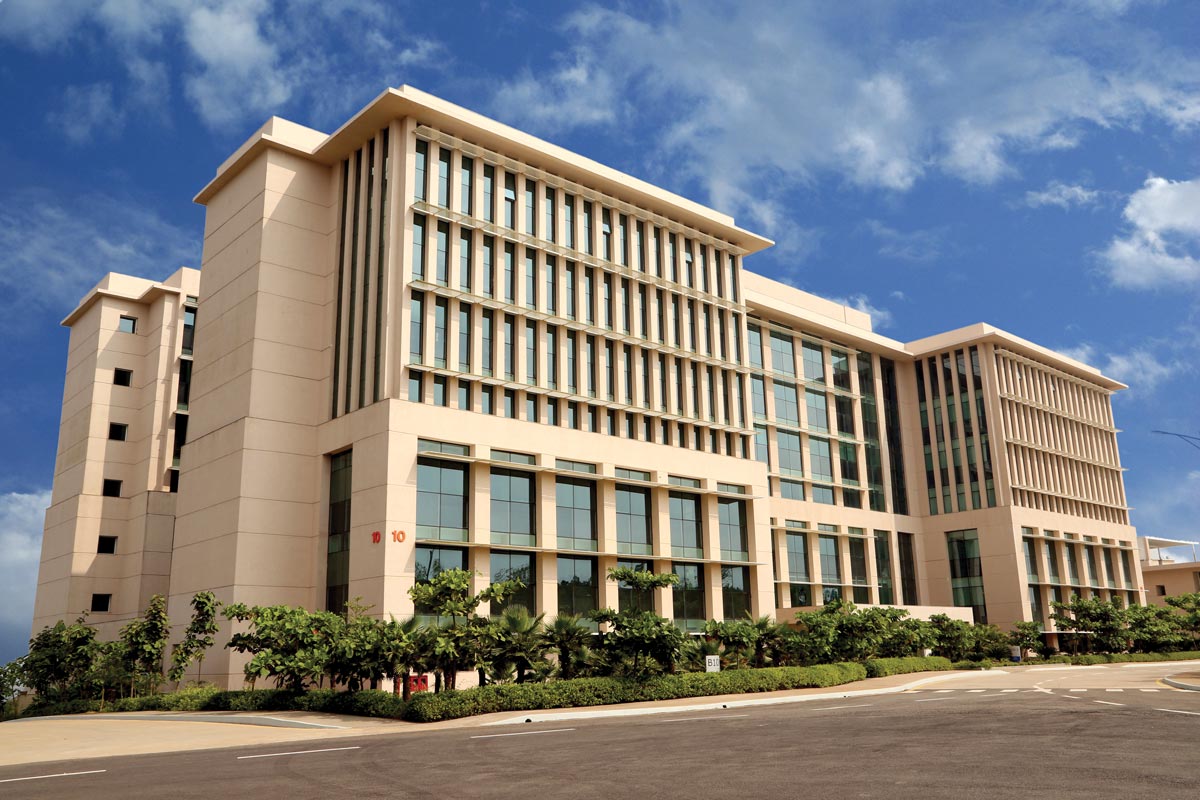
Synonymous to brand ‘India’, Infosys has found itself time and again in some of the most prestigious lists worldwide — it has been touted the second most respected company in India and is among Forbes’ list of top 100 best digital companies globally to work for, to name a few. An institution in itself, Infosys has strived for excellence throughout its almost four-decade-long journey. And this goes beyond its mere business functions.
During the recently held Smart Office Summit, Punit Desai, Regional Head of Infrastructure for Infosys, gave Commercial Design a peek into the ‘behind the scenes’ operations of the company. He spoke about the strategies and measures adopted by his team, whose responsibilities include design and construction management for the organization’s buildings and campus. In addition, Desai highlighted how the team directed several arduous projects to uphold the company’s ambition of building carbon-neutral and net-zero buildings in future. In this interview, he delves further into every stage of Infosys’ journey to achieve this goal.
Laying the foundation
Seeing that India’s office sector is evolving at a rapid pace, it’s not uncommon that office buildings and campuses are growing bigger and larger to accommodate the increase in the scale of operations and their subsequent complexities. Given this, Desai shares how the management and operations of large- and ultra-large campuses have been sustained guided by their five-point strategy.
Almost a decade ago, Infosys had taken up a goal to become carbon neutral, to have no negative impact on the environment on account of conducting their business. “The aim was to become one of few IT companies worldwide to offer carbon-free services to clients. This means that when we associate with any organization across the globe, we add no carbon footprint to their business on account of their association with us,” affirms Desai.
He goes on to explain that the five-point strategy is a framework devised to act as a guide in achieving this goal. It efficiently manages energy, water, waste and the overall carbon footprint of the organization. “If you look at the carbon footprint of most organizations in India,” says Desai, “A substantial portion of it is attributed to their primary dependency on electricity and the scale of consumption. So, to reduce our footprint, we realized we had to cut down on our need for electricity.”
Infosys decided to reduce their need for energy by reducing the per capita consumption by 50% and then harness the required optimal electricity only from green power sources. The company also realized that, due to the sheer nature of the business, which required deploying large number of people, they were high on water consumption. A comprehensive solution was chosen to bring down per employee water consumption by 40% and, in addition to this, it was also decided that zero wastage from the buildings would be transferred to landfills.
“Apart from energy use, good portion of the carbon footprint is attributed to employee commute and business travel. We have put measures in place to enable employees to use alternate and effective means of collaboration in place of travel. However, travel can be optimized but not avoided completely. To compensate for carbon footprint from this aspect of our work, we have been pursing number of carbon offset projects too,” elucidates Desai.
The organization addressed these aggressive goals at a steadfast pace with the help of a team made up of in-house experts for various verticals such as air conditioning, human-centric lightning, electrical systems, indoor air quality, landscape, architecture, water and waste management, and so on.
THE FIVE-POINT STRATEGY
1. Integrated and goal-oriented design approachThe first of the five-point strategy adopted by Infosys, Desai says, is to manage large-scale operations through smart office principles. “Design plays a vital role in steering the operations and functions of any company. At Infosys, we have an integrated and goal-oriented design approach. Often, experts within a single organization choose to work in silos in their respective field or domain. That is something that, we knew, had to change,” asserts Desai, illustrating this point with the following example.
When it comes to designing lighting for a new building, for instance, the team works with a set goal of ensuring that at least 70-75% of the building is daylit without glare. To achieve this goal, the architects and lighting engineers work as one unit to design the building footprint and facade. This design element determines the amount of light that enters the building, the glare factor, how the building interiors react to light during the day, and the optimal lighting level required for spaces within. Thus, despite the fact that the task is essentially lighting, a team of multidisciplinary experts, including lighting engineers, consultants, architects, facade specialists, etc., unite to achieve this goal.
“Similarly, while designing HVAC systems, it’s vital to recognize that lighting also plays a big role in reducing air-conditioning loads — as does a facade with features such as efficient window-wall ratio, wall and roof insulation, glazing, ventilation, etc, that have ramifications on interior cooling. Therefore, it’s not just the HVAC consultant but also experts from other related domains that need to come together to set an efficient system in place,” explains Desai. This integrated, goal-oriented approach has proven its capability for Infosys to such an extent that it has become a philosophy that’s is strategically referenced for all new buildings. It has led to low energy consumption levels as well as effective operations that have subsequently supported the facility’s management throughout its lifespan.
2. Installing, commissioning and re-commissioning
The second part to the strategy adopted by Infosys focuses on an aspect that is often ignored. “Having built more than 15 million square feet in the last decade alone, we’ve noticed that this aspect of building construction is taken for granted or not considered important enough to invest time in,” says Desai. One reason for this is that, owing to the structure of most contracts, the service of installation and commissioning is not given enough importance. However, Desai emphasizes it as a critical step that verifies if the design intent is met and if it is up to the mark.
For example, if a building is specifically designed to be 70% daylit, not exceeding 1000 lux, then, it is at this stage that this intent gets verified. All design goals relating to thermal comfort, visual comfort, air quality, energy efficiency, plug loads, UPS efficiency, etc, are tested during this phase. Desai reiterates the fact that, if followed, this step makes operations relatively simple for facility managers and, if not, then their jobs become equally difficult.
When constructing a building that typically has a lifespan of 80-100 years, architects and design engineers are associated with it only for the first two to three years i.e. the design, construction and commissioning stage, while the operations team manages the structure for the rest of the building’s life cycle. In cases where this phase is skipped, the systems installed may deviate from the design intent and fail to deliver expected performance, and this is when re-commissioning comes into play. It is imperative that regular checks are conducted to ensure each system’s performance.
3. Automation
Large-scale operations are best managed by using data and deploying automation to drive a building’s efficiency, and Infosys invests heavily in collating and analyzing its data. At any given time, across a 3,00,00sqft building, the company records data from almost 1,500 data points every 10 seconds. “Not all of the 1,500 sensor points may not always share critical data; however, they do help identify problems or crises that eventually help diagnose the situation. Of these, 200-300 points provide crucial parameters and give us realistic information about the building’s health,” states Desai, adding that the deployment of smart building technologies has proven invaluable to the company’s operations.
He adds, “We collect 1.5 times more data than the rest of the industry because we see value in this data, as it enables us to manage everything in real time. The entire building operates on ‘auto-pilot’ — no systems need to be started or stopped manually, everything works on automation. In fact, we control and focus on the indoor experience and environment quality through automation, be it thermal or visual comfort.” Desai states that a team of experts oversee operations and manage using data collected by automated systems. He says, “All of Infosys’ office buildings in India are connected to a common platform, which is constantly monitored by experts with the help and support of on-ground staff, making it an extremely efficient and transparent system.”
4. Retrofitting
While it’s always been easy to fit-out newer structures with the latest smart office systems, it’s not as simple with existing ones. Desai recalls that the company found itself in a similar situation a decade ago. He shares, “In 2009-10, we began to look at our existing infrastructure of 25 million square feet, which was not built on today’s principles. Back then, retrofitting had come to our rescue. Since we were also building new infrastructure at that time, we learned about new solutions, designing techniques and technologies. So, we used that knowledge to fix and upgrade our existing buildings. The retrofitting operations led to major improvements and enhancements in chiller plants, lighting, UPS and electrical systems, heat pumps, cool roofing, etc.”
The task is anything but easy, Desai confesses, stating that he hadn’t at first believed that complete automation could be achieved for an older structure. “Our first project was especially challenging — it took nine months for the first 500, 000 square feet of retrofits. We learned from that experience and we realized that anything that isn’t functioning right or performing up to the mark in existing buildings can be fixed. Such investments in older infrastructure can significantly improve business. It has provided us with returns on investments within 18 months to five years, and we have actually reduced the connected kilowatt across Infosys by 33 MW, which is over and above the savings we made.
5. Sustaining ultra efficient operations
After an infrastructure is built with all the measures and best practices in place – from building it with integrated-design approach to having it installed and commissioned with right processes, systems and smart automated technologies – it then comes down to sustaining its performance. Especially for this, Infosys has set up a remote management center with experts who constantly monitor the buildings and its systems. They analyze if it’s functioning at par with the required standards – this includes thermal comfort within the building, it’s visual comfort, indoor air quality, energy and water consumption patterns, operations of critical assets such as data centers, server rooms, etc. Any abnormal functioning or alerts are looked into and checked immediately. Monitoring operations, analyzing data and taking necessary measures at required stages, is what enables teams to effectively manage large operations, confirms Desai.
The bottom line
The strategic deployment of these measures has helped Infosys as an entity to achieve enviable results. The company surpassed its aim to reduce employee energy consumption by 50% — it reported an achievement of 55% reduction in 2019. It has also reduced per employee water consumption by 59%, which amounts to consumption of approximately 45 liters per person per day.
When Desai’s team began work on the five-point strategy, the company’s statistics pointed out that their per capita electricity consumption was 297 units per person per month on a campus level. This was successfully lowered to 134 uptill March 2019. Infosys now aims to still lower this figure to 100, in the future.
It is mindboggling that, in the last 11 years, the company has managed to lower its carbon footprint while growing in numbers. From 2008 to 2019, the company’s employee strength went up by 158%, while its net energy bill increased by a mere 16%. Infosys invests in both, old infrastructure and buildings new, ensuring that its every building or campus is guided by the principles of integrated design approach and green building standards.
Infosys’ plans for the future are ambitious, Desai reveals: “We believe we can further reduce water consumption levels from 45 to 30 liter per person per day at campus level, which means the office building will only be at about 15 liters per person, per day. We are confident about this possibility only because of data from some of our new infrastructure.” And what is the company’s next big goal? “We want to achieve and sustain all of the above stated goals and we want all our buildings to conform to and be certified as per USGBC LEED Platinum standards, so that we have affirmation and verification by a third-party entity,” Desai concludes.