



The Mumbai chapter of the Buildings of the Future conference had a selection of industry leaders’ debate about the critical role the sector plays in the commercial real estate industry as developers, owners, operators, consultants, and technology solution providers.
Setting the tone for the conference, Rimi Chatterjee, DGM, Smart Building Technology Solutions, Real Estate Segment, Schneider Electric, stated, “At Schneider Electric, we continue to contribute and are often responsible for the impact our buildings have on people and the planet.

The commercial real estate in India sits at a crossroads today between high finances, the quest for productivity, and the need to cope with the constant changes in government regulations. And sustainability is a factor that resonates with each of these aspects. Buildings consume 40% of the total energy consumption, which means the way buildings are designed, built, operated, and maintained is constantly under scrutiny, which also means that there is a call for change. We need to harness the power of digitisation and IoT, by including machine learning technologies and artificial intelligence, to give real-time data and help operators and owners with critical insights that will help them increase productivity as well as reduce operating costs.”
Reshaping the real estate in India
| Panel speakers: Reshaping Real Estate in India – Towards Net Zero Buildings |
| Tikam Jain, CEO – Pune, Lodha Group |
| Raman Sapru, Director – Design & Engineering, K Raheja |
| Balaji Sankaran, Vice President, Prestige Group |
| Rajiv Batura, Senior Vice President, Runwal Group |
| Bhupesh Arora, Business Head Digital Energy, Schneider Electric |
| Moderated by Bibhor Srivastava, MD, ITP India |
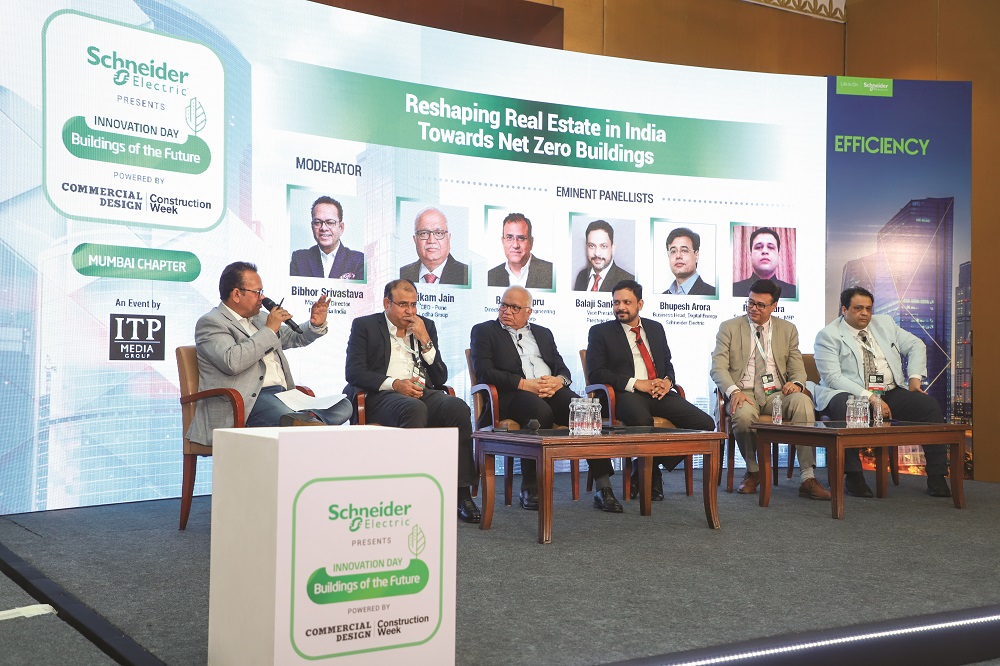
As net-zero buildings are becoming the need of the hour, the first panel discussion of the conference was aptly conceptualised and titled ‘Reshaping Real Estate in India:Towards Net Zero Buildings’. Speaking on new trends in sustainability, Tikam Jain, Chief Executive Officer – Pune, Lodha Group, said, “There is a vast difference in building design over the last 15 years and technology is driving the space. Light sensors, waterless urinals and other smart building applications that use the highest level of Automation are now being integrated with the buildings. It needs to be a continuous improvement process, where we consistently review our data and try to improve efficiencies.”
Shedding light on the process, Raman Sapru, Director – Design and Engineering, K Raheja Corp, explained, “The construction industry uses a lot of energy, and net-zero buildings are all about giving back to nature. We need instruments to measure how much water and energy buildings consume, collect data, and analyse them in a command control centre using artificial intelligence and apply it to the context.”
Sustainability is going to have a very positive impact on assets and is a very efficacious tool to fight the prevalent global warming issues. Balaji Sankaran, Vice President – Services, Prestige Group, said, “We make sure our client’s aspirations are met, and for our new upcoming commercial towers in Mumbai, we are targeting the highest possible level of decarbonisation. This means we shall be saving up to 20% to 30% energy and 50 to 70% water by using sustainability techniques. Environmental sustainability and economic sustainability go hand in hand. With these green measures, we can see benefits and RoI in just four to five years, adding immense value to our assets.”
The targets set at the 2050 Net Zero Coalition as part of the Paris Agreement also apply to the realty sector. Sharing some insights on the same, Rajiv Batura, Senior Vice President – MEP, Runwal Group, noted, “Of the 600 bn sq. ft in a commercial space, around 350 mn sq. ft needs to be retrofitted, and the projected budget is estimated to be aprroximately INR 2500 crores. We, hence, must go from ‘part’ to the ‘whole’ approach. We have laid down our roadmap and believe that anything which can be monitored, can be managed. Data acquisition is of prime importance, and we do technology transfers to reduce the connected loads to the building electrically. We also believe in recommissioning the building and continuously checking our performance against the set benchmark.”
The conversation today has moved from green buildings to sustainable buildings. Continuing its drive, Schneider has also launched the Green Yoda, a sustainability initiative that aims to build a community of conscious citizens, businesses, and institutions to unite for a collective action towards the adoption of practices in energy efficiency, renewables and solar, Automation, Digitalisation, and a new world of electricity to meet both individual and corporate sustainability goals. Bhupesh Arora, Business Head, Digital Energy, Schneider Electric India, further adds that, “As the industry is moving away from fossil fuel-based technology, we help our partners digitise their buildings to achieve efficiencies and decarbonisation goals. We have already piloted our first microgrid site with Tata Power Delhi in a school building.”
India’s Warehousing Sector – How it has evolved
| Panel speakers: India’s Warehousing Sector – How it has evolved |
| RK Narayan, President – Strategy & Business, Horizon Industrial Parks |
| Makrand Dixit, Chief Technical Officer (CTO), Welspun One Logistics Parks |
| Bhavesh Mehta, Core Committee Member, IGBC Mumbai Chapter |
| Pinkesh Teckwani, National Director ‑ Industrial & Logistics,Knight Frank (India) |
| Sweta Sharma, Head – Building Segment, Greater India Region, Schneider Electric |
| Moderated by Prajakta Karnik, Editor, Logistics & SCM India |

With the booming manufacturing and e-commerce economy, logistics and warehousing are two of the fastest-growing segments in India today. It has witnessed exponential growth, was valued at around 1 trillion rupees in 2020 and is growing at a CAGR of 15% until 2025. Makrand Dixit, Chief Technical Officer, Welspun One Logistics Parks, mentioned, “Digitalisation is the new way of life. India has 26000 pin codes connected from a logistics perspective, and this has only been made possible through data and digital access to everyone. We have 400 million online users across the country today, and to cater to such a large demography, warehouse management with robotics and AI is immensely helpful.”
The booming e-commerce sector is also reducing delivery times. R K Narayan, President – Strategy & Business Development, Horizon Industrial Parks, observed that “For the institutional investors globally, in general, the most sought-after asset is the last mile, within the urban limits. This is more of a challenge from the supply chain management perspective from order fulfilment, tracking, route optimisation and quick turnaround of the inventory. The physical side, which is space, is also a bottleneck, but that is still evolving.”
Pinkesh Teckwani, National Director- Industrial & Logistics, Knight Frank India, added, “Today’s consumer does not have patience, and the competition between the big boys in ecommerce is all about how fast you can deliver. In terms of real estate, this means you need storage spaces within the city, and the challenge is the availability of space, as land is very expensive here.”
Storage facilities have evolved over time and are now capable of handling multiple processes within the premises, such as sorting, packaging, billing, dispatching, etc.
This makes it a process-intensive unit that needs Automation to increase its operational efficiencies. Sweta Sharma, Head – Building Segments, Greater India Region, Schneider Electric, stated, “Many facilities are involved when there is a need to get a package delivered. This involves a lot of data exchange and communication between these facilities that needs a proper integrated system. None of the digital technologies should work in silos, and all technologies should talk to each other. What we bring onto the table is a communicable technology which is interoperable and capable of talking to each other.”
Sustainable warehouses can satisfy the stakeholders, improve the bottom line and even achieve net-zero targets. In his concluding remark, Bhavesh Mehta, Core Committee Member, IGBC Mumbai Chapter, pointed out that, “Automation between the warehouse facilities and the last-mile delivery must go hand in hand. The National logistics policy has been an enabler for the sector’s growth, and the supply chain cost in India is about 14 to 15% of the GDP, with a target to reduce this by 4%. Warehousing storage space is just the tip of the iceberg, and there is a huge opportunity in India, given its high consumption pattern. The initiatives taken by the government, like multimodal logistics, will help improve efficiency. Hence digitisation is the driver to become more sustainable and help the sector become more efficient.”