


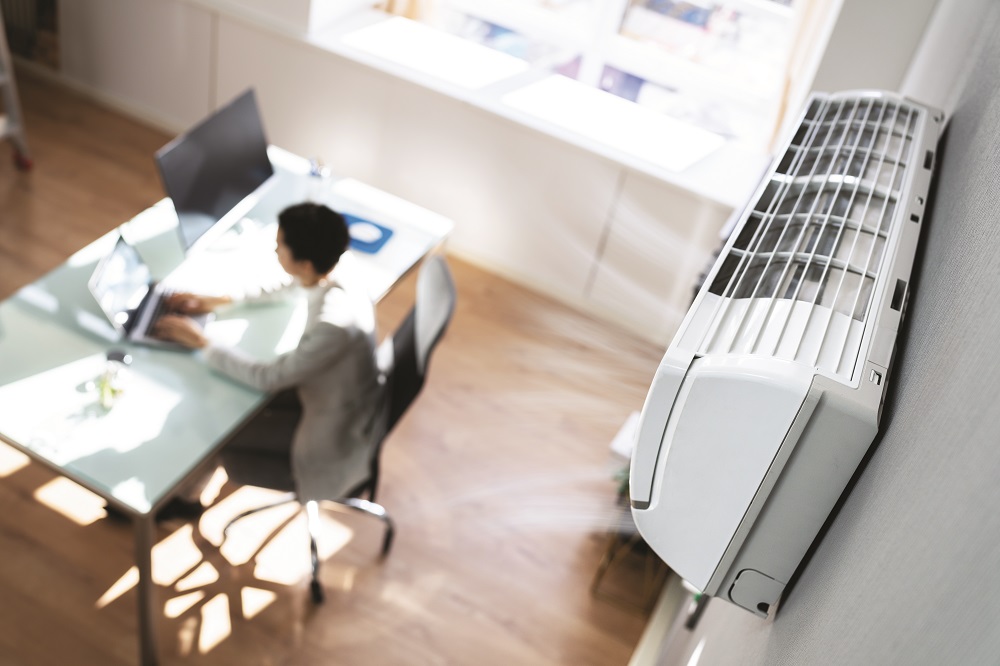
In a survey of employees an overwhelming majority of respondents (90%) agreed that the quality of the air they breathe has a direct impact on their health and well-being, according to a report released by Honeywell. Honeywell’s third annual Healthy Buildings Survey recently queried 2,500 office workers in buildings with 500-plus workers in Germany, India, the Middle East, the United Kingdom and the United States.
For the first time this year, the survey posed questions to gauge office workers’ beliefs and attitudes about their building’s environmental impact. Given a choice of having their employer prioritize either improving IAQ or reducing their building’s carbon footprint, nearly half (44%) of respondents say their organization should be able to accomplish both objectives. These findings suggest that employees’ concerns for the environment is increasing along with their belief that office IAQ affects their well-being and productivity.
Notably, 80% of those surveyed say good indoor air quality (IAQ) contributes positively to their productivity, more than the global response rate of 68%. The workers surveyed also voiced more trust than respondents in the other regions that their employer or facility manager has taken the necessary steps to provide safe IAQ, with nearly nine in 10 (88%) agreeing. The percentage of Middle East respondents who ‘strongly agree’ with this sentiment (58%) jumped by a surprising 17% from last year’s results. Ultimately, employees put the onus on employers and building managers to maintain IAQ.
Respondents from different countries aligned with in their willingness to give up job perks or benefits if it meant the funds would be reinvested to reduce the environmental impact of their building. A surprising 35% of respondents would sacrifice part of their salary or bonus, while nearly all of those surveyed (95%) would give up at least one job perk or benefit, including:
- Food perks like coffee, tea or snacks (45%)
- Building amenities such as a fitness center or lounge (41%)
- State-of-the-art technology for their day-to-day work (40%)

Among the five surveyed regions, respondents in the Middle East and India tied for the lead in wanting to be kept informed about their office building’s current IAQ, with nearly nine in 10 (89%) wanting frequent or at least occasional updates. Those surveyed also led the field (63%) in claiming they would speak with their leadership if the latter did not put measures in place to maintain a healthy indoor environment.
“These findings suggest that surveyed office workers view safe air quality as a top priority and trust that their employer or building manager has taken the steps to provide it in the workplace,” said Phil Daniell, vice president and general manager, Honeywell Building Technologies, Middle East, Turkey and Africa. “The awareness of surveyed workers reflects the investments in the region to create healthier and more sustainable buildings to help meet respective development goals. This can continue to help guide employers and building managers stay ahead of the curve when it comes to improving occupant experience and a building’s carbon footprint.”
The 2023 Healthy Buildings survey results reveal changes in respondents’ awareness and concerns about both the planet’s health and their own well-being. Nearly half of those surveyed (45%) across all markets report that their expectations for better IAQ in the workplace have risen significantly over the last three years. At the same time, almost three-fourths of respondents (73%) consider it urgent that their employer or facility manager take steps to reduce carbon emissions.
Taken in their entirety, the 2023 results convey three overarching themes:
- Employees want and expect a healthier work environment. Employers should take note of this and act on it, not only to prevent their people from looking elsewhere for work but also because a compelling majority of respondents (68%) feel that good IAQ makes them more productive and 49% report that it makes them more effective as problem solvers.
- Employees want transparency. One of the actionable takeaways from this survey is that nearly two-thirds of respondents (64%) consider it very to extremely important that their employer or building manager keep them informed of their building’s air quality – yet only 16% say their building’s IAQ is monitored continuously. When investing in IAQ technology, employers and building owners should think about how they might communicate meaningful data to their employees — for example by installing dashboards in the building that display these metrics.
- Modern workers understand that we’re all on this planet together. One of the key takeaways from this year’s results is that office workers have their eye on the “Big Picture” – what they can do to help mitigate climate change. Nearly three in four respondents (73%) consider it very to extremely important that their employer or facility manager take active measures to reduce their building’s carbon footprint. The good news is that modern building management systems along with advanced controls software can both improve IAQ and help reduce carbon emissions.

Honeywell’s ready now Healthy Buildings solutions can help improve occupant well-being, meet energy efficiency goals and, importantly, change the way occupants experience a building.
Surveyed workers’ concerns about the environmental impact of their workplace may be buoyed by the emphasis organizations are placing on sustainability as detailed in the 1Q 2023 Honeywell Environmental Sustainability Index, a quarterly survey of business leaders directly involved in their organization’s environmental sustainability initiatives measuring key trends pertaining to global efforts in climate change mitigation and other sustainability initiatives. Seventy-one percent of organisations surveyed in the second release of Honeywell Environmental Sustainability Index ranked sustainability as one of their top five priorities (highest percentage) and 63% of surveyed organizations said energy evolution and efficiency are a top priority. The Index shows organizations are increasingly taking a balanced approach to environmental solutions, embracing more technological solutions alongside process changes.
The Honeywell Survey was conducted by Wakefield Research (www.wakefieldresearch.com) among 2,500 workers in buildings of 500-plus workers across five markets – Germany, India, the Middle East, the United Kingdom and the United States – between January 12 and January 22, 2023, using an email invitation and an online form. The data has been weighted. Results of any sample are subject to sampling variation. The magnitude of the variation is measurable and is affected by the number of interviews and the level of the percentages expressing the results. For the interviews conducted in this particular study, the chances are 95 in 100 that a survey result does not vary, plus or minus, by more than 4.4% points from the result that would be obtained in each market if interviews had been conducted with all persons in the universe represented by the sample.