


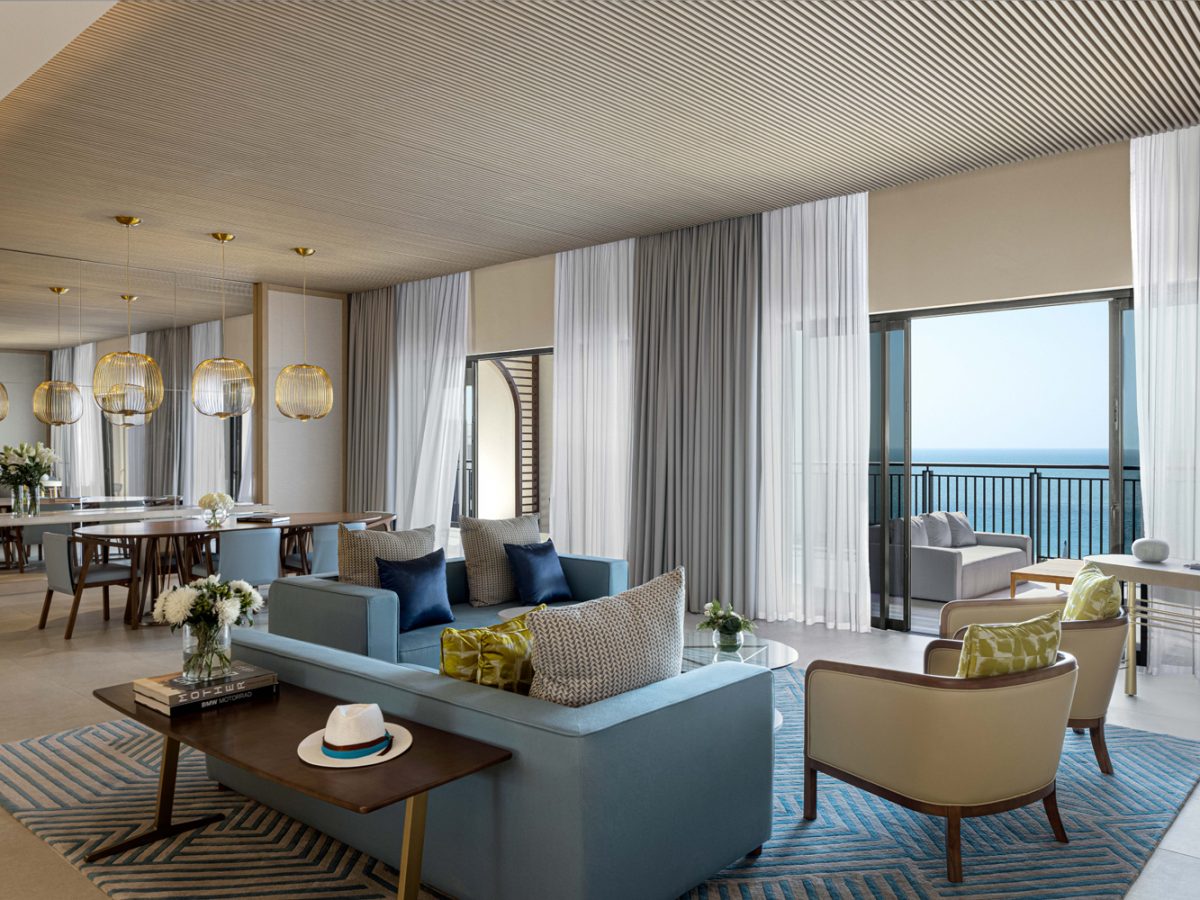
Deeply rooted in local traditions, yet embedded with a vision of modern luxury, the new Jumeirah Gulf of Bahrain Resort and Spa, near Manama, was designed by Lebanese architectural firm, GM Architects.
The property is a representation of the journey taken by pearl traders for millennia, beginning in the heart of the city. Envisioned by GM Architects as a place of cultural exchange and lively interactions, it references Bahrain’s shores, scattered with fishing huts and where life is intertwined with the sea, and finally on to the vast ocean on board a traditional boat or “Banoosh” in search of pearls and new worlds.

The Story
As visitors move through the hotel’s diverse spaces, each tells a part of one whole story. The architects’ main goal was to create a unique place through a holistic approach keeping very close contact with the local culture, all while assuring a relaxing and luxurious environment in line with the high standards of the Jumeirah hotels.
The main lobby is an invitation to enter this journey, with a welcoming glimpse of the sea in the distance, and a spectacular glass lighting installation which hangs above a seating area “Majlis,” which suggests oceanic elements like sea foam, pearls, and a light breeze. Approaching the outer façade, the guests pass by a water mirror that links the inside with the outside nature, as well as large bookshelves carrying objects and books as if gathered from a global explorer. Further into the hotel this vision of pearl traders, intercultural references, and seafarer’s flows naturally with the elegant and contemporary atmosphere.

Inspiration from the city
For the design of the lobby, certain private rooms, the ballrooms and the business centre, GM Architects took direct influence from the surrounding city, creating each space to reflect an inherent part of the local city life, such as the bustling streets, the houses with local architecture and aesthetics influenced by far away Eastern cultures, decorated with lattices and foreign materials.
The light-filled interiors of the ballrooms for instance were inspired by a wind tower, with high ceilings naturally illuminated above and adorned with meticulous geometric carvings.

An immersion inspired by the shore
The journey continues as guests approach the shore where GM Architects utilised materials and traditions found closer to the sea such as seagrass weaving and elements found on boats and afloat the shore. The hotel’s bar is an interpretation of the interior of a boat with wooden ceilings and hanging lamps that resemble ropes and pulleys. In addition, the firm has added details around the hotel that are inspired by the local arts and crafts such as the hanging glass installation that follows you up the stairs, as well as the aesthetic of weaving grass native to the area. The hotel offers a series of island bungalows and an island restaurant and bar inspired by the sea and its naturally occurring compositions and materials. Within the island bungalows, guests are in proximity to the resort’s main asset: The ocean.

Encapsulating the sea element In the design, we see the influence of the sea spread across several spaces including the resort’s bar lounge, Lebanese restaurant and spa. The bar lounge extends onto the water and its wooden columns and ceilings resemble a boat’s mast and sails against the ocean breeze, accompanied by elegant furnishings and a breathtaking ocean view.

For the Lebanese restaurant, the team highlighted the intercultural aspect that is influenced by local fishing traditions with hanging glass lamps that remind us of buoys or tropical fish beneath the surface. The spa itself is the pearl of the resort, with luminous white light and marble interiors, epitomising the epicentre of relaxation and harmony.