


How many lives can architecture have? Have we ever thought of conservation or restoration as an act beyond the material and as a manipulation of architecture and design itself? If a construction is structurally sound, and has an intelligence that might prove useful with time, it takes nothing more than a well devised road-map to rescue it from oblivion and reassemble it to create a space that continues to crafts stories. This also means the transformation of something that already exists into something purposefully intended and consequently appreciated.
Exterior facade of the building.
Now, the existence of architecture and its conservation cannot be reduced to a mere building or a set of drawings, but encompasses the ideas, routine sentiments, legacy and practical constraints of the ones associated with it.
Reception area.
The recently revamped Bharat Bhavan II, housing the headquarters of one of India’s ‘best-performing’ public-sector entities, Bharat Petroleum Corporation Limited (BPCL), by Somaya & Kalappa allows these dissimilar domains to effortlessly coalesce into a single satisfactory stream.
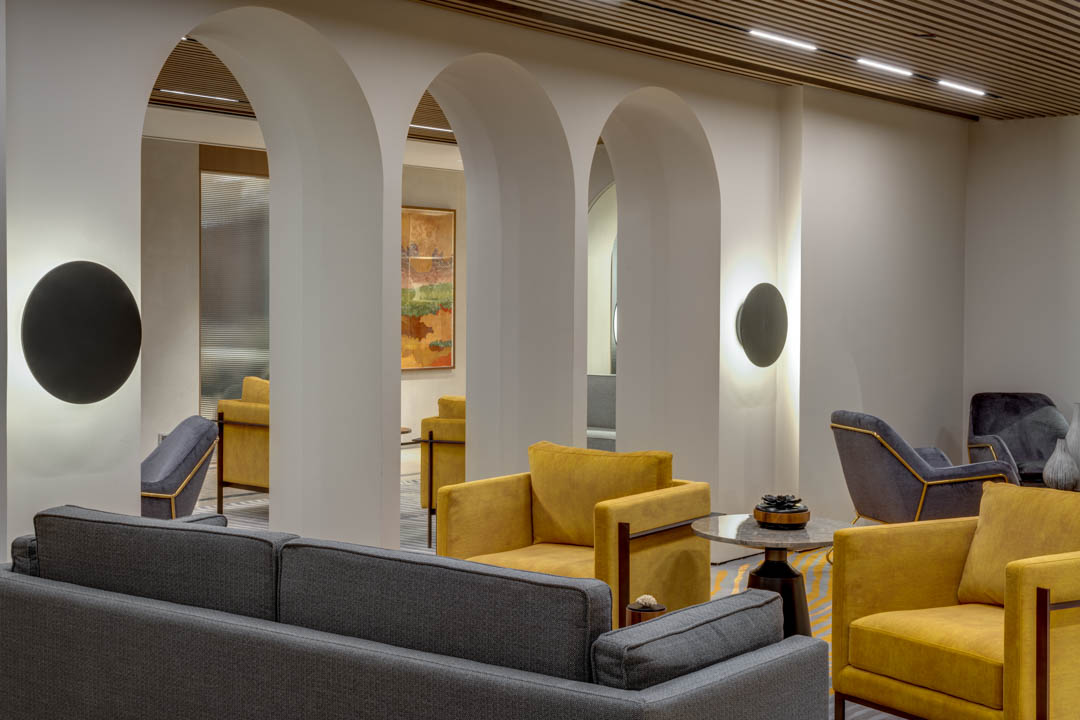
Formal waiting area.
THE CONTEXT – Upholding a legacy
Bharat Bhavan II is a living story of architectural metamorphosis. It is a tale of the gradual transformation of an elegantly designed building, with a blend of Neoclassical and Art Deco style of architecture, nested amidst the historic Ballard Estate in Mumbai, India’s first planned business district.
Its journey began in the early years of 1950s, when the building was originally designed by architect J. A. Ritchie on a plot neighboring the Burmah Shell Company head office at the time.
Brinda Somaya, principal architect, Somaya & Kalappa Consultants (SNK)
On January 24, 1976, a new era dawned, as a 100% public sector enterprise, Bharat Refineries Limited, acquired complete ownership of Burmah Shell’s interests in India, including the largest refinery and a nationwide marketing organisation.
There exists a multilayered historic parable and philosophy behind the design of the structure. While, the ground floor features typical details of banded rustication in the Neoclassical style like other buildings in the precinct, the upper floors feature cladded marble with windows banded vertically in the Art Deco style and accents.Main lobby.
Bharat Refineries Limited, which was later named as Bharat Petroleum Corporation Limited, went on to be one of the country’s foremost public sector undertakings.
THE PREMISE – Building a narrative for the future
Public sector companies, more often than not, are planned to be strictly functional and cost-effective, with little thought given to the intangible intricacy of crafting an ambience that could encourage an environment of collaboration, productivity, creativity and innovation in its turn.
The ground floor entrance lobby.
However, with BCPL’s understanding of the fact that — like the people we live and work with, the buildings that we inhabit everyday should also form an important part of the narrative of our life and its future — the newly remodeled office evokes this very feeling of continuity in an environment that otherwise constantly confines and isolates.
Fourth floor waiting area.
Bharat Bhavan II was acquired post its completion, by Burma Shell Company of India Ltd in 1950s to accommodate its need for additional office spaces. Until the start of the restoration and repair works in 2019, the building was used by BPCL to house its various departmental offices. The company wanted to undertake the restoration and upgradation of the building’s façade along with its interior renovation.
Nandini Sampat, director, Somaya & Kalappa Consultants (SNK)
This building would be BPCL’s global headquarters, serving the requirements and catering to needs of its higher management and the various profiles of visitors from around the world. Hence, they wanted to upgrade the interiors of the building to reflect their corporate narrative with state-of-the-art facilities.
Meeting room.
The main objectives of the design are fairly apparent in the resultant creation. They are significantly governed by the constraints of the existent architecture and the shifting aspirations of the inhabitants. The building is now designated to executive managements including the chairman, directors, executive teams and support staff. The requirement of an Experience Center with the latest technology was put forth to share with visitors and clients alike, the history, business philosophy and future vision of the company.
Second floor lobby area.
The introduction of a Corporate Digital Center (CDC) that would lay out a strategy for the company’s digital transformation was also a pre-requisite. All the shared facilities were to be equipped with cutting edge technology and systems that reflect the manner of business and strategy of the future. The interiors had to have an understated elegance, while ensuring efficiency in layout and functionality. The design of spaces prescribe a way of life, as they form a sequential experience from one setting to another, a responsibility that cannot be taken lackadaisically.
Chairman’s cabin.
MODUS OPERANDI: A process that manifests discipline, vision and function
The foremost step undertaken by SNK, along with their consultants, was a thorough inspection and investigation of the original built fabric of the project to understand the various layers of additions alterations done to the original fabric over the years. Accordingly, precise steps were then planned to reverse these interventions, to restore the façade to its original characteristic, as it would have been envisaged by the architect, J. A. Ritchie, during its conception.
CDC’s centres column cladded with stretch fabric.
Now, to identify and restore the numerous modifications done to the structure through the period of last 70 years wasn’t an easy task at all. It was as ardently difficult as it was tedious. But, this is where the legacy of SNK shines.
Lift lobby.
The conservation involved improvisation and multiple changes to the initial planned stages, all along the execution process. This was primarily based on the multiple execution challenges and newly discovered data after the building was further investigated at its bare basics. With the mammoth task at hand SNK first identified and understood each of the issues, and accordingly resolved them tactfully with improvised execution techniques.
Waiting area.
Shedding light on the process and its challenges, Homeyar Goiporia, VP – Projects at SNK, explains that “As we could not strip and reclad the marble facade totally, we had to identify cladding stones that had cracked or lost adhesion to the external surface and worked out a methodology of refixing the existing and the new marble cladding.
Homeyar Goiporia, VP – Projects at SNK
Specialty chemical adhesive grouts were used along with mechanical fasteners to anchor the marble cladding to the external face of the building. Additionally, wherever the marble was to be replaced, selection of the new marble was carried out very carefully to ensure this matched the existing one which had weathered over time. The ground floor of the building which is in Malad stone was cleaned using water jet at a regulated pressure and a ph-neutral cleaner in certain areas. Repainting of the jointing was carried out wherever possible. Further, all windows were replaced with a uniform design during this upgradation.”
Continuing on the same thread and elaborating further on this, Ram Savani, director, Savani Heritage Conservation, said “The facade of the building is unique in its own way — with the basalt stone face at the ground floor level and marble cladding on the facade above the ground floor. This marble facade cladding was in a vulnerable state as its backing mortar had come loose.
Ram Savani, director, Savani Heritage Conservation
The strengthening of the mortar was done using a specialised chemical of low viscosity and repairs to the architectural fabric was done by implementing the grouting method that ensures the binding and was done using white cement. Such restoration of the externally exposed marble is not a common practice and given it was done under the guidance of the consulting architect, SNK, made it a successful implementation.
In addition to the already existing inventory of structural challenges, the project was also affected by the global COVID-19 pandemic that hit India and the world. “One of the greatest challenges we faced was completing this project during this time. The success of the project is reflective of the incredible effort made by the entire team including but not limited to the client, contractor, project managers, consultants and labour who collaborated with our studio. The challenges were innumerable but working together with dedication and commitment led to the impossible being possible and the building being completed and handed over December 2020,” proudly commends Brinda Somaya, principal architect, SNK.
Rakesh Bhatia, Sr Vice-president, Ecofirst
Consolidation and structural intervention procedures were undertaken for strengthening of the original structural system while trying to maintain the authenticity of the building envelope. Provisions for incorporation of an upgraded and contemporary service and security systems were also completed. A complimenting lighting scheme was also designed to accentuate the features of the heritage building.
The project also warranted the integration of services to ensure efficient maintenance and sustainable methodologies of design were put forth in order to achieve a LEED rating. Elaborating on these strategies, Rakesh Bhatia, Sr Vice-president, Ecofirst, states that “From very beginning the project had set the right benchmarks in terms of energy and water resource optimisation . The project intends to save 35% of actual energy cost as compared to a Base Code Building and 30% of water savings has been targeted. It will soon be certified under LEED Commercial Interiors USGBC. The use of materials with recycled content including a lot of art work has been promoted throughout the interior landscape. It’s indeed a great pleasure to have latest sustainability benchmarks merged with the old world charm in this heritage project.”
Given the age of the building, there were several aspects that now needed to be accounted for that weren’t implemented earlier. Sharatchandra Rao, director, Engineering Creations Public Health Consultancy, expounds on how the MEP systems were systematically integrated with the structure: “The building was not fire compliant, as the fire regulations which are in place now were not even existent when the building was constructed.
Sharatchandra Rao, director, Engineering Creations Public Health Consultancy
To address the fire safety procedures, it was critical to construct a water storage tank with a capacity of 1.0 lakh litres in FRP; this itself was a major challenge. Separate shafts were introduced for all services, while rising mains (bus duct) were installed for vertical electrical connectivity. All services were designed to comply with green building norms. This called for implementing measures such as installation of low-flow water fixtures and faucets, electrical energy monitors, energy efficient VRF air conditioning system with VAV boxes were used for customised and controlled air flow. Toilet exhaust is passed through air-to-air type heat exchanger, to reduce temperature of fresh air intake, thus recovering energy. Simultaneously, there’s also a system to monitor and control fresh air with the help of CO2 sensors.”
Executive waiting area.
The concept for the interior design is inspired from BPCL’s logo itself. The logo is a confluence of two elements namely, Yin and Yang and the golden drops of oil, which is inferred from Bharat Petroleum’s logo. However, the genesis of the unique symbol reminds us of the dynamic interplay of two polar forces. This idea of balancing the opposite forces is what is represented metaphorically.
The concept makes its manifestation through design elements, accent colours and artworks, across all the floors. The colour scheme is kept neutral with the accent colour palette taken from ‘Mother Earth’. Each floor has one or two accent colours that re-enforces the idea of balance but also creates a soothing and subtle ambience.
Metaphoric representation of the company’s identity like refinery, geology, fluidity, circle and green initiatives are introduced through textures and art forms. The design of spaces prescribes a way of life, as they form a sequential experience from one setting to another, a responsibility that cannot be taken lackadaisically.
Gayatri Singh, gallerist and art curator, Art Incept
The idea of sustainability, which plays a key role in company’s philosophy, is brought in by sustainable artworks, custom curated and made by Indian artists and craftsmen. Giving us a glimpse into the process, Gayatri Singh, gallerist and art curator, Art Incept, states, “The project required 150 artworks in varied sizes and mediums over a short period of time. While some were straight forward canvases or even prints, many were wall sculptures, paperwork with textures and layered pieces. Project management, a good team of artists and tight curation was the key here.”
She adds that “SNK provided an excellent brief, which also helped clearly define the company’s business and the overall theme for the space. Our curators worked closely with the design team to develop ideas for each of the spaces.”
As the project was in execution stage the COVID-19 pandemic had a massive impact on the work on site which subsequently impacted the timeline. Some of the factors that influenced work at site were delivery of material, limited dependency on foreign market, the monsoon rain, supply of skilled labour and close down of transportation system due to lockdown. “To ensure we were able to deliver, we utilised a majority of Indian products thereby supporting local, regional and national businesses.
During the pandemic work, continued to be coordinated and curated with a variety of Indian artists and craftsman who needed this support particularly during this challenging time. To be able to keep these artists and craftsmen engaged with work was important to us all and a service required us to ensure that this immensely valuable people of our nation were supported during this time. Due to the outstanding commitment of the client, our team, sub consultants and the contractors, the project was successfully completed during these difficult times,” proudly avers Nandini Sampat Somaya, director, SNK.
The design of the BPCL office stands to represent different forms of preservation – of both, meaning and memory. The design arranges these principles into a new language articulating a process wherein art becomes architecture. The artistry, subtle though it may be, is resonant across the space and in turn evokes more. In refutation of the soulless glass box, which has proliferated through much of the city, the BPCL office makes a deliberate attempt to visually illustrate its design considerations.