


With a career spanning over 25 years, Anurag Mathur’s journey in real estate incidentally began as an architect. Presently, the CEO of Savills India, he has been associated with some of the most trusted names in the industry and has been a first-hand witness to the growth and progress of the sector since the 90’s, along with each of its downturns.
Operating within an industry, where the needs and demands are evolving at a brisk pace, is no easy task. Mathur elaborates on how the company facilitates the creation of high quality workspaces and delves into the fundamentals that can make offices an agent of change.
- What are the strategies adopted by Savills to streamline its project delivery processes?
The onset of the pandemic has accelerated changes that have been predicted for the near future. Perhaps for the first time, what research often predicts over several work generations has been observed in a single work generation. This is more than enough justification for our team to stay current on industry trends and thought leaders’ viewpoints, adjusting and meeting clients’ needs.
In addition to the regular offerings of our services, we understood client requirements and developed customised service offerings for workplace transformation and return to office (RTO) strategies post-pandemic.
Based on these, we have been able to offer ongoing support to both our current and potential clients, focusing on some of the key drivers that have helped shape the new workplace like:
• Organisation culture
• Employee well-being
• Flexibility/Adaptability
• Innovation/technology
• Collaboration

- What strategies has Savills adopted to reconcile with the constantly upgrading technology-induced design changes?
With the shift in the way businesses have been operating over the past couple of years, delivering a comfortable experience has become increasingly essential as clients in our business transition to a digital presence. As a result, teams are gradually able to accomplish spontaneity and socially connect with clients remotely and physical meetings are steadily being replaced with digital collaboration tools.
- How is ESG integrated within the company’s framework?
We have created an environment-friendly workplace for several of our global enterprises for whom we managed build-outs of new offices in major Indian cities while simultaneously achieving financial benefits by incorporating sustainability in design.
Meeting international standards like LEED or WELL, which have a lot in common and don’t usually or necessarily require invasive and expensive renovations, is one of the simplest methods to strike a balance between sustainability and well-being. For instance, LEED would provide points for making a staircase accessible and well-lit to reduce the use of elevators and conserve energy. Similarly, WELL would award points for encouraging physical activity using a staircase. Both LEED and WELL are now considered the industry standard for sustainability and wellness in commercial real estate and look to promote the quality of internal atmosphere that successfully supports the wise use of natural resources while enhancing users’ mental and physical well-being.
The process typically begins with performing a gap assessment to ensure that the projects satisfy sustainability prerequisites and minimum certification requirements. These projects consciously adopted sustainable practices and ensured optimum lighting, controls, water-efficient fixtures and demand-controlled ventilation, among other initiatives.
A demonstration of Savills’ walking the walk’ and not just talking about sustainability is our recently revamped Singapore office, where several commendable initiatives were taken:
• Circular recycling, old desktops reused as new desktops
• Old built-in joinery, reworked into new joinery, e.g., lockers
• 83% recovered of the 15 Tons of FF&E, Savills managed to recover more than 83% of all materials
• Circular re-use economy created 425 person-hours of local employment in Singapore
• 2,900 KG CO2 recovered, estimated embodied CO2Te not accounting for stored carbon
• 3,250 trees planted; 130 trees are required to offset the 650 KG CO2 absorption of 3,250 trees after ten years – 65 Tons of CO2/year.
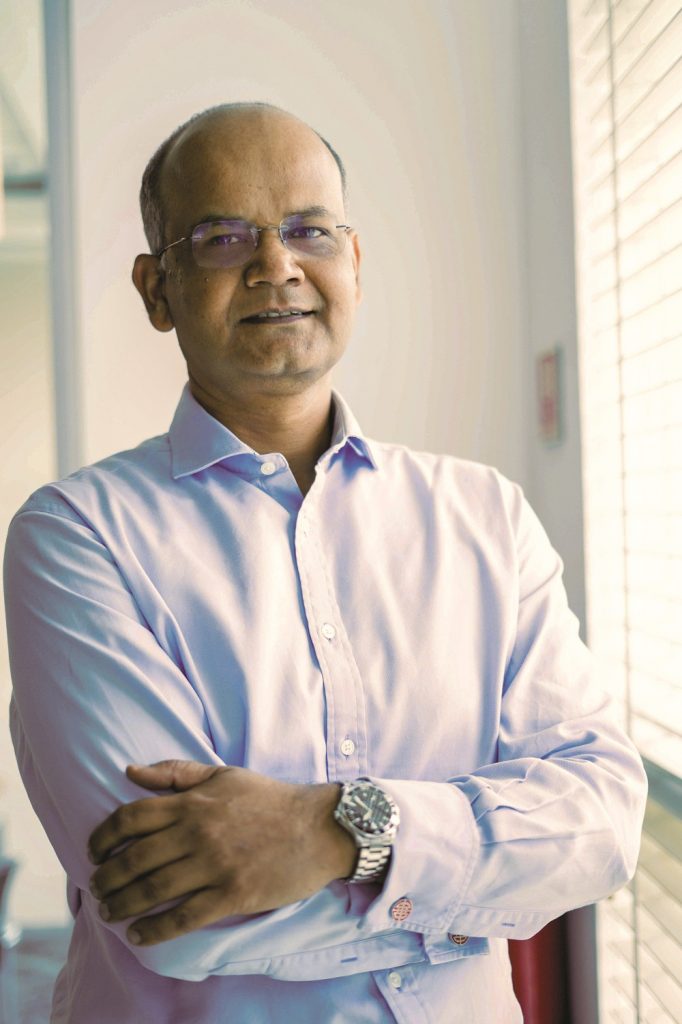
“Meeting international standards like LEED or WELL, which have a lot in common and don’t usually or necessarily require invasive and expensive renovations, is one of the simplest methods to strike a balance between sustainability and well-being.”
Anurag Mathur, CEO, Savills India.
- How is Savills embracing technological interventions?
Corporate real estate, a traditionally on-site and in-person industry, is embracing virtual collaboration and project management tools. While the essential tasks of construction cannot yet be performed remotely, the industry has accepted technological interventions in project management and execution. Savills has a few technologies in place to manage project sites, including remote site monitoring, virtual site reporting tools, digital twinning of buildings & spaces, and virtual reality (VR) for concept design visualisation.
We realise that IoT can revolutionise facilities’ operations by allowing for more efficient use of resources and an increase in productivity. This includes reducing prices on energy costs, optimising workplace capacity and utilisation, providing faster resolutions for service requests, and improving the occupant experience. IoT has introduced unprecedented efficiencies for facility management. A central strategy incorporating sensors, devices, platforms, applications, and analytics reduces errors while building operations run more smoothly. By leveraging a wide range of connected devices and sensors, a facilities manager can have complete visibility over the building’s systems and operations at all times.

- What are some of the most pivotal design shifts taking place in the industry?
The pandemic has given businesses a fantastic chance to modernise their workspaces into places that feel safe and keep the employee experience at the forefront to recruit, retain talent and be resilient in an evolving market. This means creating spaces that feel safer than home and those that are worth the trip to the office. While sustainability has been a part of boardroom conversations for a long time, it has only recently been propelled into the limelight. These two trends have met at the height of the pandemic.
However, sustainability and well-being are not just aspects of a single project. Clients are looking at a mix of owned and flex spaces in the more extensive real estate portfolio. By minimising the travel time and distances that their employees must endure, they can reduce their carbon footprint. This also has the added benefit of a company expanding its presence throughout tier 2 cities and suburbs.
Companies have been able to reduce their physical footprint by subletting key essential services, such as data centres. The ability to work from anywhere is supported by cloud-based services, which help businesses retain and attract talent.
Reducing core/ owned space also allows for increased investment in smaller spaces. Sustainable practices are regarded as being very expensive, and once businesses have reduced their physical footprint, they can consider directing more capital expenditures to improve the workspace and employee experience. A shift in organisational mindset and an accelerated digital transformation have also removed the reliance on physical presence. This indicates that the necessity for actual travel is being diminished as workplaces and workspaces are outfitted with increasingly intelligent virtual collaboration technologies. This not only lessens the carbon footprint but also enables staff to work in a comfortable, familiar environment.
- What are some of the principles that define Savills’ own office spaces?
Our own office workplace design supports more collaboration, brainstorming sessions, and team-building programs. This helps satisfy the social needs of employees as well as meet business requirements when they come to the office. The employee experience is a very crucial actor in designing our offices. We consider the social engagement elements while designing the space as well as drafting HR policies. The aim is to elevate the employee’s overall experience to the next level, from entering the premises to moving to their work desk. Gone are the days when providing a few informal spaces for discussions and meeting rooms were enough. More informal collaborative areas have replaced conventional meeting rooms.

By minimising the travel time and distances that their employees must endure, they can reduce their carbon footprint.”
Anurag Mathur, CEO, Savills India.
- When working on and managing such massive commercial campuses, what are some of the most common challenges?
Flexibility, wellness, practical amenities, and a focus on changing expectations of work are the key to rethinking commercial campuses of massive scale. Here are four insights that are key to understanding the new workplace:
- The role of the workplace and office buildings are evolving: Work and place have become uncoupled, redefining the office as the best place to bring people together — especially for those whose jobs rely on in-person collaboration or specific spaces or shared resources. Physical and virtual experiences must be fully integrated since digital systems will continue to shape a seamless level of connectivity and personalisation.
- Culture, community, and collaboration are at the core of the new work experience: The fundamental role the office is shifting to is as a place that brings people together to collaborate, build personal and professional relationships, and connect with a company’s unique business, mission, and purpose. New behaviours, technology, and policies will be required to allow flexible and virtual work to thrive, while also supporting coaching and mentoring and more equitable and inclusive experiences.
- Pre-pandemic trends are accelerating: Choice, autonomy, health, and well-being have become paramount for individuals and teams to perform at their best. From health checks and touchless security to improved air quality systems, owners and users are focused on healthy buildings and experiences. Outdoor spaces are increasingly becoming part of the workplace environment, with open façades and retrofitted rooftops providing additional work settings.
- Flexibility and adaptability are critical for a hybrid workforce: A new hybrid workforce, working both at the office and remotely, is an opportunity to fix the pre-pandemic issues of the workplace, and to explore new real estate strategies. Office buildings will increasingly get smarter to enable office-to-home connectivity and anticipate evolving tenant needs. New workspace approaches must be more responsive to rapidly adjust to new ways of working, with flexible spaces and furniture for newly emerging work patterns.

- What is the outlook for the commercial real estate market in India for the upcoming years?
Indian real estate has always attracted significant capital from domestic and foreign investors. While this was somewhat affected during the pandemic, we anticipate investor confidence to recover in 2022, creating investment opportunities across the office, residential, and industrial segments, among others. In fact, India is expected to register a slight uptick and clock in approximately USD 3.5 billion – USD 4.0 billion of private equity investment in real estate in 2022. We also anticipate debt deals in residential assets to rise and expect to see the advent of new REITs going forward. For example, Blackstone Group is planning to launch India’s maiden retail REIT, and this should get listed in 2023.
In 2021 and 2022, the industry also saw alternate sectors such as data centres, student housing and life sciences gaining prominence. We expect these segments to grow further and present lucrative opportunities to investors helping them to recalibrate their strategies and diversify their portfolios. Regarding the life sciences sector particularly, we estimate potential investments of about USD 14 billion-USD 27 billion in life sciences R&D real estate over the next ten years.
On the back of strengthening business confidence among occupiers, as evident in robust office leasing in the first half of 2022, we expect the demand momentum to continue through the year and reach pre-pandemic levels of 55-60 million sq. ft. Banking on aggressive hiring plans in the technology and knowledge-based sectors, we foresee 2023 to record new heights in office leasing demand with a commensurate rise in supply. The demand is now more broad-based and not heavily reliant on the IT-BPM industry, with other sectors like flexible workspaces, engineering and manufacturing contributing notably to office leasing demand in India.
After hitting consecutive peaks in 2018 and 2019, leasing by flexible workspace operators took a backseat in 2020 when apprehensions arose with respect to the viability of shared spaces. As the office markets embarked on a period of gradual recovery in 2021, flexible workspace operators with out-of-the-box services and enterprise-level offerings took advantage of dynamic commercial real estate requirements and regained the confidence of occupiers. In the coming days, occupiers are likely to focus more on the conversion of fixed real estate costs into variable costs, which will vary as per organisational requirements. As businesses evolve constantly, shared spaces will continue to provide organisations with a chance to design a highly fluid CRE portfolio as per their business strategies, which in turn will further cement the flexible workspace sector in the country’s office market. We anticipate that the flexible workspace sector will account for around one-fifth of the overall demand in 2022, conveniently crossing the pre-pandemic share of 14% in 2019.