


We live in the age of digitisation, where almost every activity we perform is influenced by technology in some way. Right from ordering food to reading books, technology has seeped into almost every aspect of our lives.
Similarly, technology is also being integrated into the world of commercial interior design. Just like streamlining a plethora of different various business processes, companies can now streamline the design process of their commercial workspaces with the aid of new and improving technologies.

The conventional approach to interior designing of commercial spaces has become redundant in the last few years. It is no longer relevant to obtaining the desired results and which would make the customer journey engaging and inclusive. The fragmented approach of three disjointed aspects of design, product, and delivery experience under one roof often requires businesses to handle different stakeholders separately, ending up in an unorganized mess.
Untethered and unobstructed technology has entered the realm of commercial interior design and changed the game for interior design service providers, as well as businesses who are willing to get their commercial workspaces designed with an increased impetus on technology.
Here are some of the most important ways in which technology has become an important norm in commercial workspace design:
Centralised platforms for all stakeholders
The issue of the fragmented commercial interior design industry is resolved by implementing a centralised digital platform that can provide multiple services to businesses on a unified interface.

For designing commercial interiors, a company must deal with designers, suppliers, furniture articles and furnishings dealers, and many more. Things can get really complicated if you cannot bring everyone on the same page.
To solve this problem, businesses now prefer obtaining holistic interior design services from interior design and build firms that use their own proprietary platforms to design and execute the builds of commercial workspaces. These centralized platforms allow businesses to avail themselves of a range of different services without approaching different entities. Using technology to organize the services offered in the commercial interior design space helps companies save valuable time, effort, and money in giving the right aesthetic appeal to their workspaces.
Experiential platforms
Gone are the days when technologies like virtual reality (VR) and augmented reality (AR) were new and niche. These technologies have found successful mainstream applications in the realm of commercial interior design space.

Businesses are switching to experiential platforms for purchasing articles like furniture and furnishings instead of making on-premise visits. The dealers and designers also prefer setting up virtual stores instead of spending a fortune building physical stores.
Such experiential platforms allow service providers to make their stores travel wherever they go without the need to worry about physical real estate. Here, a store can occupy a vast space for accommodating hundreds of thousands of different designs and articles. While dealing with customers, suitable designs and articles can be displayed as per their needs and preferences at the click of a button.

Commercial interior designers can also provide immersive demos of their designs to their customers without the need for them to visit physical stores. This way, business customers have more options to choose from and see how the designs/articles would look after installation.
Virtual walkthroughs
The application of technologies like VR and AR can also be extended to offer virtual walkthroughs to clients willing to design commercial interiors. These walkthroughs immerse you into the virtual world and help you visualize how your commercial space would look after being designed.

Virtual walkthroughs allow customers to get the look and feel of the surroundings before they are designed in a specific way. If they do not like a particular design or want to make necessary changes to the same, service providers can get the relevant changes made and show the results to the customers at that very moment. This way, the actual design process starts only after the virtual model is completely approved and the overall selection process is expedited with the help of these virtual walkthroughs.
Incorporating sensors in interior designs
While sensors have been a part of interiors for a long time, their prominence has increased lately. Since the pandemic, the use of sensor-based technology has increased while designing commercial interiors.
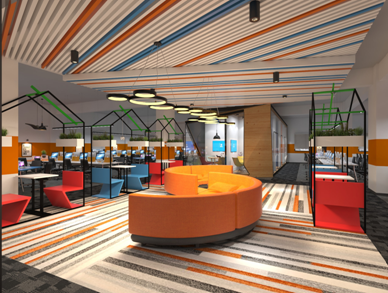
Businesses operating at all scales today are opting for smart design ideas that include innovative uses of sensors. Sensor-based technology has found multiple applications in the commercial interior design space, from lights that turn off when there is no one in the room to automatic coffee machines. It is an ideal addition to the tech-enabled interiors designed for commercial workspaces, especially those built for larger occupancies.
Interactive AR applications
Modern AR-based applications are often used as substitutes for virtual walkthroughs and demos. These applications help you visualize specific sections and design elements of commercial interiors simply by overlaying them onto the existing areas.

This makes it simple for you to visualize how a dedicated section of your workspace would look with a particular design and articles. Interactive AR applications allow clients to be double-sure before finalizing the design elements and help them make the right choices. Also, as they provide them with a precise look at specific sections, they can identify the design elements that need to be improved and communicate with the designers regarding the same.
Effective creation and sharing of mood boards
Mood boards are one of the most important aspects of creating commercial interior designs. They convey the precise design schematics and arrangement of all design elements, which include the use of colours to the clients before a design is finalized.

With technology seeping into the commercial design space, mood boarding has become virtual and more holistic. Innovative software platforms allow interior designers to create more accurate and expressive mood boards that make it easier for clients to visualize the designs.
Moreover, social media and online collaborative platforms make it easier for designers to share mood boards with their clients, irrespective of where they are located. It allows all the key stakeholders to collaborate and finalize the designs to be applied to the given commercial interiors.
The final word
If you are planning to get your workspace designed, you cannot afford to ignore technology as a whole. One can leverage the benefits of these softwares and applications that can help you execute the future design of your workspace in your favour. An ideal blend of innovation incorporated with tech would also help you design commercial interiors in a way that gives a unique identity to your brand.