

The built environment caters to one of the three basic needs of human beings-food, shelter and clothing. Over the centuries, this environment has become significantly complex due to ourneeds. The 21st century demands human health and well-being, sustainability, climate change,and user experience be considered while designing dwellings.
Fenestration design is an integral component of the construction industry, which must be subjected to the same parameters. It is, therefore, essential to design fenestration systems for healthier habitats.
Importance of fenestration systems
A significant portion of the building envelope consists of fenestration systems. They play the role of security guards for a building in terms of regulating the passage of air, light, dust and other exterior elements into the structure. They also act as connectors for the interior and the external context by providing views of the surrounding. This helps the space to establish a connection with its context. Finally, they also regulate the interior environment by protecting the user from extreme weather conditions and temperature changes.
Impact of fenestration on human health and well-being
Along with their spatial role, fenestration systems considerably impact the health and well-beingof the inhabitants of that space. Exposure to natural light throughout the day, optimal thermal comfort, and effective ventilation are essential for a healthy lifestyle. These factors contribute to a regulated body clock and improved health for human beings. Doors and windows enable these components by regulating and optimising them according to the prevailing site conditions.
Defining a healthier built environment sensitively
The designed, built environment ensures and promotes its occupants’ physical, mental and social well-being. Structurally, the building envelope must be waterproof and leakproof and restrict the ingress of dust particles and insects. Also, spaces should make the user feel comfortable and at ease with their surroundings. Spaces with proper ventilation and lighting reinforce this comfort for the occupants. Healthy habitats also incorporate environmentally appropriate materials during their construction process. One can apply this idea to fenestration systems as well.
While defining habitats, it is important to consider the various typologies of spaces humans interact with daily. Other than residential spaces, people also commonly spend a significant amount of time in commercial, institutional and public spaces. These spaces offer different interface of human interaction owing to their purpose and frequency of use.
Effective fenestration for healthier spaces
Healthier living spaces consider a holistic approach that covers all aspects of human well-being. Regarding fenestration, the primary role of function should be satisfied. Windows made from sustainable materials are an ideal fit for these spaces. Aluminium and glass are recyclable materials commonly used in the fenestration industry. Fenestration systems developed with innovative technology offer higher performance in terms of energy efficiency. As a result, they allow the passage of natural light while minimising the heat and UV rays transmitted into the building. This further helps in maintaining thermal comfort inside the space.
Additionally, systems that offer customisable mechanisms give the user more flexibility to regulate the internal airflow, thus guaranteeing adequate ventilation. One can also take care of this at the planning stage by considering the site location, altitude, sun-path diagram and windrose diagram. Performance-related factors should also be separately considered when it comes to commercial and institutional spaces. For example, office spaces, shopping malls and large-scale indoor spaces are often equipped with active cooling systems to maintain an optimal temperature.
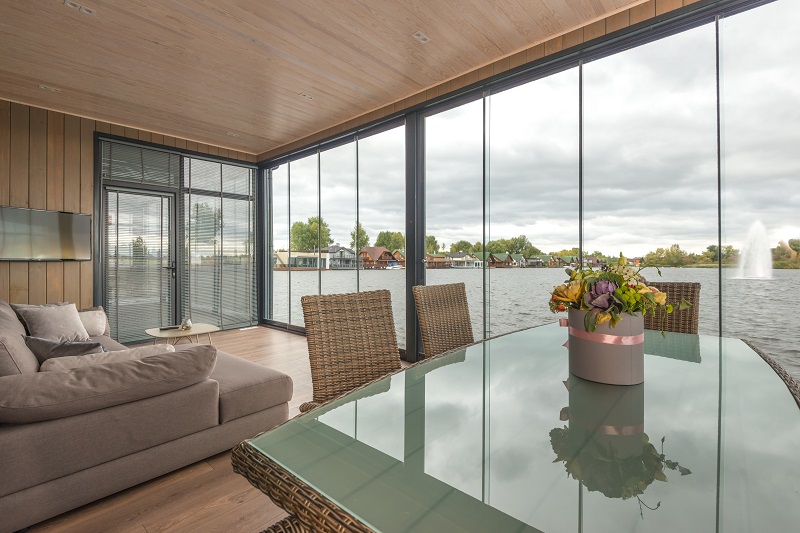
Designing the fenestration systems that lower the heat transmission and lessen this load on active systems can be an important consideration for commercial spaces. Windows and doors also contribute to the user’s experience within a space. Windows that blend with the aesthetics of the space while offering generous views of the surroundings enrich the user’s mental well-being. This can be further enhanced by employing larger window spans with sleek, minimal profiles that blur the boundaries of the indoors and outdoors. Additionally, systems that offer longevity and durability inevitably last longer and can age well with the rest of the space. With respect to leading a better lifestyle in a healthy built environment, the fenestration system has a lot to contribute.
One can look at each of these contributions individually to design them for optimum benefits. The fenestration industry uses technological advancements to improve these systems for better efficiency.