

Just like style and substance, form and function should go hand in hand when it comes to designing commercial interiors. Here, form refers to the creation of a design and function refers to its use in the context of the space it is designed for. Inconsistency between form and function would never go well with commercial interior designs.
In the case of commercial interior designs, precision is always the key. It is important for designers to make decisions that are not only aesthetic but also calculated and contextual to the space.
Ergonomics & Commercial Interior Design
A skilled interior designer should know the connection between designing and ergonomics of the concerned place. In simple words, ergonomics is nothing but the study of how individuals react to the space around them. It is the science and art that deals with closing the gaps between individuals and their surroundings.
To combine form and function in your designs, it is important to be well-versed in ergonomics and how they can be used for designing commercial spaces. There are specific patterns in which people use certain commercial spaces and interact with them. In other words, you can say that ergonomics allows you to create more user-friendly designs. It allows people to get their work done and perform even the most basic tasks in an effective and comfortable manner. The purpose behind combining form and function using ergonomics has always been to make the concerned space more useful.
Principles Of Ergonomic Interior Design For Commercial Spaces
When it comes to combining form with function with the help of ergonomics, the scope of commercial interior design is fairly vast. There are several ways in which you can utilize a space ideally and provide a lucrative environment to the visitors as well as people working therein.
However, it is important to keep a few principles in mind while using ergonomics for commercial interior design. While there are no standard principles that need to be followed objectively by everyone around the world, here are some critical ergonomic interior design principles for designing commercial spaces:

Focus On Simplicity & Flexibility
As a study and practice, ergonomics often sounds pompous and complicated. However, once you understand its essence, you will realize that is certainly not the case. When used for designing commercial interiors, the core of ergonomics lies in simplicity and flexibility. Always remember that ergonomics is not just about providing a comfortable posture as people sit on chairs and couches. It is also about making the space look good in a simple yet aesthetic manner.
Always keep your ergonomic designs simple and flexible. These two adjectives go hand-in-hand because simple designs can be easily customized based on different needs and preferences. The more complex your approach is, the more difficult it will be to make changes in your designs.
Focus On Light & Light Sources
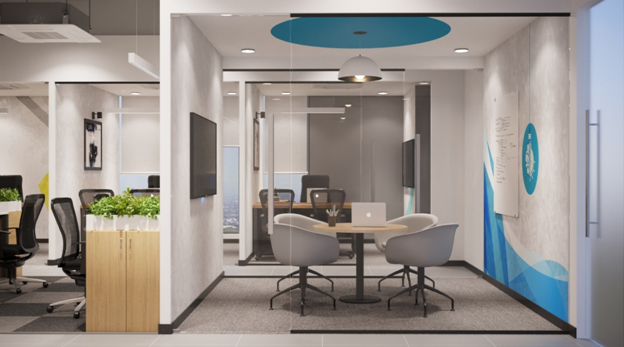
Light and light sources play a crucial role in the experience of people working in commercial spaces. Especially when it comes to designing offices, it is always advisable to make provisions for enough light in the interiors. Here, you may need to make distinctions between the kind of lighting that would suit the space – such as general/ambient lighting, task lighting, accent lighting, and more.
Not knowing whether it is light or dark outside often leads to a stuffy and claustrophobic workplace atmosphere. It is, therefore, important to focus on natural sources of light wherever possible as you design a commercial space.
How To Design Commercial Interiors Where Form Follows Function
Coming back to where we started, commercial interior designers need to ensure that form follows function. The perfect blend of art, craft, and utility makes a commercial space holistic and a design project successful.
Here are some of the most important aspects to consider when it comes to designing commercial interiors where form follows function:
Design With A Purpose In Mind
You can never add utility to your designs if the purpose behind them is not clear. Irrespective of the type of commercial space you are designing, be well-versed with its purpose. Understand why that space is important, whom it is built for, what value it will add after being designed, and the objectives of your client.
This will provide you with a sense of direction and help you make important design choices, such as coming up with the colour scheme for the interiors, building a coherent theme for the entire property, and much more.
Keep Future Customizations In Mind
More than function, the form of interior design is highly dynamic and may change frequently over time. As you design commercial interiors, it is advisable to keep all future customizations in mind. Apart from objects like ceilings and walls, you can always be fluid about the design, allowing it to be customized in the future according to the needs and preferences of your client. While having a solid base is necessary, catering to the ever-changing and ever-evolving design needs is equally important.
Add Value Through Functional Designs
As you design commercial interiors, always make sure that you add value to the space allotted to you. While the computers on the desks and the pictures on the boards can be changed, aspects like desk alignment, lighting, and spatial planning cannot be altered. It is these aspects that add value to functional designs.
As you merge function with form, do so with the intention of adding to the present and future value of the property you design. This will not only provide a conducive space for staff, guests, and customers
who frequent the space now but also increase the value of the property as compared to when it was originally bought.

The Final Word
Designing interiors without form or function would never culminate in a wholesome project. Commercial interior designing is all about the perfect marriage between aesthetics and utility. When you find the perfect balance between the two, your creations become holistic!