


A brief glance into the journey of the world’s foremost e-tail giant, Amazon, would undoubtedly demonstrate how the company has always been at the forefront of cutting-edge office design and workplace environments. Amazon opened its first office in India in 2013, and we all have witnessed its unprecedented expansion in terms of its footprint here in India. Its planning and design concepts exemplify that no single workplace trend has replaced those that came before; instead, it’s the way people work that has continued to evolve, layer and multiply.
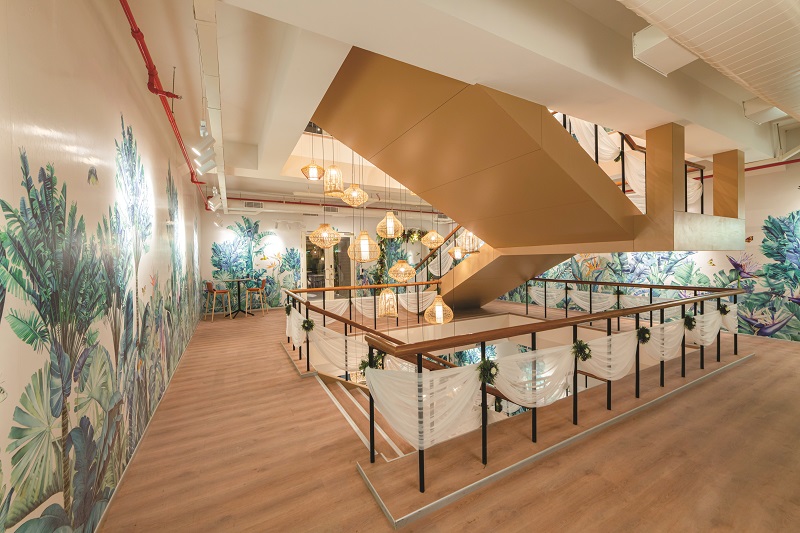
While designing a workplace, a common belief is that the typical notions of an office should not constrain creativity and innovation: be it within the boundaries of a modular workstation unit, the walls and partitions, cabins, etc. As such, Amazon has been exploring design ideologies beyond the rudimentary – catering to the individualistic needs of its inhabitants that not only encourages engagement but also score high on functionality. This principle has been adopted across Amazon’s India offices. The result is a confluence of modern expression that conforms to contemporary design ideologies, representing the company’s aspirations while also pushing spatial design to take up a role of corporate identity and staying adherent to the fundamentals of a workplace.
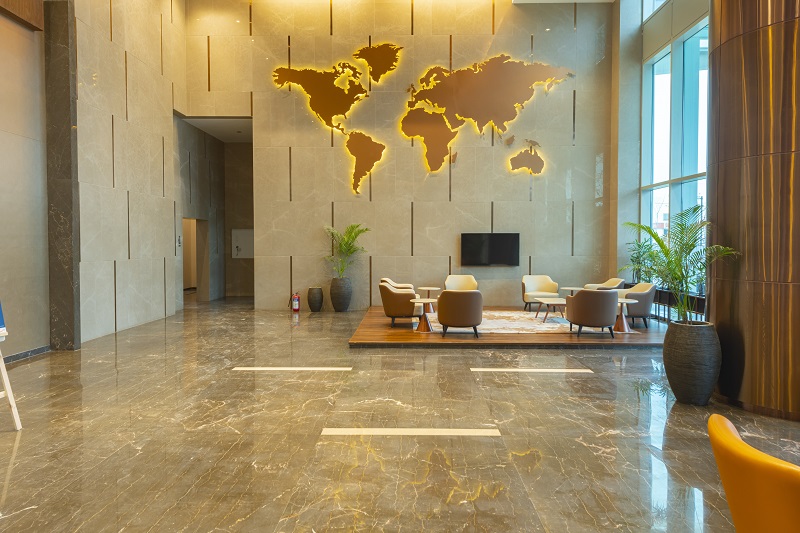
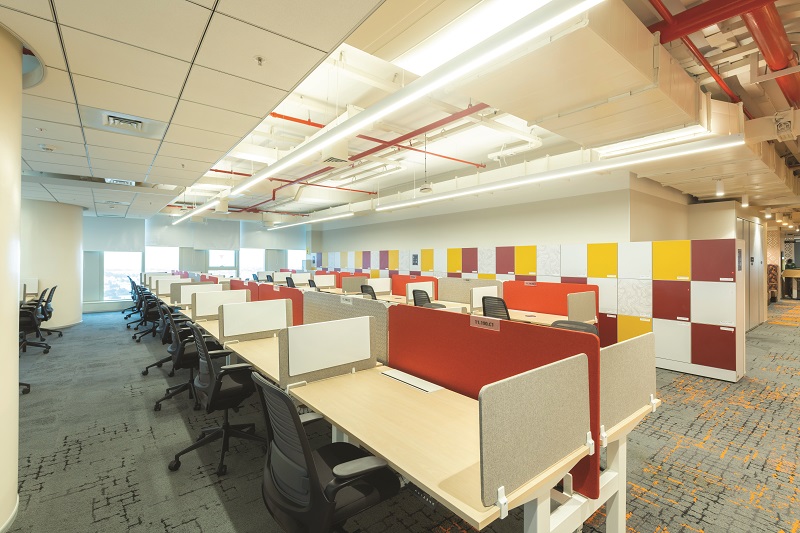
Amazon’s agile workplace is designed around team neighbourhoods that balance individual workspace with team collaboration and building amenities to provide the best workplace experience. Agile workplaces have unassigned seating that is allocated to a specific team, not the general public. You can move freely within your neighbourhood as you shift between work activities, allowing flexibility to support your needs and improve team connections. Neighbourhoods are designed with the space types your business unit uses the most, and no two are exactly the same. Like any neighbourhood, each one is designed and programmed for the people who reside there.

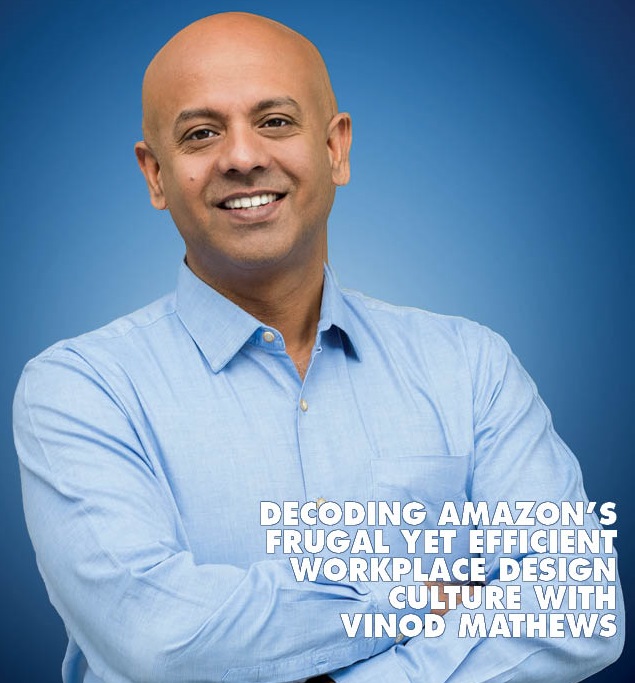
In an exclusive interview with Commercial Design, Vinod Mathews, Director, Global Real Estate & Facilities, APAC at Amazon, expounds further on the design principles and pattern of the company’s workspaces. An Indian Army Veteran and CRE professional with more than 24 years of experience, he is an expert in leasing, greenfield construction, office fit-out projects and facilities operations. He has been instrumental in guiding Amazon’s aggressive expansion strategy for office real estate over the last five and a half years, taking it to 16.69 million sq. ft. portfolio. This includes the greenfield construction of its largest office building globally in Hyderabad.
How is Amazon adapting to the ever-evolving dynamics of a workplace?
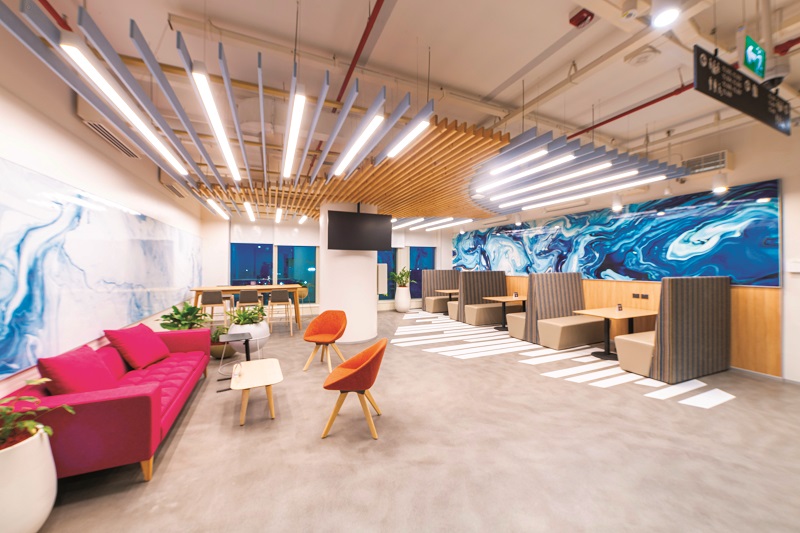
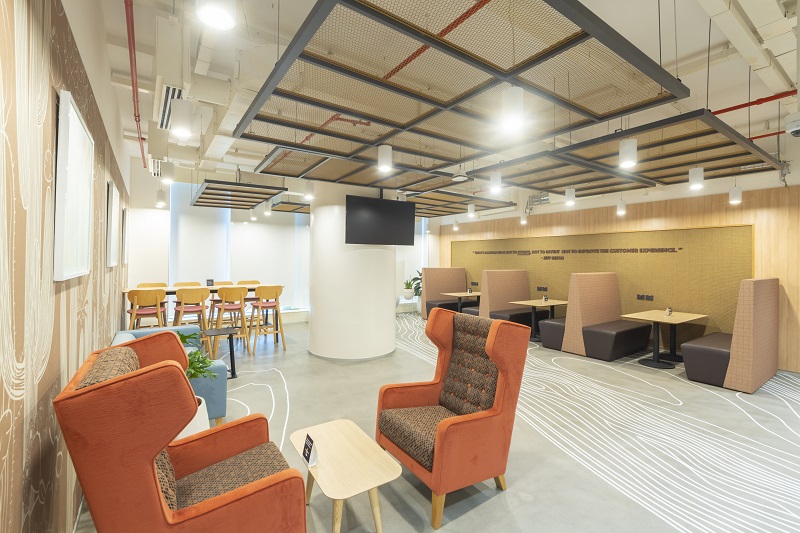
Amazon has always been committed to building diverse, inclusive, adaptable, flexible workplaces for our employees. We look at 20%-25% of the work area seating capacity to have a variety of alternate working spaces. Going beyond a typical work floor, we have also created social spaces, gaming areas and a library for our employees. All these features encourage our employees to #WFHere (offices). Additionally, technology has been deployed to build an infrastructure that sustains the efficient performance of the equipment through an intelligent building management system, improving the operational efforts of the facilities. Our endeavours to shift towards a hybrid working model have enabled us to re-baseline how our offices are built with modularity, allowing one to adapt to the diverse teams’ work culture easily.
We are in an ever-evolving world, and with technology moving at such a fast pace, the way employees work is also changing. We can now carry our work everywhere, and our fundamental strategy is to continue to look at the seamless transition from one place to another without impacting the customer experience.
What are the common challenges when working on and managing commercial workplaces as large in scale and diverse as Amazon’s?
The industry has evolved significantly in the last 25 years of the IT boom. The way we look at physical spaces and the offering which was provided to employees has changed completely. The customer expectation of the quality of services has gone up. Many partners and service providers have kept pace, but the biggest challenge is the lack of suitable talent availability and grooming of future talent for the real estate and facilities industry
The three biggest challenges that we face are:
- Identifying the right building to lease which can adapt to Amazon’s futuristic requirements.
- We need to ensure that each building is consistent with the customer experience, yet the built environment should look different. This is a continuous exercise for us and pushes us to raise the bar as we grow.
- Reaching the crest, and at the same time accommodating the company’s growth plans and creating adaptable and flexible workplaces while mitigating crisis like a pandemic, labour shortage, global supply chain issues etc.
How is Amazon’s principle of frugality incorporated into its operations?
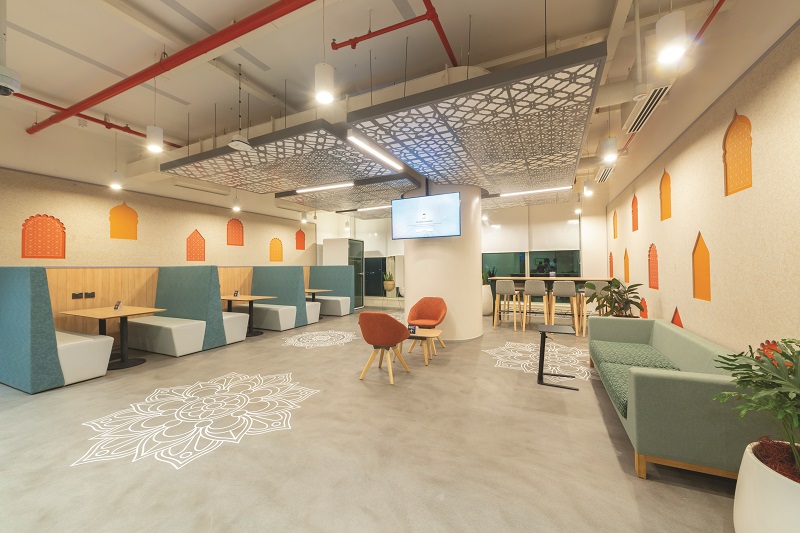
Amazon has diverse teams with specific work needs. We have adopted modularity in designs that helps remodel the spaces with lower cost and time impact –abiding by our principle of frugality.
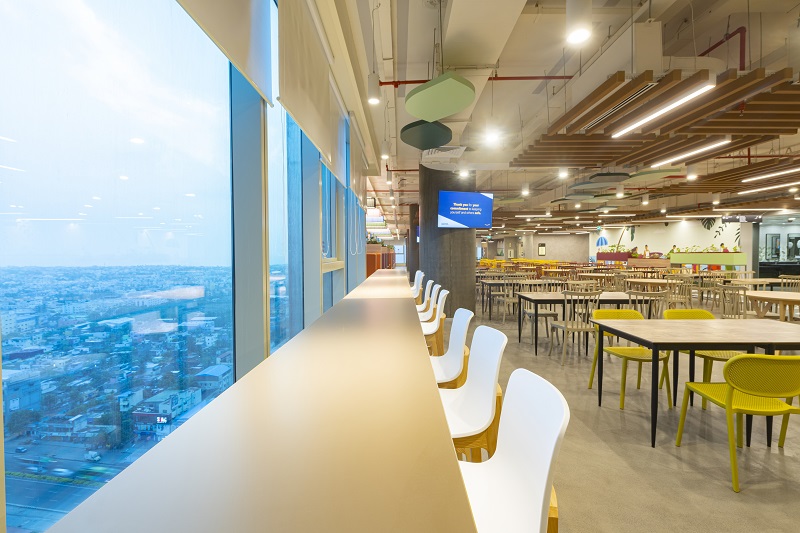
In our large offices, we have built our own in-house cooking cafeteria, offering a variety of options to choose from for our employees and taking care of our operational support staff, who are a critical part of the company and help us provide a great customer experience.
How has the Amazon facilities team used IoT to its benefit?
This space is evolving, and we are working very closely with our global tech teams that support RE&F to evaluate a consistent, scalable model globally while focusing on data privacy and the information security bar.
What are some of the various sustainability measures taken by the company?
At Amazon, we are committed to and invested in sustainability because it’s a win-win equation for all the stakeholders – it is good for business, the planet, our customers, and our communities. Today, we are India’s largest stand-alone office building space to achieve USGBC LEED Platinum V4 certification under the commercial interiors category by adopting efficient design solutions and standards that allow an estimated reduction in annual energy consumption by 23% and 76% reduction in water consumption. These are our initial efforts toward achieving the climate pledge goal by 2040.
What are the systems and software the company has in place to monitor the operations and functions of the structure?
We use a cloud-based smart building management system to control and monitor the building infrastructure equipment. The pandemic has taught us a lot about how the operations are monitored remotely. We have adopted tools to monitor the construction sites remotely, and operational buildings reducing the manual interface and extensive dependency on the resources achieving a high degree of data integrity.