

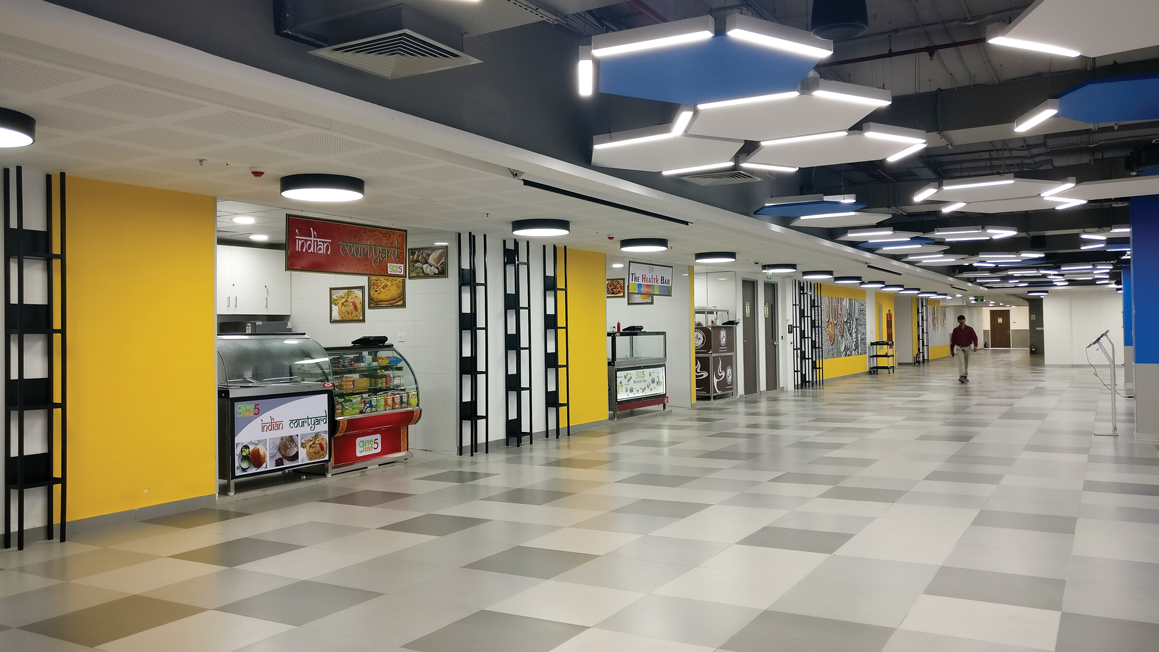
Designing a workplace for an organisation that enables its stakeholders to create and reinforce their brand value and equity requires more than just a keen eye for aesthetics and design of office furniture and utilities. Making interior spaces come alive enough to speak volumes of the organisation’s identity and speciality requires a thorough understanding of its values, goals, vision, work culture, employee dynamics, the way the space would be utilised, etc. It requires using these attributes as pointers to build a holistic hub.
The India offices of Qualcomm, one of the world’s largest telecommunications company, exemplifies these principles with its materialistic built form, which exhibits an expressive contemporary organisation with the promise of steadfast commitment to purpose. Explaining the genesis of its facilities, the design and projects team at Qualcomm expound on their strategies and approach behind their office campuses.
Ideation
Gaurav Shah, the project head for the company, says the driving force behind the design was to provide an environment that allowed employees to do their best work and support their changing spatial needs over time. Flexibility and sustainability went hand-in-hand and lead the design process.
As a first step in this direction the team thoroughly evaluated the local construction market strengths, to find the means, methods and materials that could be sourced locally. While maintaining a global standard of scope and quality, the execution of the project was based upon viable local practices.
Qualcomm also invested in an in-house team of architects, space planners, MEP engineers and construction experts to ensure the requirements of their design and planning are well understood and implemented. The design process began with detailed spatial planning, followed by concept layout or test fit that was modelled in-house and then handed over to the external AE firms for production, along with an extensive set of design guidelines.
“We always look at our past projects, evaluate their successes and then look at our future needs in determining requirements. All relevant stakeholders are consulted early on in the design process to keep it as linear as possible,” elaborates Shah. By emphasising on providing efficient building with operational ease, Qualcomm is one of few companies to strike a perfect balance between capital and operational expense. The key factors that were paramount to the design were: design and space quality; budget; adhering to timelines; and designing an energy-efficient and easy-to-maintain building.
Challenges
Working on a project of this scale and magnitude surely came with its share of complexities. Shedding light on some, the team states, “Given that design changes were inevitable, understanding the implications of those changes — on the budget and the schedule — and ensuring that all dependencies are captured at the initial stage was one of the most critical concerns.” In addition to this, keeping everyone on track and focused on the final product, while managing a project with teams in different parts of the world and time zones was another conundrum.
Contributions
The involvement of FMs within the design process was initiated right from the start, at the concept stage, and continued throughout the project till operations went live. The facilities team were an extension of the construction team through the various stages — from material selection, site observation, weekly meetings, walkthroughs and snags listings, etc. Some of the main areas that the team contributed towards were the café and break area operations, materials and equipment selection, employee needs, etc.
The facilities team also believes that it was more of opportunities, than challenges, addressing various issues that cropped up during the project execution. Since the involvement was continuous, the feedback given was immediately discussed and taken to a logical solution. Given that the goal was common for all, there were extensive discussions on a few hurdles like the end date, cost, delivery decisions, etc, to arrive at a common decision.
Technology
Being at the forefront of technology advancement, Qualcomm is one of the first to adopt the performance improvement technology or system for its facilities. A fully automated cafe, assessing real-time feedback, performance rating, invoicing, automated data centre maintenance, equipped with checklists, SOPs on tabs, effective tracking of costs system and process, etc, are just few of the verticals that have been completely digitalised.
Employee satisfaction tools — to raise, track and measure the response and resolution times that enhance employee experience through helpdesk — have revolutionalised communication both ways. There are several other metrics or factors that are also deployed to measure the efficiency and effectiveness of products or services — whether building by condition index or datacentre by PUE — each of these have significantly helped the team measure success. Cost also played a vital role in defining the facilities success and contribution.
‘Green’
Through the right selection of materials and equipment, the company recorded a drop in its energy usage by 5% every year. They also source 90% of required energy from solar power. They have been able to save water by building USGBC LEED (Gold) certified building and providing water conservation methods like auto sensor-based devices and through the sewage treatment plant that provides grey water for flushing, landscaping, cooling tower condenser water and washing the exterior areas. The company has also implemented a robust waste management system, which has resulted in Qualcomm recycling 78% of its waste. All organic waste is recycled at the company’s organic waste converter installed at one of its buildings. Meanwhile, all other waste such as hazardous e-waste is recycled in compliance.
Identity
With an in-house planning and design team, Qualcomm strived to maintain a consistent brand and feel in sync with their facilities worldwide. With this aim in mind, they also added regionally appropriate graphics and branding for each project to celebrate the local composition of each location.
The core concept across all the projects has invariably been to provide a work environment that allows their engineers to do what they do best — innovate. The company gave the design team an understanding of a typical engineer’s day by having them shadow a few employees at work. Learning how engineers do their work allowed the design team, and the AE teams to plan the right type of space that breeds innovation.
Priorities
Some basic strategies that were put in place right from the start was the provision of natural light and exterior views for all occupants; areas to collaborate and places for chance encounters; amenities like game rooms, music rooms, etc, that allowed employees the opportunity to take a break during the work day; and selection of materials that are easily to maintain.
Each design element was monitored by controlled construction costs, which was accomplished by exploring alternate materials and manufacturers that could offer equivalent products at a more competitive cost and a thoughtful simple design that still provides interest.
PROJECT INFORMATION
Project name: BANGLO.J
Location: Bengaluru
Architect: Synergy, MMoser and VPCPL
Project team: Gaurav Shah (director of construction), Guiillermo Tomaszewski (senior architect), Akshat, LNU (senior construction manager) and Swati Jain (project engineer)
Project area: 566,485sqft
Project name: BANGLO.C
Inclusions: New ground up facility with offices, labs, new cafe and fitness centre
Location: Bengaluru
Architect: Qualcomm
Project team: Gaurav Shah (director of construction), Guiillermo Tomaszewski (senior architect) and Marshall Simpson (project engineer)
Project area: 87,000sqft (site), 175,000sqft (parking), 197,000sqft (office)
Project name: HYD.B
Location: Hyderabad
Architect: VPCPL
Project team: Gaurav Shah (director of construction), Guiillermo Tomaszewski (senior architect) and Lalit Kachhawaha (senior construction manager)
Project area: 388,543sqft