


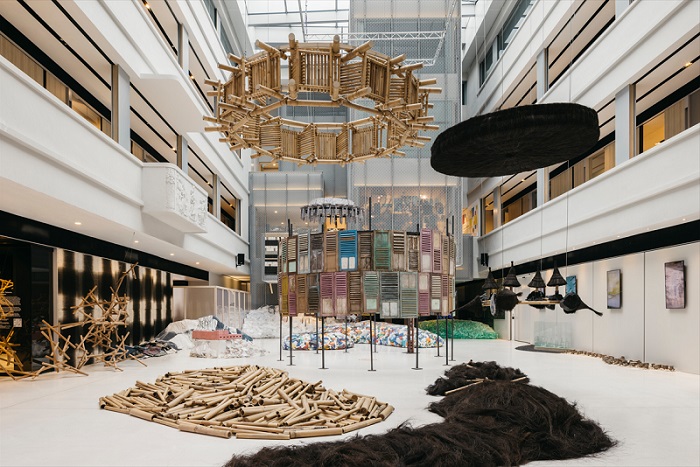
The exhibition N*thing is Possible, initiated by hospitality brand Potato Head and co-curated by OMA / David Gianotten with Shinji Takagi, has opened at the National Design Centre during Singapore Design Week. The three-month-long exhibition explores the potential of waste and uncovers new possibilities in achieving zero waste within hospitality through cross-disciplinary collaboration.
A core statement of N*thing is Possible is: zero waste and the experience of comfort and enjoyment are not mutually exclusive, and creative efforts across disciplines can transform materials at the ‘end’ of their lifecycles into a reservoir of resources. There is not a single global standard for sustainability. Sustainability is an ongoing exploration of new ways of creating and living based on available local resources and knowledge sharing.
Ronald Akili, Founder of Potato Head: “Hospitality has long been the source of so much waste and destruction, however after years of committing to doing better and making many mistakes along the way, we have discovered that it can be a force of good for the environment and local communities. Through collaborations with visionaries that share our mission of building a more sustainable tomorrow, we are able to approach each problem as an opportunity to make something beautiful. We hope that our journey can inspire and facilitate change so that our industry can be a sustainable one.”
David Gianotten, OMA’s Managing Partner – Architect: “The traditional model of hospitality encourages instant comfort. With the wide usage of single-use products, is there any chance to achieve zero waste in hospitality? OMA and Potato Head have been working together since 2012. We have been experimenting with ways to reduce waste going to the landfill through creative hospitality management, cross-disciplinary collaboration, and engagement with the local community. In N*thing is Possible, we share our ongoing investigation in the meaning of sustainability in hospitality and how it can be achieved.”
The exhibition spanning 1,000m2 begins with photographs and videos that capture the overwhelming volume of refuse generated by our daily habits. At the main atrium, natural materials and waste – bamboo, timber, plastic, textile, glass, Styrofoam, cooking oil, oyster shells – form a landscape. Above, objects made with the landscape materials – designed by Potato Head’s collaborators – are on display. This Waste Landscape illuminates how refuse can be transformed into valuable and beautiful items through experimentation and knowledge sharing. A central piece of the exhibition is a circular installation made with discarded shutters. A timeline showcases Potato Head’s journey since 2010 in creating an environmentally conscious hospitality business, highlighting its zero waste initiatives in Bali from 2017.
The exhibition continues with the Blueprint, where the ongoing waste management program at Desa Potato Head – a resort in Bali – is presented as open-source information. In 2017, Potato Head, in collaboration with Bali-based environmental engineering consultancy Eco Mantra, initiated a series of government-independent efforts to achieve zero-waste at the Desa. Since then, Eco Mantra has measured the volume of refuse going to landfill, revealing that it is approaching zero. Documentation of Potato Head’s zero-waste initiatives in Bali is showcased alongside macro-scale studies on Bali and Singapore’s nation-wide waste issues as conducted by Eco Mantra, National University of Singapore, and OMA. The topics examined include top-down, government driven zero-waste incentives, public responses and awareness, and landfill capacity. A key observation is: fundamental changes in the general public’s waste management practices hinge not only on government-level directions; private sectors are able to initiate small-scale, yet progressive measures with potential long-term effects.
The exhibition exit is a circular-shaped gift shop. Products that encourage a zero-waste lifestyle are displayed on installations built using woven panels made of recycled plastic waste. The exit becomes part of the exhibition, prompting critical responses to the questions: is recycling the best solution to the waste problem? How can we reduce waste in the first place?
Potato Head’s long-term collaborators featured in the exhibition include Indonesian architect Andra Matin, Catalan industrial designer Andreu Carulla, Jakarta design studio BYO Living, Bali-based environmental engineers Eco Mantra, American artist Futura, Japanese architect Kengo Kuma, British furniture designer Max Lamb, French director and photographer Thibaut Grevet, London-based design studio Toogood and the National University of Singapore.
OMA is the architect for Potato Head Studios (2020), a resort in Bali with a public open ground plane to welcome both hotel guests and the local community. Since 2010, OMA and Potato Head have been collaborating on a number of hospitality and tourism projects in South-East Asia. OMA’s exhibition design team is led by Managing Partner – Architect David Gianotten and Project Architect Shinji Takagi.
__