


What has been the impact of the low-touch economy on workplace design AND operations? Could you share with us what you identify as the short-term fads and long-term trends in this sector?
The term “low-touch economy” refers to the economic and behavioural shifts that the Covid-19 pandemic has prompted, including social distancing, remote working and collaboration, and health and safety measures. Like all physical spaces, the office has also been impacted by the low-touch economy, both in its design and operation.
- The biggest impact on workplace design has been an increased need for flexibility and adaptability. Flexible, open-plan offices allow workstations to be spaced apart or separated with acrylic sneeze guards, creating a safe work environment for employees.
- With offices oscillating between remote and in-person modes of working, flexible offices can accommodate a varying number of employees and create spaces serving other functions like collaboration or brainstorming.
- Technology plays a prime role in the low-touch economy, with remote working occupying a central position in the movement. Sensor-based lighting, air-conditioning, and shared services like elevators eliminates the need for human-activated controls. Other commonly touched elements like doors and washroom fixtures are also replaced with sensor-based products to provide a touch-free experience.
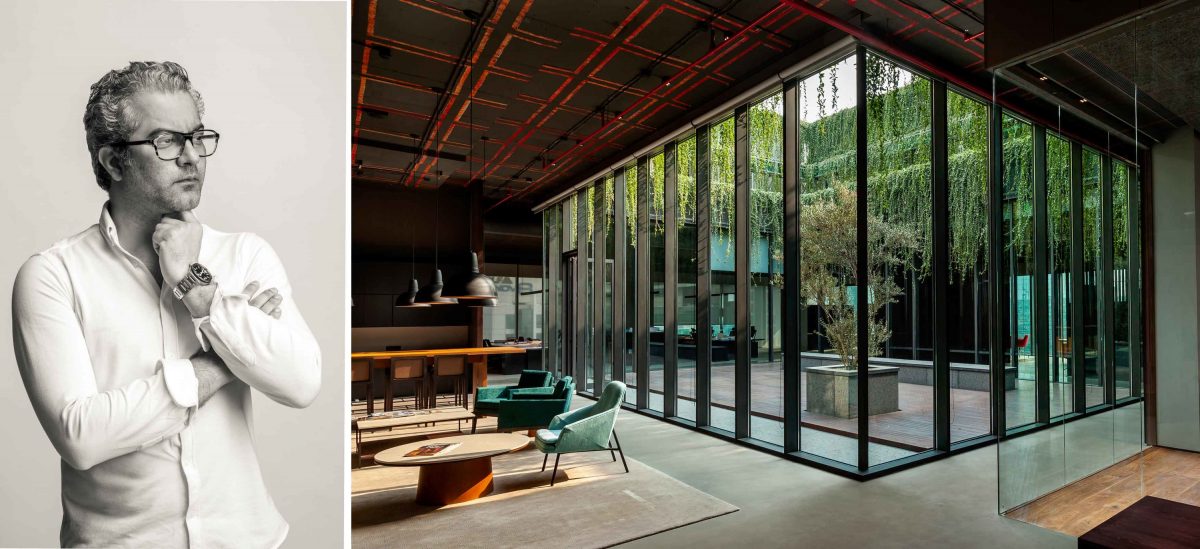
- Natural light and ventilation has an important role in creating healthy indoor environments; therefore, offices are designed to allow ample daylight inside. External windows, skylights, courtyards, and light wells create naturally-lit work areas and provide outdoor spaces for collaboration and recreation.
- Technology for disinfection and health screening are commonplace in office environments now, including UV disinfection robots, sanitizer dispensers, and thermal screening devices.
The meeting room at the East India Hotel Headquarter office is equipped with state-of-the-art technology for video conferencing and presentations. Self-automated roller blinds control the amount of direct sunlight entering the workspace, reducing the office’s air-conditioning demand.
Short-term changes: Technology for disinfection and health screening will likely disappear after the pandemic. I also believe that the current trend of remote working will, in part, transition to a hybrid model of work or a return to the physical office. When our schedules start going back to normal after the pandemic, we will have realised that there are some things that we can do from home, but not all.
Long-term fads: Remote work is here to stay — many firms around the globe have entirely switched to virtual modes of working. In workspace design, the need for flexible and adaptable offices will remain long after the pandemic, as changes in technology are set to further transform ways of working. The need for natural light and ventilation will also remain, as the requirement for positive and healthy work environments is going to be a constant need.
The pandemic has made individuals more environment-conscious, and this awareness will reflect in the design of office spaces too. A strong element of focus in office design will be the choice of materials and their lifespan, as well as the lifecycle of furniture and spaces.
The firm’s studio office with naturally-lit and ventilated through windows; the studio provides ample space for safe, socially distanced working.
How can builings be made adaptable to future changes? Has sustainability taken a backseat in the post-pandemic era?
I believe that sustainability goes hand-in-hand with post-pandemic design, as the principles of adaptability and longevity are important for both sustainable design and office design in the post-pandemic age. The integration of natural light and ventilation creates safe and positive working environments and also impacts the office’s energy consumption, as it reduces its artificial lighting and air-conditioning demand.
At Architecture Discipline, We have never believed that buildings are like traditional temples or classical forms that cannot be altered. We see them as flexible frameworks that interact with each other. This allows us to create large floor plates that are well-lit and well-serviced, further equipping us with a tremendous amount of flexibility in the planning and usage of space. Therefore, our buildings, from within and outside, are designed to allow for easy reconfiguration, making them adaptable to future changes.
While flexibility remains inherent to our designs, we also consider the lifecycle and serviceability of our buildings in our design process. Indoor air quality, air conditioning systems, and even water requirements have been accounted for. Therefore, even with an unprecedented occurrence of the pandemic, I believe that our buildings have been robust enough to sail through this time because of their focus on flexibility and sustainability.
The outdoor lawn at the firm’s studio office is used to accommodate ad-hoc offices designed from repurposed shipping containers. The remainder of the space is used to host presentations and socially-distanced events.
How will the role of design and designers change with the advent of the new normal?
I believe that the pandemic and the growing adoption of remote work will result in offices with a reduced footprint, accommodating a limited number of employees working in-person. Generally, companies may invest less in developing and refurbishing physical workspaces with the advent of digitization, and the role of architects in smaller commissions will be questioned and redefined.
But I also think that this time has taught us to be more critical, that we must be more appropriate in what we build and not just build for the sake of it. It also makes us realize how little we really need to coexist happily. Design is about reduction and optimization; we need to be more appropriate in what we build and not just build for the sake of building. There is a strong need to revisit the essence of design and start removing all the unnecessary embellishments that result in waste and clutter.
Adaptable and open-ended, the social spaces of the East India Hotel Headquarter office enables safe, socially-distanced collaboration and can be used for informal meetings or working.
Instead of building new structures, offices of the future must reuse and revitalize existing buildings, imbuing them with new memories. This is going to be the century of recuperation. So, let’s not destroy space, forests, and consume more water. Treating our own waste and generating our own energy and reducing consumption is the miracle we need to save our planet.