
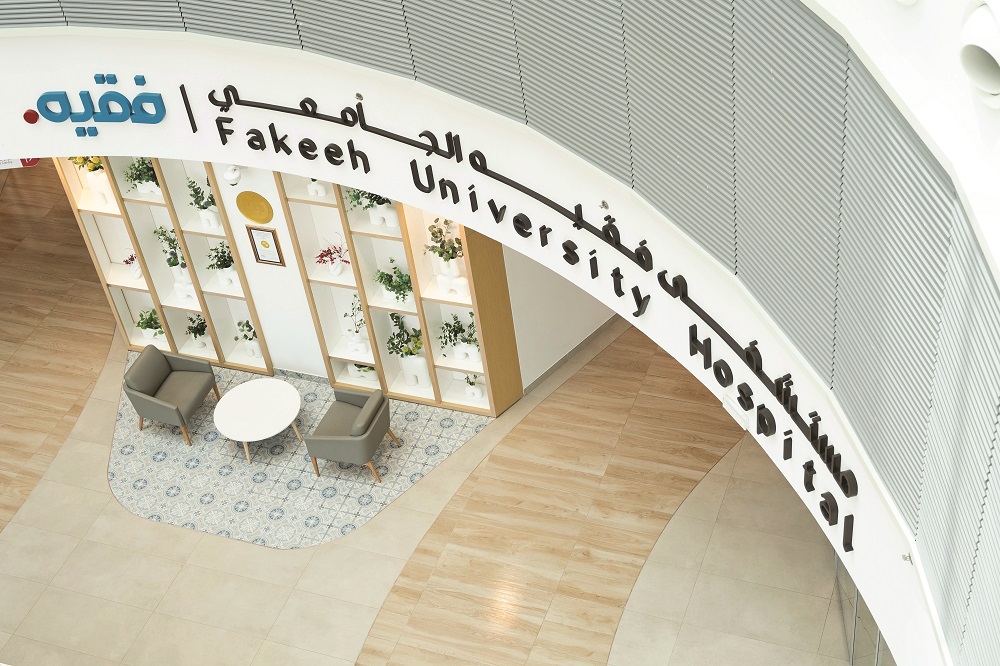
When leading healthcare institute Dr Soliman Fakeeh Hospital Company decided to open a new cutting-edge hospital and a working university in Dubai, they faced all the challenges that come with rapidly changing medical technologies. Questions like, how can hospitals keep pace? And how do you design in a way that caters to that level of constant change?
Identifying an opportunity
The company saw an opportunity to tackle a global problem: The patient experience. No matter where you are in the world, a hospital visit can be cold, impersonal and lonely. As research starts to show the benefits a welcoming environment can have on the patient healing process, healthcare organisations are realising they need to change their approach.
Through their new hospital in Dubai, the Saudi Arabia-based healthcare group saw a chance to address some of these issues, and to deliver something unique. With Fakeeh University Hospital (FUH), they envisaged personalised, caregiving and holistic, 360-degree approaches to patient health. They also wanted to raise the bar design-wise, creating a luxurious space patients would feel at home in – more like a five-star hotel than a medical facility while achieving health and safety in interior design.

Finding the right partners
It’s one thing to deliver a luxury hospitality experience, but how do you deliver that experience across one million square feet? Designing and building such a huge facility, and a highly digitalised one at that, required partners who could deliver at this scale.
“We needed up-to-date, reliable, adaptable and long-lasting products that would live up to our promise of the best caregiving standards. We also needed partners who could be in consistent exchange with us in the early stages of the construction process, feeding back on spatial dynamics and products that would be suitable and relevant,” says Dr. Varun Katyal, director of operations at FUH.
With its ability to create comprehensive healthcare furniture solutions at scale for everything from clinics to the laboratory and pharmacy, and from in-patient rooms and waiting areas to administration zones, Herman Miller was the natural choice. Through Advanced Business Concept (ABC) – a certified Herman Miller dealer that specialises in interior furniture solutions – they came on board early in the design process.
“Change is imminent inside any healthcare facility. So having furniture that adapts to change was key, and that’s something we knew Herman Miller and ABC could provide,” says Dr. Katyal. “We also chose to partner with Herman Miller and ABC because of their ability to deliver a full healthcare furniture solution from one source” – something that’s vital for a healthcare facility of this size.”

Building in change
A key part of the FUH vision revolves around creating a highly digitalised hospital that keeps pace with cutting-edge medical technology. That’s why they chose to integrate path-breaking, smart technology from day one. For Herman Miller, this meant incorporating not only current technology, but also catering to future digitisation within its furniture solutions.
“Part of the challenge was accommodating the machines and blending a full modular system to support this,” says Ayman Najim, COO of ABC. “That system had to be able to change and adapt. Let’s look at the pharmacy, for instance. “The client wanted to have a fully automated pharmacy dispensing system, so we had to incorporate this into the furniture.”
Herman Miller integrated healthcare systems such as Co/Struc into the design for the pharmacy and the clinical lab early on. Modular and made up of readily interchangeable components, Co/Struc can adapt to technological changes, and it can easily be reconfigured if systems and processes shift.
“We’ve already seen the benefits of this in both the pharmacy and the clinical lab. The clinical lab has also been automated since the initial design, and that meant we had to reconfigure the layout,” says Dr. Katyal. “Having a system that’s based on components that can easily be moved around and replaced in another function or service made a huge difference. “We had to reshuffle the components to adapt to the equipment.”

Balancing health and safety with design
“A major consideration was how you balance aesthetics with functionality in healthcare on a longer-term basis – especially when your client wants something very beautiful, something that creates a warm and inviting environment, instead of the cold, clinical healthcare spaces of the past. At the same time, there are certain requirements you need to stick to when it comes to healthcare functionality,” says Ahmed Yosri, dealer market manager for Herman Miller, MEA. Not only does every fabric need to be easy to clean, but it also has to withstand the wear and tear of people’s traffic. “This is part of the overarching guidelines of infection control no hospital can live without,” says Yosri. Luckily, ABC were able to deliver a high-end look and feel, while incorporating materials that meet infection control practices and products that fit the healthcare industry’s requirements for cleaner, anti-bacterial materials. “This elevated the guest experience, and the staff and patient experience, too,” says Yosri.