

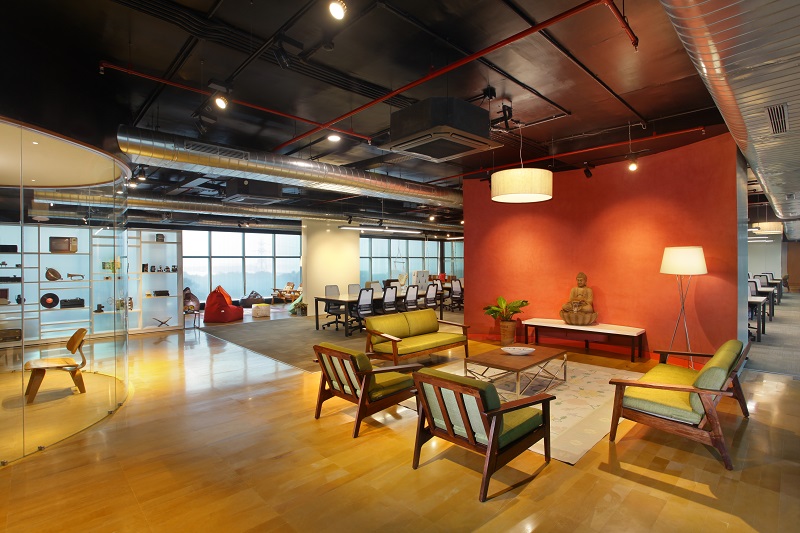
The spatial experience of a brand drives new-age workspace design today. Spatial branding is at the juncture of interior design, visual identity, mural and wall art, furniture design, and company ethos. With LinkedIn, Amazon, Facebook, Inshorts, etc., having offices across cities, establishing the identity of the brands spatially, creatively, and uniformly in their workspaces is a fascinating design challenge. While there are no standard approaches, multiple interventions and meanings towards artists, artisans, and craftsmanship infused with technology are becoming successful solutions in rendering spatial branding.
At any point in time – pre or post-pandemic, the need to be productive in office spaces remains a primary yet necessary function. Contrary to the fact that traditional office spaces were derived by the narrative to offer spaces for solely work purposes, the conversion in corporate offices today is a worthy investment despite where the trends go. Apart from the basic tendency to work within a designated area, new-age offices have much more to offer in terms of spatial features. It is essential that the productivity and creativity of an individual boost at a much higher level when given the opportunity to enjoy their surrounding workspace rather than be confined in a typical office cubicle.
The demand for spatial branding gained massive traction when it was initially incorporated by the Giants of Silicon Valley, followed by corporations worldwide wanting to reflect their core values within their workspaces. While it may seem trendy to design ‘hybrid’ workspaces or break down ‘traditional’ offices, it is essential to reimburse the ideology of branding in interiors.

Design strategies
The spatial experience of a brand needs to reflect the values, the ethos, and the vision a brand emotes. Hence, it has gone beyond just using brand colours and logos.
Designers have a huge role in designing workspaces that closely align physical spaces with a company’s vision, branding, and policies. Certain brands of higher status are now hiring programming consultants to prepare a set of guidelines for their campuses. With the idea of each office space providing the same experience to each user irrespective of the office location, the design process begins by understanding what the brand stands for. To decode the design brief and research challenges, conducting interactive sessions with the leadership and the employees can be helpful. Studying work patterns and benchmarking studies of similar spaces aids in capturing three basic approaches; humanistic strategies, technology-driven strategies, and the soul of the organization.
There are several tools at the interior designer’s disposal to bring oneness between the brand and its spaces with respect to all design elements – colours, art, furniture, natural and artificial lighting, services, use of negative and positive space, the richness or frugality of decorative details, use of biophilia and shadow/light play, etc.
Design that aligns with the brief and branding guidelines and encourages interpretation of the brand values through the spatial elements should be of dire importance while designing such workspaces. For instance, introducing the brand colours or logo in subtle or derivative forms in furniture or patterns, carving out spaces that align with the brand’s values, and creating pockets within the office area that encourage people to get together is prominent for a brand that believes in the sense of community.
The well-known Facebook office at Menlo Park, California, is an excellent example of how workspaces can implement a brand’s spatial experience. In line with advocating openness in communication and sharing, the office space is welcoming, with no barriers or toll gates for staff and visitors alike in all areas. Such exceptions allow ease of access in common spaces like food courts, shopping areas, and open green zones with no fixed entry and exit points where the maximum movement of people is expected. One is free to wander around and explore everything on their own, just like a typical Facebook app user.
Another great example is the corporate office for ‘Inshorts’, a media company located in Noida, designed by Edifice Consultants to energize a young crowd and operate 24/7. The intent was to have a space that would emulate the idea of home; wherein the reception would manifest itself as the drawing room, the cafe would translate into the dining room, and the work areas would cater to the needs of up to 6 teams, each comprising 6 to 8 members allowing coworking/discussion spaces as an alternative to traditional formal spaces, with an attempt to create an informal zone that is more relaxed and personalized.
The brief was enriched by insightful inputs from the client, along with customized spatial requirements such as team briefing spaces and acoustic barriers between the gaming/working areas. A composition of positive and negative spaces created through built volumes encourages informal discussions, defining the unbuilt interstitial spaces. These open spaces also act as tactical separators to create an engaging visual and sensory connectivity. The public zones of the office blur the office interiors and render privacy to the more exclusive and restricted areas.
Local artistry and craftsmanship
An increasing trend towards including local art in corporate spaces is evident. Paintings from artisans of Bastar, from Gonds and Bhils of the tribal community, wood or stone carvings, and pottery also are increasingly used in offices. There was once a trend to put up motivational text or proverbs for easy visual access as people walked around. That has now been replaced by evocative art forms – illustrations, abstracts, realistic paintings, graffiti, murals, etc. Visual branding is a considerable aspect of spatial branding of office interiors. For example, Lighting as a design approach helps accentuate design elements and can also be used to depict the branding using different forms or colours.
Usage of innovative signage and wayfinding strategies improves the end-user experience. In addition, spatial branding of interiors holds the potential to provide much-needed exposure to the rich Indian art tradition. Nowadays, interior design firms work with agencies to commission art from local artisans, who are duly acknowledged in the art installation as the creators. Educating the client on this approach is essential as well.
Sustainability in Spatial Branding
There is a massive push for material use and design sustainability in the construction, architecture, and interior design space. A collaborative approach anthologized by the brands and design firms in conjunction with the requirements mandated by law makes a conscious design approach. In addition, sustainable and environment-friendly elements such as the following may hold the potential to create interesting design solutions. Here are a few examples:
Energy – rooftop solar PV, low energy system design, robust measurement, and monitoring protocols.
Lighting – maximum workspace exposed to daylight area. All peripheral zones would be connected to daylight sensors & introducing light shelves for higher daylight penetration into workspaces.
Resilience – flexibility of workspace with minimal waste generation considering requirements or retrofits. Post-pandemic adaptability – provision for mixed-mode ventilation, space, and system adaptability.
Materials and furnishing – recyclable, salvaged, local, renewable – certified material. Greenguard certified furniture, low VOC materials, natural dye fabric.