


Building skins and façades have a multitude of roles and functions. On one hand, they provide a visual character to a building – which extends to the local character of a neighbourhood or, at times, to a skyline of a city.
On the other hand, façades have a key role towards building performance and create a link between the interiors and exteriors of a building with respect to climatic response, protection from harsh physical conditions and maintaining user comfort levels.
The role of a façade is as complex as the building itself, as it needs to strike a balance between all the parameters such as aesthetics, visual character, structural stability, solar heat gain, daylight filtration, visibility, thermal comfort, branding and programmatic zoning, among other aspects. Due to its complex nature, usually designers opt to harness the potentials of a façade to either aesthetic effects or to building performance. Very rarely do the two merge, although that’s the intent ideally. But what stops us from integrating all aspects of a façade in design? Is it the complexity of the problem, or is it the inadequate knowledge of available design tools? Perhaps, it is a combination of both. However, both these issues can be sorted with the help of a specialist.
EMERGENCE OF FAÇADE DESIGN SPECIALISTS
We are currently in the age of specialisation in architecture, where multiple streams within the profession have emerged to create an interdisciplinary and multi-layered process of design. This has led to smarter projects as each specialist – be it energy consultants, structural designers, façade designers, project managers or architects – play their respective roles to collaborate on a project.
Looking at the importance and complexity of a façade in a building, façade design specialists can take up roles of design and building of façades with their association of engineers and vendors. While there has been a lot of progress in the construction, supply and material segment of this domain, very few are focusing on the design aspect of façades.
Many designers have taken up the expertise of façade designing by use of Computational Design Techniques, namely Parametric Design and Algorithmic Design. This allows collaborations with the architects wherein a façade design consultancy can be provided which focuses on parametric design methods that allow a wide range of design possibilities and fabrication options.
Parametric design, if rightly put to use, within the domain of façade design, can aid in developing smarter façades that can perform a multitude of tasks in an optimised way. Parametric design opens up vast possibilities of controlling performance-based factors right from the early design stage of a façade project, yielding results that speak beyond mere aesthetics.
Since parametric design is a technique and method of designing, we can’t truly make a fair comparison between a non-parametrically designed façade and a parametric façade; but it would not be wrong to say that possibilities of designing smarter and efficient façades is made possible today with the aid of parametric methods.
PARAMETRIC WORKFLOW FOR FACADES
Parametric techniques of designing can be achieved today with a multitude of software and methods. Although the pace of change in technology is on an all-time high, methods remain the same, more or less, with new software packages allowing advancing functionality.
Parametric design is not about the software platform merely, but is based deeply on the way of designing. One can create their own customised ‘software platform’ using various coding languages, which designers are slowly getting acquainted with.
Some of the coding languages that allow a parametric workflow would be Python, C++, VBnet. These can be embedded in one of the commonly used and popular parametric design tools – Grasshopper, which is an extension to NURBS based 3D modelling software Rhinoceros. Other evolving parametric tools include Dynamo, Generative Components, Maya, CATIA, among others. One can extend the workflow for parametric design using coding languages that are supported by conventional design tools.
Coding is one of the most popularised skills in the West today, not restricted to just the design community. It is gaining popularity amongst designers across the globe, as it can allow one to extend one’s creative canvases to vast avenues.
Parametric workflow allows designers to take objective and informed decisions during the process of design, where every geometry and information is associated with the building through parameters that can be controlled to produce a multitude of outputs and options. Analysis and fabrication data can also be linked in the workflow along with key parameters such as material quantities and costing.
Having an objective workflow towards design allows rational decision-making and an efficient and optimised solution for the project with respect to costs, material use, structure, etc. In a nutshell, parametric workflow harnesses the potential of computers to analyse big data and visualise complex forms and associate them to provide an integrated solution. This is an efficient use of Computational Design for façades and building skins.
THE MASTER CONTROL
Parametric workflow allows designers to rapidly iterate forms based on parallel feedbacks from parameters like cost, structural feasibility and building performance to tweak the designer sketch-board through a Parametric Master Control.
This non-linear workflow allows holistic development of the project based on a large set of parameters by linking them to each other through a smart use of simple algorithmic workflow. However, it is important that the set of parameters are quantifiable data.
This maintains the integrity of the project while allowing quick iterations and rapid prototyping. It also allows incorporation of changes in brief that can be easily accommodated even at a later stage of a project without disrupting the project workflow.
CULTURE OF COLLABORATION
Having an expertise in Computational Design, rat[LAB] Studio often delves into collaborative projects to assist in façade design and building skin development with other designers and architects by taking up the scope of Parametric Design Consultants. Additionally, the studio also undertakes independent façade design projects by using advanced methods of designing through an algorithmic workflow.
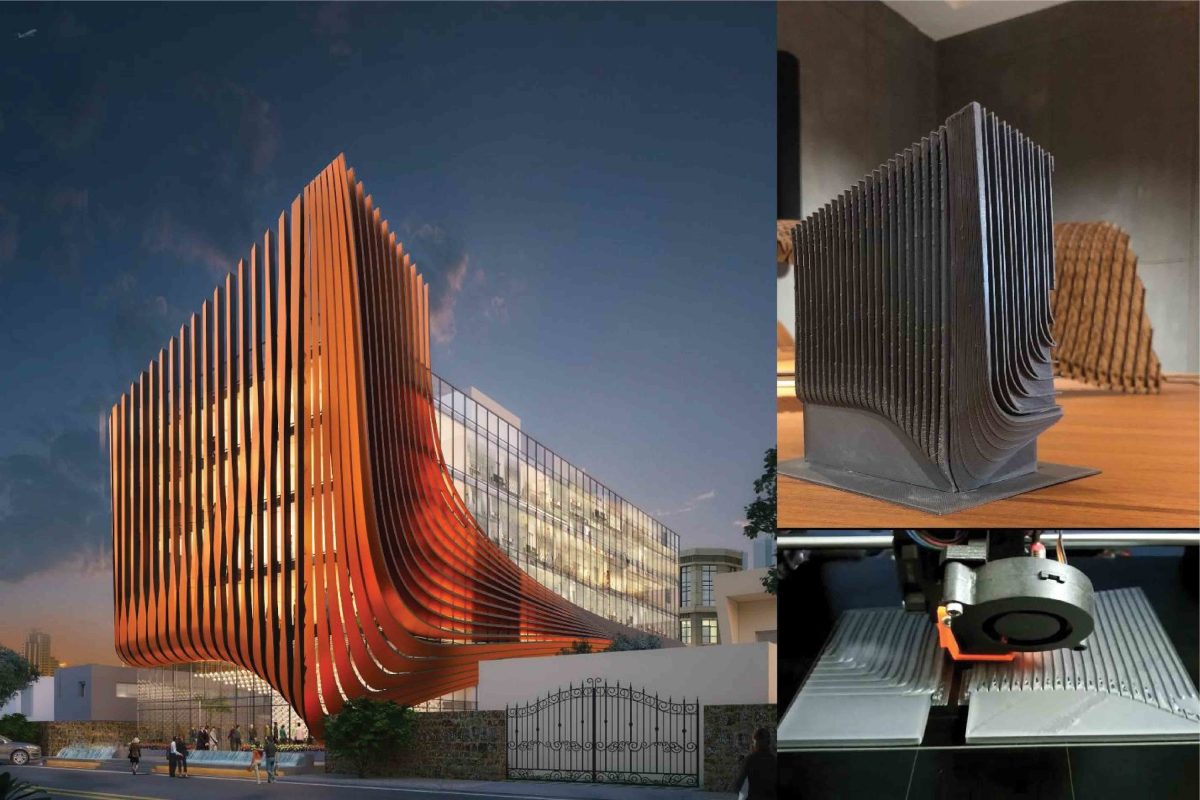
One of the ongoing visionary projects by the studio is a collaboration with Architects Urban Zen, Hyderabad, for a corporate office. The façade is quite complex as a mix of flat, single curved and double curved surfaces that define the vertical fins – which, in turn, blend to form horizontal members. The studio used 3D printing technology to create prototypes of the façade for creating an efficient structural and façade system and choosing the most appropriate cladding system.
Another collaborative project with the same firm explores a fluid façade language on a 20-storey building in Hyderabad using Parametric and Computational Methods which require a cladding system that has to be light-weight yet visually solid, and loaded on a conventional structural system. Innovation happens in such projects by following a non-linear integrated workflow to achieve a complex result.
Proposal for dynamic façade at MAK’s Exhibition Space in Los Angeles, California, at the site of Mackey Apartments, which was designed by one of the pioneers of Modernism – Rudolph Schindler in 1939.
The adaptive façade system used in some of the projects has been an evolving research of the studio demonstrated through adaptive[skins] project research at the MAK Center, Los Angeles (2014), initiated at AA School of Architecture, London (2012) by founders Sushant Verma and Pradeep Devadass, and articulated in the building skin design of Tokyo Shopping Center project by the firm in 2016-17. The work keeps evolving using technology as an innovative driving factor.
It is a project that was started in London as part of an academic research and built upon in various iterations in Los Angeles later on. It was started with the sole vision of challenging the static built environment against the dynamic natural environment, where numerous layers of architecture come together to make a building function in negotiation with changing environmental parameters such as sun, rain and wind. The research has taken a series of iterations from 2012 to 2014, with the latest developments shaping up in Los Angeles, CA at the MAK Center. A dynamic façade system was designed as a proposal for MAK’s Exhibition Space at the site of Mackey Apartments, which was designed by one of the pioneers of Modernism – Rudolph Schindler in 1939.
The project adaptive[tensegrity] questions the static nature of architectural spaces, encouraging dynamism and motion in architecture via movable building skins. In an exhibition at the MAK Center in September 2014, the research lab presented a prototypical interactive installation made of tensegrity components embedded with sensors that responded to human movement. This was tested as a potentially suitable building type for Southern California and other semi-arid locations.
An international collaboration of rat[LAB] with Takumi Yoshioka and Masaki Morinobu of Nonscale Co., Tokyo led to a proposed shopping centre for Japan at the SC Fair 2016 held at Yokohama, south of Tokyo, in Japan. The project is designed by Nonscale Co., while the highlighting roof-structure has been envisaged and designed by rat[LAB]. This large span adaptive roof structure inherits hybrid qualities of a tensile and a grid shell, with automated shading devices inbuilt in the structure. The project explores computational techniques to develop form, structure and an adaptive skin/envelope for the architectural build. Advanced computational techniques and methodologies have been used to design a complex roof structure that can adapt to dynamic environmental conditions. The multi-functional shopping centre will be sheltered by a large span skin which incorporates origami shading modules with a transparent material for a visual connection. It will be a shopping centre ventilated like any outdoor space with controlled temperature and better comfort levels.
DESIGN MANAGEMENT
In another ongoing façade project, the studio is following a non-linear workflow to employ three geometrical systems and providing façade solutions with integrated cost and energy analysis using an algorithmic approach.
In the design process of the façade, a set of parameters are set as geometric variables using the Parametric Design Toolset. They act as objective information in the algorithm used to generate façade options. For example, angular rotation of bricks is used as a geometric parameter where angle of each brick is controlled as per visibility and light studies that follow and provide a feedback look back into the algorithm.
The next step is to develop the algorithm that brings all the variables within a comprehensive equation (or script) to feed them to parametric tools for computing and analysis. A design language or a geometric syllable is decided to be mapped on the algorithm. The output façade options are then analysed for structure, environment and cost.
Performance analysis is the most critical part of the design process. It requires an objective critic, and computational framework provides an integrated method to blend design and engineering.
- Energy analysis (building performance): The energy performance of the building is analysed for further optimisation; aspects concerned are solar insolation, ventilation, temperature, daylight factors, etc.
- Cost analysis: The cost estimation of the façade plays an important role in shaping it. With integrated BIM, cost estimation can be obtained in real time for every iteration.
- Structural analysis: The structural feasibility of the façade can be tested using advanced computational tools. Specific aspect of structural system such as shear stress, bending moment, load, etc can be obtained with high degree of certainty.
- Construction methodology: The most suitable construction system for the design options can be evaluated and fabrication data, assembly sequence and construction methodology can be extracted from the parametric workflow, if used smartly.
Custom reports can be generated from these analyses for consultation with clients and engineers. Based on these analyses, primary parameters can be tweaked to further optimise the design options. Although these are listed as succeeding steps, the parametric workflow is a non-linear process which helps designers shift from one aspect of the design to another for parallel ‘design, iterate, analyse’ process.
In another recent façade project by the studio, the skin of the building is envisaged as a porous surface with punctures made through CNC cutting of MS sheets, while globally emerging into a continuous pattern when seen from a distance.
Interpreting from the brand identity of the client, a pattern is generated parametrically, with variable punctures emerging out from a central focal point, spread on the full façade of 3,300sq-ft as a pattern that cuts direct glare, brings in indirect illumination into the space, as well as marks the building with a highlight feature on the busy street.
The pattern is fragmented into 40 panels of regular sizes placed on a MS grid framework, anchored to the building slabs. Each panel is numbered for quick sorting and site assembly, which come together to form a patterned façade for a banquet cum boutique hotel space.
In another project by rat[LAB] in collaboration with architect Abhishek Bij of Design Plus, New Delhi for Molded Dimensions Factory, Gurgaon, a prominent part of the façade is designed to create an aesthetically dramatic effect, while optimising building performance and fabrication cost. A differentiation among members of the façade is being parametrised through an algorithm that calculates the running length and cost of various building members.
This allows us to change the base parameters (such as angular variation, dimensional shifts, etc.) and study its changing effect on fabrication cost and environmental performance. Multiple platforms are integrated to evaluate the results in real-time, as we change the influencing parameters and create a range of designs. This allows choosing an optimum design for the façade, based on the set criteria. The algorithm is also developed to extract fabrication data from the parametric model, saving on design and production time, hence cutting down on project costs.
One of the key advantages of following a Parametric and Algorithmic Workflow for façade design is the association of project brief, fabrication data, project costs, material calculations, analysis data and project visuals into single non-linear workflow – where a façade designer plays a key role to control and curate the workflow. This bridges the gap between designers, fabricators and engineers to give a streamlined output.